Our children’s education is about more than just earning a diploma
School leadership must be centered on serving students, not determined by algorithms or the flip of a coin.
I’ve decided there are some things you can’t prepare for. Your kids applying for college is one of them. First, there are the mechanics of the process — grueling and obtuse, for sure. And then there are the emotions of it all.
Watching your child compile their accomplishments, hopes, and dreams, push through their nerves and insecurities, and lay their whole selves out for faceless admissions officers to judge is harder than I would have thought. For a boy-mom like me, seeing that kind of earnest and authentic vulnerability is rare.
I didn’t anticipate how much scrutiny and value-signaling would also come from others. It’s clear that brand recognition and exclusivity are cornerstones of how we perceive higher education, just as for any other consumer product out there. It’s easy to get caught up in it. But all I’ve ever wanted is for my kids to find the people and places that bring out their best — to learn, grow, thrive, and ultimately soar. That’s not just for college, but throughout their lives.
Education is one of the most crucial social determinants of health. Research has shown nearly every health metric or outcome — from obesity, chronic disease, disability, to life expectancy — hinges on education. Educational attainment becomes foundational to how you eat, live, work, and play. The return on investment in education is outsized, promoting well-being, employability, productivity, and lower healthcare costs.
Public health experts and physicians know this. Policymakers say it. Parents feel it.
Why does Philadelphia seemingly keep trying to prove it the hard way?
History of neglect
The long-neglected and underresourced infrastructure in our school buildings has led to scheduled school closures. A budget shortfall is threatening more than 300 school district jobs. We’re told these are separate issues that should not be conflated. But it’s hard when the well-being and future of our children are at stake.
I keep thinking about Paul Piff’s research using a rigged game of Monopoly. The study setup, from the University of California, Irvine, was simple: one Monopoly game, two players, and a flip of a coin to start. The person who won the coin toss got two dice and double the money, allowing them to move around the board faster, pass go more often, and collect more money each time.
I worry that Philadelphia leaders continue to stack the odds against children who deserve more.
Researchers observing the games saw differences in Monopoly success — properties owned, rents collected, and cash on hand — immediately. But players also differed in their behaviors as the game went on. The coin toss winner got more confident and even brash along the way, while the coin toss loser became quiet and more subdued. At the end, when asked why they won the game, the coin toss winner more often ascribed success to their own merit and skill — not the fact that the coin toss determined they couldn’t lose.
I worry Philadelphia leaders continue to stack the odds against children who deserve more.
We’ve lived through Philadelphia School District upheaval before. Philly’s graduating Class of 2026 was the first to go through the lottery process for high school — just as they were coming out of COVID-19 distance learning. We know what poor communication and execution look like through an admissions process that reduced all students to a number, thrown into an algorithm no one understood, which, together with a computer-graded essay, would determine their high school placement. Some kids were excluded entirely, through no fault or shortcoming of their own — simply because of how the algorithm was coded.
A coin toss
The message Philadelphia students heard was that all magnet schools were equal. Therefore, admission to one was considered equivalent to any other. What the kids felt was a lack of agency and validation. It was a flip of a coin.
Few questioned the goal to increase equitable access to magnet schools across Philadelphia. Yet, a myopic fixation on high school while overlooking the pipeline leading to high school — specifically, elementary schools in underrepresented zip codes — never made sense. We now see planned school closures in some of these same neighborhoods in North, West, and Southwest Philadelphia.
As if on cue, the Pew “State of the City” Report, which I eagerly await every year, came out amid the education madness. It shows us signals of how our city is faring, and could give us some insight into how to do better.
There is much to be proud of. Philadelphia no longer bears the moniker of the poorest large city in the U.S. — we’re now second to Houston. We also have a poverty rate that is less than 20% for the first time since 1979. Rates of homicides, gun violence, and overdose deaths also continued to decrease. Notably, murders are now at the lowest levels since 1966.
» READ MORE: Femtech has emerged as both a corrective and a catalyst to close the knowledge gap in medicine | Opinion
Each of these improvements is a testament to the tireless and coordinated efforts across Philadelphia. It comes from focused attention, committed resources, and substantive action.
Lagging behind
Where there has been less progress is very relevant. Compared with past years, the number of Philadelphians with college degrees or higher has remained largely unchanged since 2021. The economic growth seen in other cities, meanwhile, has been attributed to a steady increase in their young and educated residents.
The median household income in Philadelphia has not grown significantly. Finally, the growth in total population of the city has slowed, with an overall decrease since the pandemic. Either fewer people are moving in, or more people are moving out.
From my vantage point, education is a key engine. When it stalls, opportunity stalls, income declines, growth slows. And that doesn’t just begin in college.
I was part of the wave of parents who decided to stay in the city to raise their children, bucking the decades-long trend in which many families moved to the suburbs when their children became school-age.
We believed in our communities, our neighborhoods, the potential of our schools, and in Philadelphia’s future. We wanted our children to benefit from all this city had to offer, and to contribute to the communities around them. I fear the calculation some young parents may now be making is whether that approach still makes sense.
Clear guidelines
Philly’s school problems unexpectedly shone through in the report of the Yale Committee on Trust in Higher Education. The committee was convened to understand rising mistrust in the nation’s most prestigious academic institutions. You could replace “universities” with “Philadelphia School District” in some areas to find striking overlap. Some Yale committee recommendations seem particularly relevant for this moment and our city’s leaders:
Take responsibility: Act with strategy for sustainable gains, not short-term fixes.
Focus on the mission: Ensure every child is prepared to succeed.
Deliver educational value: This is not one-size-fits-all, but a building block to thrive.
Recenter the classroom: Support teachers and aides, so they support our kids.
Open the gates: Strengthen the foundation of elementary schools; growth will follow.
Build trust: Through action aligned with promises and clear communication.
Lead by example
I have seen poor examples of school leadership. I once heard the principal of a neighborhood elementary school say: “If you have a million dollars, why would you send your kid to public school? I’m the principal of this school, and I can’t even afford to live in this neighborhood.” I’ve watched a school counselor wield her power through arbitrary and rampant detentions, rather than listening, understanding, or guiding. They both propagated a negative stereotype of urban public education — most disappointingly, that it is inferior.
» READ MORE: When it comes to accountability for Epstein’s wealthy associates, what’s the real price tag for justice? | Opinion
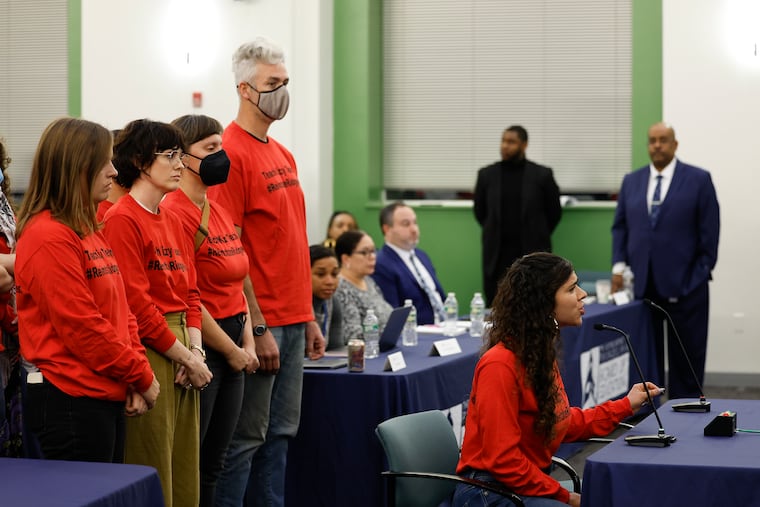
Yet, I’ve also seen so many others. The understated intentionality at schools like the Academy at Palumbo proves it. Long before the Yale report, Palumbo’s leadership embodied the recommendations. Despite being overlooked and undervalued, this school leadership centered on serving their students. Not with ego, entitlement, or feigned authority, but determination. And a solid belief that strong education is a right for all children, not a luxury for some. This has been echoed through the many advocates and champions who have made their voices heard these last few months.
Every parent, no matter our geography, culture, community, or background, wants our children to be healthy, able, and successful in the life they choose to build. We look to our schools, teachers, and educational leaders to help us prepare them for all that is to come. This isn’t just for a degree or job prospects, but for their well-being.
Every one of Philly’s children deserves limitless opportunities ahead of them — not from the flip of a coin, but a barrier-free path. When they can learn, grow, thrive, and soar, so, too, will Philadelphia. We all win.
Priya E. Mammen is an emergency physician, healthcare executive, and public health specialist who helps the nation’s most impactful companies integrate clinical integrity at scale.

- How do you prove you’re American?
- We are at a generational inflection point in healthcare. It’s time for Gen X physicians to assert themselves as the stewards of our profession.
- Have we decided health is a perk?
- As our central source of scientific guidance loses credibility, other experts step up
- Who will write our history?

Inquirer Opinion Newsletter