For Haitians in Pa. facing deportation, the World Cup is a rare source of hope
There are 15,000 Haitians living under temporary protected status in Pennsylvania. Cheering on their team in the World Cup represents a powerful symbol of hope and unity at a precarious time.
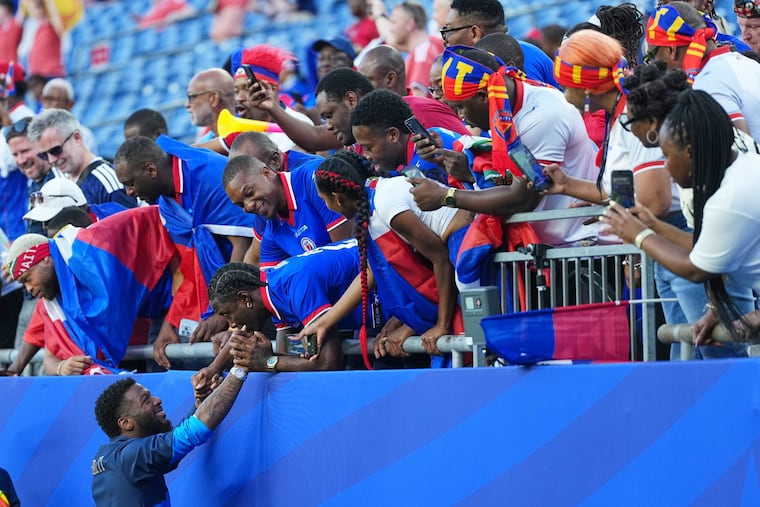
Haiti’s June 19 World Cup match against soccer’s most decorated nation, Brazil, held at Philadelphia’s Lincoln Financial Field, encapsulates the contradictions at the heart of FIFA’s flagship event this summer.
The World Cup — and Haiti’s first appearance in it since 1974 — is a welcome distraction from the humanitarian and security crisis at home. For many Haitians, however, the Trump administration’s cruel immigration policies, including its effort to terminate this Caribbean country’s temporary protected status (TPS) — a form of protection against deportation to dangerous situations — casts a shadow over the tournament.
Since a catastrophic 2010 earthquake, Haitians have dealt with one disaster after another, including a cholera epidemic, devastating hurricanes, increasing violence, and chronic political instability.
The current crisis, during which criminal groups have consolidated control over most of the capital, Port-au-Prince, and expanded to at least four more of Haiti’s 10 regions, has killed thousands, displaced more than 1.5 million people, and led to widespread sexual violence.
Even before the World Cup began, the odds were stacked against Haiti’s “Grenadiers” — a nickname that pays homage to the revolutionary soldiers who fought for Haiti’s independence in 1804. The squad managed to top their regional qualifying group for the tournament despite not being able to play a single game on home soil; their national stadium is in an area controlled by criminal groups. It was a remarkable feat — one that ended Haiti’s 52-year wait to participate in another World Cup, and became a source of immense pride for Haitian soccer fans around the world.
For the coming weeks, Haitians will be celebrated on the world stage and their players welcomed with open arms, but their fans may find their paths to the stadiums — or to the United States itself — inaccessible.
In Philadelphia, many by now will have already seen proud Haitian fans sporting their team’s blue and red jerseys. But while the World Cup inspires hope and pride for Haitians living in the U.S., the Trump administration’s immigration policies, including the possibility of U.S. Immigration and Customs Enforcement presence at or near World Cup venues, may elicit anxiety, fear, and exclusion.
Haiti is one of 39 countries affected by U.S. government travel restrictions that prevent fans from supporting their countries in person this summer. Although the ban includes an exception for athletes, Woodensky Pierre, the only Haitian player based in the country, missed a vital pre-tournament match after his U.S. visa wasn’t approved in time. He landed at Miami airport shortly after the game began and was later embraced by his teammates on the pitch at the final whistle.
It is the attempts to terminate Haitians’ temporary protected status, however, that pose the most serious human rights concerns for Haitians who are already in Philadelphia and other cities.
Under U.S. law, the Department of Homeland Security can designate a country for this status when conflict, environmental disasters, or other circumstances temporarily prevent its nationals from returning safely, or when the country cannot adequately handle their return.
TPS protects beneficiaries from removal, allows them to apply for work and travel authorization, and prevents Homeland Security officials from detaining them solely based on their immigration status.
Haiti first received this designation after the 2010 earthquake. Since then, and because conditions in Haiti itself have not improved, hundreds of thousands of Haitians in the U.S. have built lives, raised families, and become essential contributors to local communities, including in Philadelphia. Approximately 330,000 Haitians now have TPS in the United States.
The Trump administration is now trying to strip Haitians of this protection.
Despite clear evidence that the human rights crisis in Haiti is worsening, the Department of Homeland Security insists that “country conditions have improved to the point where Haitians can return home safely.” A Supreme Court decision on the legality of ending this protection is expected this summer.
Terminating the protection would have devastating consequences, exposing hundreds of thousands of Haitians to detention and possible return to the “cataclysmic” situation unfolding at home, where they would face serious risks of kidnapping, extortion, and other abuses by criminal groups.
For the 15,000 Haitians protected by TPS in the state of Pennsylvania, making it to the World Cup and cheering on their team represents a powerful symbol of hope and unity at a precarious time for the community.
Other soccer fans who root for the underdog will very likely cheer on Haiti as it makes its way through all of its Group C matches (and, hopefully, into the knockout stage). But support for Haiti should extend beyond the World Cup. The U.S. government should renew temporary protected status for Haitians.
Haiti’s Grenadiers deserve their place at the World Cup. For Haitian TPS holders in the U.S., the stakes go far beyond the tournament.
Robbie Newton is a senior coordinator and in the sport and human rights team at Human Rights Watch.

- With or without World Cup tickets, these Philly fans are ready for Sunday — and beyond
- Before the World Cup, a beautiful game for U.S. Ivorians
- Philly hosting the World Cup is just the latest chapter in soccer’s American immigrant story
- A World Cup in Trump’s America is insane. How this fan is coping.
- Daniel Hilferty: We know Philadelphia can shine on the FIFA World Cup stage. Let’s show it.
- Ale Ayiti: Philly’s Haitian Americans celebrate a rare World Cup bid
- The 2026 World Cup in Philadelphia is going to be amazing

Inquirer Opinion Newsletter