Letters to the Editor | Feb. 16, 2026
Inquirer readers on alternatives to closing public schools and the dearth of participation in primary elections.
Get active
Primary election season is approaching, but for some reason, most Americans do not bother to participate. Typically, in nonpresidential election years, somewhere around 20% of voters take part. So often, because of the poor turnout in the primaries, a tiny fraction of the population decides which candidates will represent the two parties in the general election. This often leads to a situation in which many voters complain that neither candidate excites them. You should keep in mind that about 95% of elected offices are held by either a Republican or a Democrat, and they were all nominated in a primary election. And for those who have decided to register as independent, be aware that in Pennsylvania, New Jersey, and Delaware, the primaries are closed, meaning only Republicans can vote in the Republican primary, and only Democrats in the Democratic primary. Rather than bemoan the system, why not take 10 minutes, look at the party platforms, decide which one comes closer to your worldview, and change your registration so that you can be part of the solution? Registration can be done online in two minutes, and it is free of charge. This year, why not make an effort to get back in the habit of being part of our great democratic process? Your country needs you.
Patrick J. Ream, Millville
Opposing ICE
I am grateful that Sen. John Fetterman has voiced his opposition to the planned immigrant detention centers in Berks and Schuylkill Counties. His reasons, which focus primarily on the strain to the local communities, are valid. But he doesn’t talk about the effect on the people who might be sent to those centers. Since Donald Trump became president, at least 30 people have died in U.S. Immigration and Customs Enforcement custody. Centers have been reported to have inadequate food and housing, and now that the government won’t reimburse for it, medical care is almost nonexistent. Most of these detainees are not dangerous criminals. Most make valuable contributions to our communities. They are our neighbors.
Almost as troubling is the profit made by the wealthy, well-connected few. For example, records show a Berks County family sold a property for $1.5 million in 2021. It was sold again, in 2024, with a warehouse on it for $57.5 million, and ICE bought it for $84.5 million. Then, there are the profits of the private companies that run the centers and often have no demonstrated capacity to do so.
Trump’s Environmental Protection Agency established last month that a human life has no value. ICE confirms it.
Emily Davis, Philadelphia
Closed schools — or closed minds?
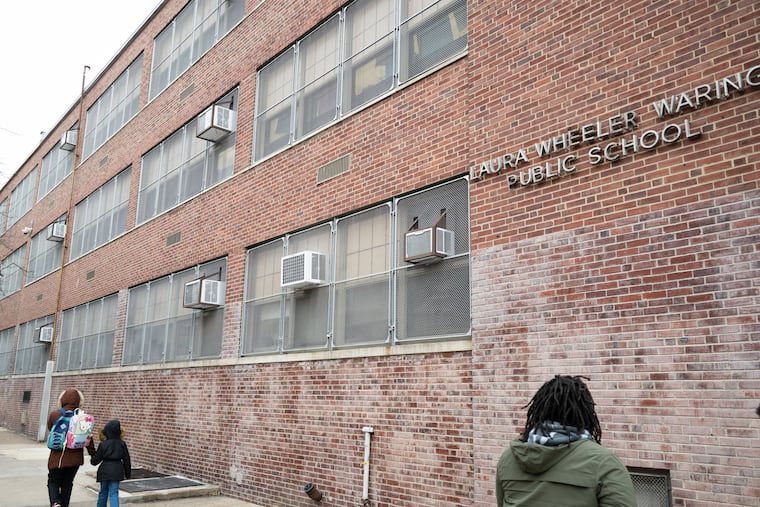
Twenty public schools are scheduled for closure in Philadelphia, where 90% of the student population is African American and where half the seats are empty. This may seem like a problem, but with imaginative thinking, it can present a great opportunity. Educators should continue to teach in one half of the buildings and use the other half for community services that support building skills for young people, such as operation of retail stores run by students, teaching them about businesses and financial literacy, spaces for town watches and police, protecting the schools and the community, and spaces for the homeless. With hundreds of seats in these school buildings closed, hundreds of minds in our school administration may be opened.
Leon Williams, Philadelphia
Truth hurts
In a recent letter to the editor, Mark Fenstermaker took offense to what he believes is the left-handed slant of The Inquirer. Without citing any factual support, he says that 95% of viewpoints in The Inquirer are slanted to the left. He writes that he hopes the paper would strive to present “unbiased, factual reporting and opinion.” That does not mean the editors at The Inquirer should abandon reality in favor of artificially balancing the number of left vs. right-sided opinions. It seems to me that, like the current herd of Donald Trump followers, truth and facts are your kryptonite. If you don’t like the truth, demean it. If facts get in the way, ignore them. Yes, U.S. Immigration and Customs Enforcement has a legitimate goal in policing illegal immigration. Dressing up like Nazi brownshirts and wearing face masks does not advance that goal or engender public support. And killing two innocent people is “slaughter” under any reasonable definition. By the way, the writer’s MAGA hat is showing: neither of these victims “chose to put themselves in danger.” I find the letters policies of The Inquirer quite fair. If not, why was I subjected to the opinion of Mark Fenstermaker?
Jim Lynch, Collegeville
. . .
In a recent letter to the editor, Mark Fenstermaker asks why The Inquirer does not cover the “tens of thousands” of migrants who have committed violent crimes.
It’s a fair question in the current climate, where our top officials falsely accuse Haitians of eating dogs and where the president’s comment about “shithole” countries echoes years later. The fact of the matter is, according to the American Immigration Council, violent crime among immigrant populations — both documented and undocumented — is about half what it is among the native-born population. There are not “tens of thousands” of cases to cover.
During times of economic unrest, immigrant populations have become scapegoats for larger social issues. In fact, during the late 19th and early 20th centuries, the scapegoats were often Southern Europeans, particularly Italians. Earlier, Irish immigrants were assumed to bring increased crime to the U.S. During this time period, fear of Catholicism was baked into the anti-immigrant propaganda, much like fear of migrants today targets Muslims.
Considering the historic pattern of attacks on migrants helps us understand the propaganda currently promoted by the White House and circulating on social media.
Ann E. Green, Bala Cynwyd
. . .
To rebut statements by the obviously biased person from Warminster: “Tens of thousands of violent, criminal, illegal immigrants” removed from our streets? A gross, unproven exaggeration. About 30% of those arrested have criminal charges pending. Speaking as a retired Philadelphia police sergeant, the two killings by ICE personnel were both manslaughter. The shots were fired by agents who were in no danger, thus making it unnecessary to take innocent lives.
Words of exaggeration and gross generalization matter.
Larry Stroup, Warwick
Toxic brew
In response to the article about the city no longer dumping snow in the Schuylkill: Granted, the snow piled up on the side of our roads does contain a toxic brew of chemicals, but where does one think those chemicals go when the snow is collected and moved to land-based locations? Do they magically evaporate, never to be seen again? Of course not. The snow melts, and those chemicals are released to either wash into the river or soak into the ground, where they, too, will most likely end up in the river. That part of the argument against dumping accumulated snow into the river doesn’t hold water. Pun intended?
Tim Reed, Philadelphia
Learn all history
I write this having just finished reading the Feb. 8 Opinion section of The Inquirer, which was entirely made up of essays about the 100th anniversary of Black History Month. What a treat to learn about the evolution of what was Negro History Week in 1926 into what became Black History Month in 1976 — and to learn, from the seven essayists, Philadelphia’s role in its growth until now. I concur that “studying the history of Black achievement is integral to understanding the American Experiment.” I am a “Johnny come lately” in learning about the heritage of our African American brothers and sisters. I was studying at Bennett College in Greensboro, N.C., and was able to take an Afro-American studies six-credit course in 1970. It was quite an opportunity for this young white woman from suburban Philadelphia to become someone “ahead of her times” in learning the names, achievements, and obstacles of prominent African Americans such as Alain Locke, W.E.B. Du Bois, Phillis Wheatley, James Weldon Johnson, and Mary McLeod Bethune. As one of the writers in the section, Harold Jackson, pointed out, now, “instead of celebrating individuals, Black History Month should focus more on the events and ideas that continue to impact how Black and White people coexist in an America that continues to struggle with covert and subtle racism.” Black History Month is a good time to reflect on “the uncomfortable reminders of what America was, and to take the steps to avoid slipping into a past we need to remember but not repeat.” We are still being called to a “more perfect union.”
Mary A. McKenna, Philadelphia
Join the conversation: Send letters to letters@inquirer.com. Limit length to 150 words and include home address and day and evening phone number. Letters run in The Inquirer six days a week on the editorial pages and online.