Bill Giles, former Phillies owner who helped create Phillie Phanatic, died at 92
Once described as “Philadelphia’s resident combination of P.T. Barnum and Walt Disney,” Mr. Giles got creative trying to attract fans. The biggest draw was the mascot he green lit in 1978.
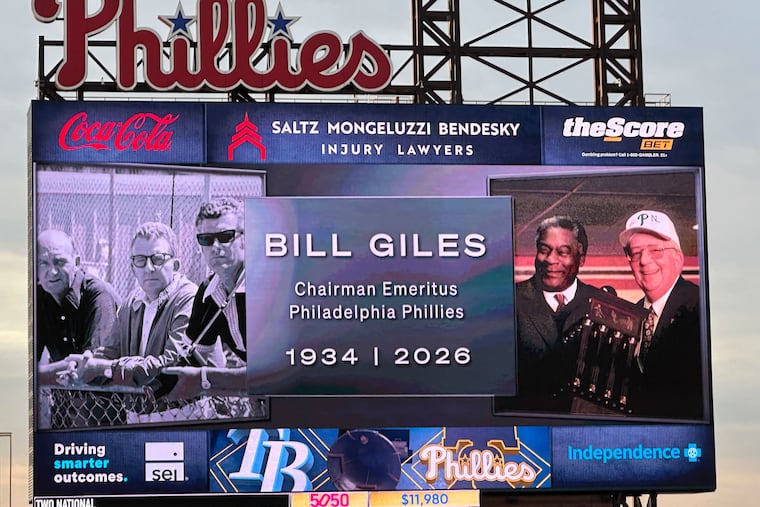
Bill Giles, the longtime Phillies executive who helped create the Phillie Phanatic and used a tightrope walker to sell tickets before becoming a part owner, died Friday. He was 92.
Mr. Giles joined the Phillies in 1969, just as they were readying to move to Veterans Stadium. The team lacked star power, but it was Mr. Giles’ job to fill the seats when the cavernous stadium opened in April of 1971. So Mr. Giles, the son of a Hall of Fame baseball executive, got creative.
Karl Wallenda walked a tight rope across the stadium between games of a doubleheader, Benny The Human Bomb exploded, fire trucks drove relief pitchers from the bullpen, and Kite Man tried to deliver the first ball one season before crashing into empty seats.
» READ MORE: Tom Burgoyne insists he’s just the Phanatic’s best friend. A new documentary convinced him to admit he’s more.
A news report once described Mr. Giles as “Philadelphia’s resident combination of P.T. Barnum and Walt Disney.” And Mr. Giles’ biggest draw was the Phanatic, the mascot he green lit in 1978.
“I always wanted to make people happy,” Mr. Giles said in 2022. “So anything I could think of I would try.”
William Yale Giles was born on Sept. 7, 1934 in Rochester, N.Y. His father, Warren, was the president and general manager of the Cincinnati Reds before becoming the president of the National League. Mr. Giles knew as a kid that he wanted to work in baseball and started working for the Reds as a teenager.
He met his wife, Nancy, when they were both students at Denison University in Ohio. Mr. Giles told Nancy after their first date that they’d be married one day and honeymoon in Hawaii. He was right. Mr. Giles graduated from Denison in 1956 and spent three years in the Air Force before working for a Reds farm team. He moved to Houston in 1962 to be the publicity director for the Colt 45s, who soon became the Astros. Seven years later, he came to Philly.
“Bill was the heart and soul of the organization for over two decades,” Mike Schmidt said in a statement. “He was a close personal friend to so many of us. He will always be a big part of Phillies history. Prayers go to the Giles family in this time of mourning.”
Mr. Giles helped the Phillies close Connie Mack Stadium, which included his idea to have a helicopter land on the field after the final game to retrieve home plate and transport it to South Philly. He gave fans that day wooden seat back slabs from the stadium, which many used as tools to remove seats and toilets. The Phillies moved the following April to the Vet, where the promotions became wackier.
“In the early ‘70s, we didn’t win a lot of games,” said Larry Bowa, who slapped the first hit at the Vet. “So we had to get people in there. It was like a circus.”
The 1972 Phillies won just 59 games, 27 of which were wins by Steve Carlton. So Mr. Giles drummed up ticket sales by having Wallenda walk 640 feet across the stadium between games of a doubleheader. He didn’t know Carlton was starting Game 1, which meant the doubleheader would be a rare game that season where the baseball was the draw. The show went on.
There were 38 people — 19 on each end — holding the wire to make it taut, but that was not enough to steady it as Wallenda took his first steps. Two weeks earlier, his son-in-law Richard “Chico” Guzman had died after he fell 50 feet before a performance in West Virginia. Guzman’s wife, Carla, started screaming for her father to back out. The Vet didn’t seem safe.
“I was sold on the idea and wasn’t at all fearful,” Giles said. “Until we got the wire up there and it was swaying a little bit. I said, ‘Oh, [bleep].’ I got really nervous.”
Wallenda thought about quitting but kept going. He walked about 35 feet and sat down, motioning for the 38 people to pull tighter.
“When he sat down on the wire, I started thinking, ‘Oh, what’s going to happen now?’ You never sit down on a wire,” Bill Hall, a promoter who booked Wallenda, said in 2022. “I started to pray to God to get us through this, but then I thought, ‘Wait a minute, God didn’t tell us to come up here.’”
Wallenda stopped again in the middle of his walk, performed a headstand on the rope, and finished. Giles was relieved. A few years later, Dennis Lehman, then a member of the front office, saw the San Diego Chicken and told Mr. Giles that the Phillies should try a mascot. Mr. Giles said OK and assigned Lehman and Frank Sullivan, the team’s promotions director, to pursue it.
The Phillies worked with Bonnie Erickson and Wayde Harrison to create the green, flightless bird from the Galápagos Islands. Mr. Giles tapped Dave Raymond, then an intern in the sales department, to play the part. The Phanatic arrived in April of 1978 and has never left.
Mr. Giles brought Harry Kalas to Philadelphia in 1971 and helped convince Pete Rose to join in December of 1978. He organized a group in 1981 to purchase the Phillies and served as team president until 1997. He then became the team’s chairman. The Phils won National League crowns twice during Mr. Giles’ presidency, which was mostly marred by low payrolls and losing seasons.
Mr. Giles said often that the Phillies were losing money and needed a new ballpark to compete. That arrived in 2004, the payrolls rose, the winning returned, and the Phils won their second world championship in 2008. Two weeks earlier, Mr. Giles — then the honorary president of the National League — presented the team with the National League Championship Trophy named for his dad. The Phillies soon started a sell-out streak of 257 straight games. They no longer needed any wacky promotions. A winning team sold the tickets in a new stadium that Mr. Giles helped build.
“The Phillies family lost an icon today,” Phillies managing partner and CEO John Middleton said in a statement. “Bill helped to reshape our franchise from a traditional baseball club into a highly visible entertainment and business operation. His profound impact in overseeing one of the greatest eras in franchise history, both on and off the field, will forever be his legacy. Our hearts are heavy for the Giles family and all those who had the privilege of knowing Bill.”