In Argentina, Pope Leo walks in the giant shadow of Francis
Pope Francis' fierce commitment to the downtrodden — migrants, the poor, the marginalized — was the most consistent hallmark of his papacy, and it remains his clearest influence.
BUENOS AIRES, Argentina — When the Argentine priest was reminded that the Roman Catholic Church no longer had an Argentine pope, he let out an exasperated chuckle.
“We are already mourning Messi,” said the priest, the Rev. Lorenzo de Vedia, referring to Lionel Messi’s departure from the Argentine national soccer team. “Two is too much.”
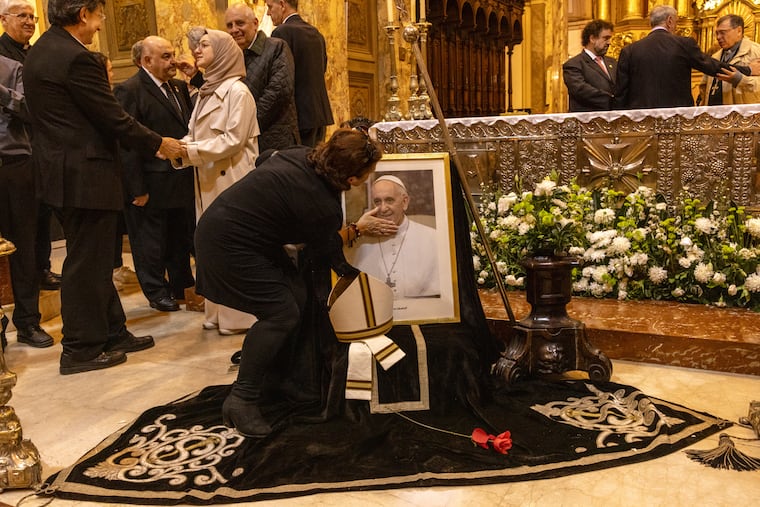
Though Pope Francis, the first Argentine pope, died over a year ago and was succeeded by Pope Leo shortly after, Argentines have hardly moved on. Francis’ photo still adorns public schools, parishes, and trade unions. Murals and mosaics of the Argentine pope dominate public spaces; street vendors still sell his figurines; parish priests quote him in their homilies.
With Leo visiting the country, Argentines are finally confronting the reality that the leader of the Catholic Church no longer speaks Porteño, the Buenos Aires dialect; roots for the city’s beloved San Lorenzo team; or shares their ritual of mate — the national drink.
As Argentines face this new reality, their reception is permeated with the pressing question of whether Leo represents an expression of Francis’ continuity. And while the answer is important to the former pope’s compatriots, it is a question much of the world has been asking.
Leo has already made trips to countries where Francis did not travel, such as Spain, Algeria, and Lebanon. But Argentina, where Francis never returned after becoming pope, is perhaps the only country where the new pontiff will still be confronted with the overwhelming presence of his predecessor.
“Pope Francis is going to be next to Pope Leo in this Argentina trip,” said Guzmán Carriquiry, a former Uruguayan ambassador to the Holy See and former Vatican official who was close to Francis.
Even some billboards welcoming the new pope to Argentina also feature images of Francis. Argentina’s president, Javier Milei, started his speech in front of Leo on Sunday by talking about Francis, whom he called “immortal.” Leo quoted him nonstop.
“To me coming to this place has a special meaning,” the pope said. “For 12 years the church listened to the voice of an Argentine pope.”
Francis left a heavy mark on the church and on Argentina. He was a surprising pope, contradictory at times, too provocative for some and disappointing for others, embracing a freewheeling style but ultimately never touching church doctrine.
Yet his fierce commitment to the downtrodden — migrants, the poor, the marginalized — was the most consistent hallmark of his papacy, and it remains his clearest influence on the church and in his homeland. Many hope it will also be a standard Pope Leo will uphold.
“Thanks to Francis we are not lying on the street,” said Miguel Angel Mercado, 25, a resident of an addiction recovery facility in the province of Buenos Aires. The center is part of a network, the Hogar de Cristo, or Home of Christ, which was founded during Francis’ tenure as archbishop of Buenos Aires.
“He came to find us on the street like nobody did,” he said. “Nobody cared about people like us strung out on the pavement.”
Mercado was participating in a summit last month in Buenos Aires that gathers community leaders from around the world and that Francis helped create in 2014.
This meeting, organized in anticipation of Leo’s visit, looked decidedly like Francis’. Street vendors, people who pick through discarded cardboard to sell, recovering addicts and priests who work with the poor gathered inside an urban complex called Pope Francis City, decorated with murals of Francis, as well as banners bearing his photos and quotations.
The artist who had painted one mural recently added a portrait of Pope Leo, though observers noted that it bore less a resemblance to the new pontiff than to Francis wearing a pair of square glasses.
The complex in La Matanza — a poor municipality in Buenos Aires province where Francis had supported the grassroots work of priests — includes an orphanage, two schools and a swimming pool where residents swim beneath the gregarious gaze of a painting of Francis holding a dove.
“When we think of the church, we think of him,” said José Ruiz Díaz, an official for the Union of Workers of the Popular Economy, a trade union of informal workers in Argentina.
Ruiz Díaz’s eyes lit up when he talked about Francis. He said that if it was not for Francis giving homilies in his working-class neighborhood among transgender prostitutes and homeless people, and blessing the carts of garbage collectors, he would not be a Catholic.
“He was our priest,” he said, “he was our spokesman to places where the outcast couldn’t enter.”
Things were not always easy between Francis and Argentina. He faced accusations that in the 1970s, when he was the leader of Argentina’s Jesuits during the country’s last military dictatorship, he had done too little to protect two priests who were kidnapped and tortured by the junta. Those allegations were later challenged by biographers and others.
And while many Argentine leftists herald Pope Francis, as an archbishop he had a rocky relationship with Néstor Kirchner and Cristina Fernández de Kirchner, the country’s former leftist presidents. While he strongly backed the “curas villeros,” or “slum priests” living and working in the country’s poorer districts, clergy members who were combative and politically active often accused him of being too cozy with the establishment.
But opinions about Francis changed when he became pope and made outreach to those considered society’s outcasts the focus of his papacy.
“Everything we’d been saying for years, now the church was saying it, too,” said the Rev. Francisco Olveira, a priest who serves in poor communities in Buenos Aires province.
Olveira, who had once considered Francis an enemy of Kirchnerism, now affectionately refers to him as a representative of Peronism, the populist political movement the Kirchners belong to.
When Pope Leo was elected last year, many supporters of Francis feared a return to a stiffer, more traditional church. But they were quickly reassured by Leo’s first speech to popular movements, in which he expressed support for social justice and the rights of poorer workers.
Francis, Olveira said, was “the only Peronist who planned his succession well.”
During his papacy, Francis fast-tracked his successor’s career, and named many new and like-minded cardinals who ended up forming the conclave that elected Pope Leo.
In the year since getting elected, Leo has called for the protection of migrants, the environment, and social safety nets. In Argentina, he toured a facility for people with severe disabilities and met with informal workers, trade unionists, Indigenous communities, and representatives of popular social movements, showing a commitment to the same groups that Francis championed. He also reaffirmed Francis’ commitment to social justice, a concept that the country’s president has loathed.
“The same cry for peace, the same love for the poor and the marginalized,” said Carriquiry, the former Vatican official. “There is a substantial continuity between the popes.”
Still, Carriquiry said, it was important that people embraced Leo without nostalgia.
Some people were so “fanatic” in their support of Pope John Paul II and Pope Benedict XVI, he said, that they struggled to embrace Francis. “It shouldn’t be like that,” he said quoting an Italian proverb that synthesizes the obligation to keep going: “When a pope dies, another is made.”
Though Leo has echoed Francis’ message, he has exhibited milder manners than his predecessor.
Still, Leo on Sunday issued a loud call for Argentina’s government to protect the unemployed, retirees, and workers who struggle to make ends meet — in what was widely seen as a reproach to Milei’s libertarian government. “The economy must be at the service of the person, not the person in the service of the economy,” the pope said.
Just by visiting Argentina, Leo was playing a potent card to win over Francis’ compatriots. Francis visited 68 countries during his 12-year papacy, and even though every president and local Catholic leaders extended invitations, he never returned to Argentina.
Francis never gave an explicit reason for not returning, but many saw his decision as an attempt to avoid being dragged into political debates. Leo, on the other hand, visited the country early in his pontificate.
“He is following Francis’ footsteps,” said Cecilia Galvan, 32, as she waved a Vatican flag trying to catch a glimpse of Leo as he passed by in Buenos Aires on Monday. “Receiving him is a way to receive Francis.”
As hundreds of thousands of Argentines gathered for Leo’s Mass on Monday, many carried flags with his image. Some wore Messi T-shirts and others shirts with Francis’ image.
“No matter who the pope is, he is welcome here,” Juan Avila, 68, said. Still, he added, “God is Argentine.”
This article originally appeared in the New York Times.