Dick Allen documentary tour makes a stop in Philly, telling ‘a great story that nobody’s told’
"My Father, Dick Allen" grew from a one-hour film to a five-part series. The producers, including his son, Dick Allen Jr., screened an episode for fans in Philadelphia on Thursday.
When production started for My Father, Dick Allen, it was supposed to be a one-hour documentary on the former Phillies star. Four years later, it’s a five-part series, featuring interviews with sportswriters, Allen’s loved ones, and former coaches and players.
The cast is loaded with Hall of Famers, including Mike Schmidt, Goose Gossage, and Andre Dawson. For co-executive producer Sharon Pannozzo, the biggest surprise was seeing just how enthusiastic everyone they asked was to participate.
“Not one person batted an eye and said, ‘Well, I can’t do that. You know, I don’t have time’. Everybody made time,” she said.
» READ MORE: Dick Allen’s Hall of Fame induction allows the Phillies, and Philly, to turn the page on the past
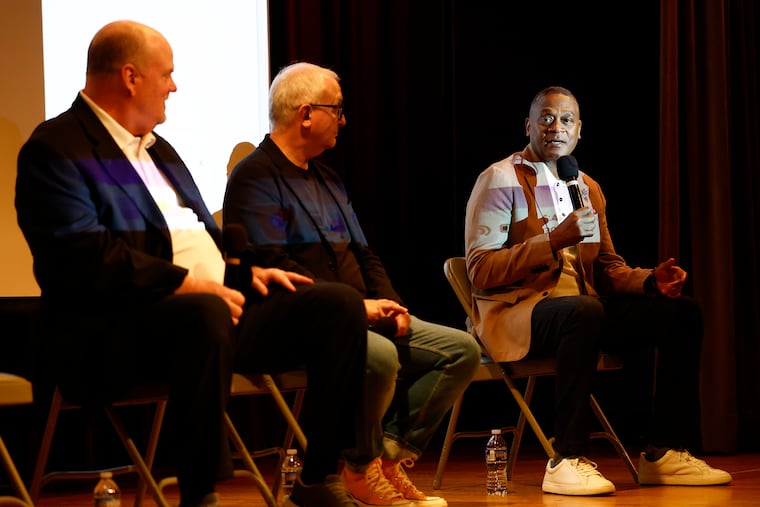
Over the past few months, the documentary’s production team has put on screening events across the U.S., as they look to find a partner to license the series. On Thursday night, they stopped in Philadelphia, where Allen played nine of his 15 seasons. Fans were given the chance to see the third episode of the series, which focuses on Allen’s first stint with the Phillies from 1963-69. Following the screening was a panel moderated by The Inquirer’s Matt Breen. The participants included director Andy Billman, graphic designer Todd Radom, Allen superfan and co-producer Andy Wooley, and Allen’s son, Richard Jr.
“Being here is like being at home,” said Allen Jr., known affectionately by his dad as Doobie. “I’ve grown up seeing that Phillies P and the Phillies logo my entire life.”
Allen Jr. also serves as a producer for the series. Well before filming even started, one of his greatest passions in life was preserving his father’s legacy. For decades, Allen Jr. advocated for his father’s induction into the Baseball Hall of Fame. Allen died in 2020 at 78.
Allen, who hit 351 career home runs, fell off the ballot in 1997 but was brought up for consideration by the Veterans Committee in 2014. He fell short by just one vote. Allen was brought up again in 2021 but also came up short. Last summer, he finally got into Cooperstown after 20 attempts, receiving 13 of 16 votes from the Classic Era Committee.
“You can work on a film in the film business for years sometimes, and then all of a sudden it comes together,” said Pannozzo. “We would’ve told the story whether Dick got into the Hall of Fame last year or not … but we had a good ending."
When Allen was inducted last summer, Pannozzo and Allen Jr. were given a tour of the Hall of Fame storage vault. The artifact that stuck with Allen the most was a questionnaire his father had filled out at 18 years old, right after he started playing for the Class D Elmira Pioneers. Allen was deeply moved by that piece of paper.
“My whole life, [baseball was] all he talked about, and I thought, OK, OK, OK, and then I get there, and it’s like, ‘Oh my gosh, he really wasn’t lying,’” Allen Jr. said.
Another meaningful experience for Doobie was visiting Little Rock, Ark., where his father had played for the triple-A Travelers in 1963. It was that year that the Phillies moved their affiliate from Buffalo to the South. Allen had previously never been to the South and begged the organization to assign him elsewhere, but he didn’t have a choice.
Allen became the first professional Black baseball player in the city of Little Rock, and it was a brutal year for him. Fans shouted slurs his way at the ballpark, in the parking lot, and throughout the city. Little Rock was also segregated, meaning that Allen was isolated from his teammates except when at the ballpark. He refused to return to the city with any of his kids.
But the documentary dedicated a whole episode to the horrors Allen faced during his time in Arkansas. When Allen Jr. explored the city for the first time, however, he wasn’t doing it alone. Hall of Fame pitcher Ferguson Jenkins, who also played for the Travelers, volunteered to go through the city with Doobie. Jenkins was very close friends with Allen and overlapped in Little Rock with him briefly in 1963.
» READ MORE: For the Phillies, Dick Allen’s Hall of Fame journey became personal
“[He] pretty much substituted for my father, going to the high school, you know, and Little Rock … that would be my favorite part," Allen Jr. said.
At this point, the team does not have a deal lined up with a distributor for the film. But they know how important it is to be able to tell the story of Dick Allen to a younger generation of fans who did not see him play.
“This is a great story that nobody’s told,” said Pannozzo. “Now we have to sell our project.”