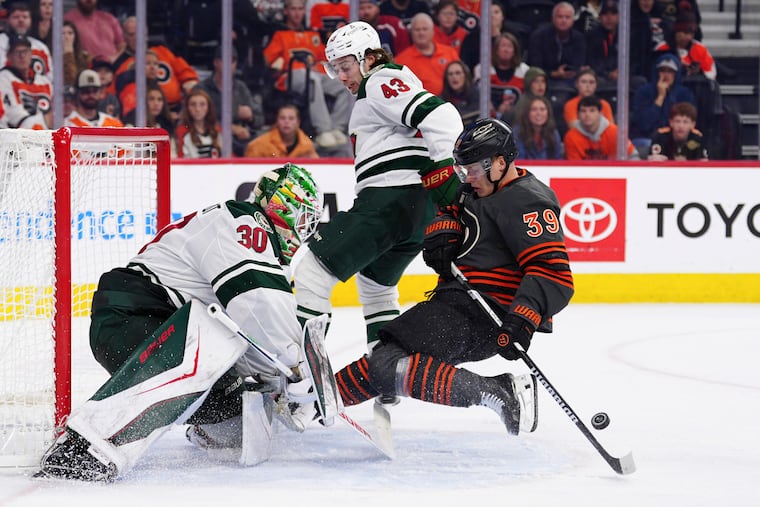
The Flyers’ poor start vs. Minnesota negated what was a solid effort overall: ‘We’ve gotten better’
While the Flyers (4-9-4) are past moral victories, they've been a much more competitive hockey team over the past eight games, including with puck retrievals. Now they need to turn that into wins.
In the bowels of the Washington Capitals’ home rink last Wednesday, Flyers coach Rick Tocchet was asked what the conversations were like after losing the previous night in overtime to the Columbus Blue Jackets.
“Well, starting on time, we talked about it,” the bench boss said. That night, the Flyers trailed 3-0 after the first period before digging themselves out of the hole to salvage a point in the 4-3 overtime loss.
Tocchet continued with something interesting.
“When we look at the video, I think we’re [at] a 20% recovery forecheck, and then we’re at like 70 or something. The game just flipped on us for those two periods. I thought we dominated,” he said. “But, the first period you can’t give somebody a 3-0 lead. It’s really hard in this league. We almost came back. Obviously, [we] got the point, but you can’t start the game with your toe in the water. You’ve got to dive in headfirst.”
» READ MORE: Flyers can’t slow down Minnesota Wild’s top line in 4-2 loss
The analytics behind recovery forecheck percentage focuses on 50-50 pucks, which are plays where either team can win the battle for the puck. Some of the issues that initially plagued the Flyers this season were their compete level and lack of urgency.
“The game of hockey is reactionary,” Tocchet said in Washington, D.C. “When you react to the puck, that gives you an extra second, second-and-a-half. If you’re pausing a lot, you’re probably not getting the puck a lot, and I saw a lot of pausing early.”
Although they were unable to complete the comeback on Tuesday against the Minnesota Wild — the visitors took a 2-0 lead before the first TV timeout, and the Flyers fell behind 3-0 just 42 seconds into the second period — the team has stepped up its game along the walls, in creating turnovers, and increasing not just their recovery forecheck percentage but their recovery percentage, overall. Despite all that, the team dropped to 4-9-4 overall.
“I’ll be the first guy to admit [it], we have been awful all year early on on that, but I think we’ve gotten better,” Tocchet said after Tuesday’s 4-2 loss, which included a Minnesota empty-netter.
“Where there’s been 50-50 pucks, we’ve come out with them. I thought a little bit more tonight again, so that is something that we are improving on. It makes a difference because then you’re getting more chances or more shots or more action at the net.”
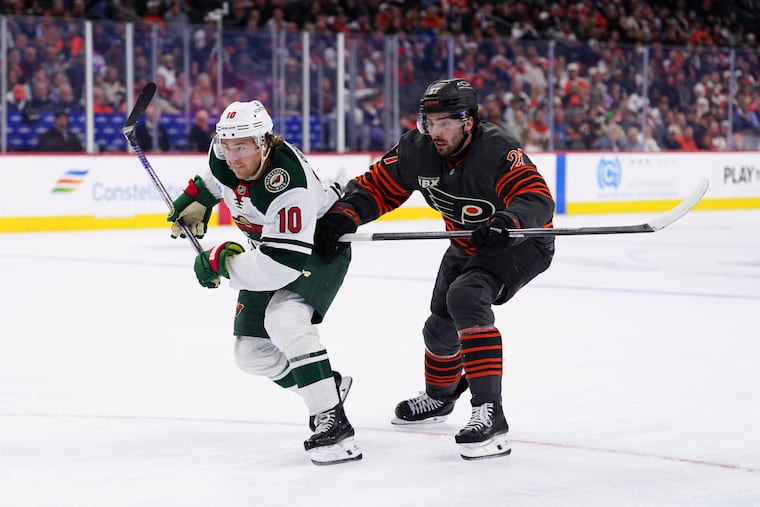
In the first period, trailing by two, Christian Dvorak, Travis Konecny, and Trevor Zegras pressured the Wild. Konecny swooped in with 12 minutes and 18 seconds left in the frame and knocked a bouncing puck away from David Špaček in the Minnesota zone. Over the next 46 seconds, Dvorak forced a turnover, defenseman Cam York helped to get a puck deep along the end boards, and Konecny had two shot attempts.
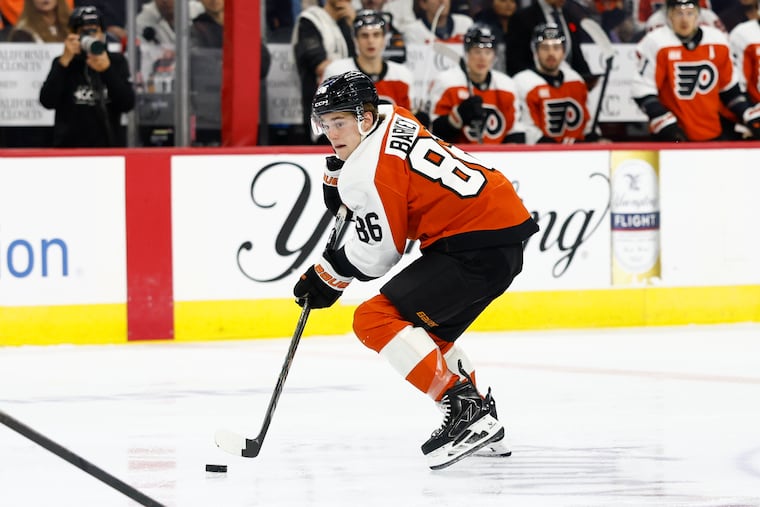
On Tyson Foerster’s third goal of the season, after Matvei Michkov drove to the net and almost got his own rebound on the zone entry, Denver Barkey used his feet and stick to knock the puck away from perennial Norris Trophy candidate Quinn Hughes to keep the Flyers in control deep in Minnesota’s end.
And in the third period, down by one, York beat former Flyer Ryan Hartman to a puck along the boards in the offensive zone to keep the pressure on. The Dvorak line once again got to work, leading to a Nick Seeler shot on goal.
» READ MORE: Flyers takeaways: Denver Barkey’s work on the improving power play remains a bright spot
“I don’t know, if you guys notice it, but if you just iso cam the walls all night in the D zone and in the O zone, it’s tough to get some of those pucks. And I thought guys tonight were not only doing the right play and taking the battle a little higher and getting pucks out, but when there was a play to be made, guys were making plays too, and that really helps,” said Konecny.
“You can make clean plays instead of chasing the puck all night, and then also know when to get it out. And there’s a balance there, but I thought for the most part we did it a lot tonight.”
It’s hard to gauge whether the uptick in wall play, battles, and recovery of 50-50 pucks has played a role, but the Flyers had more high-danger chances — 16 to 11 — than the Wild, besting them in the first and third periods. The Flyers outshot the Wild 11-4 and won the high-danger chance battle 7-3 in the final frame as they pushed for an equalizer. That is no small achievement considering the Wild entered the night with the fifth-most high-danger shot attempts (154) at five-on-five; the Flyers had the second-fewest (99).
According to Natural Stat Trick, since their first win of the season against the Ottawa Senators on Oct. 17, the Flyers, at five-on-five, have a 49.6 high-danger Corsi for percentage and 50% of the shot attempts. In the nine games prior, they were at 32.6% and 40.2%, respectively.
Why the marked improvement?
“We’ve had a couple of practices where we’ve really dug in,” said Tocchet. “Obviously, every coach goes through the same thing — every [coach] cries about not practicing, but when we do practice certain stuff, the team does get better. And yeah, that makes sense, right? A young team, if you get in more reps [and] practice, it’s better for the game instead of just playing games.”