Board rejects, for now, testing of Lincoln bloodstain
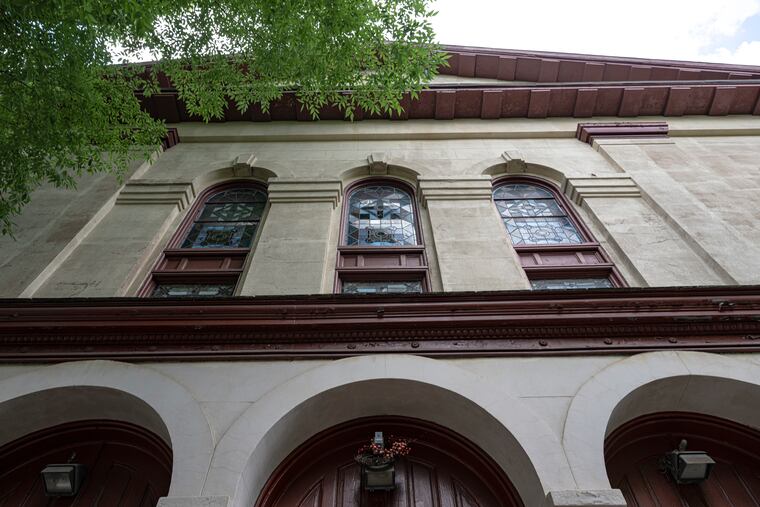
The strip of a pillowcase stained with the blood of Abraham Lincoln is usually locked away in a display case or safe at the Grand Army of the Republic Museum and Library in the city's Frankford section.
The strip of a pillowcase stained with the blood of Abraham Lincoln is usually locked away in a display case or safe at the Grand Army of the Republic Museum and Library in the city's Frankford section.
But tonight it was brought out as exhibit "A" during a debate among members of the museum's board over whether to allow DNA testing of the relic to solve a medical mystery.
Was the 16th president dying of cancer, with less than a year to live, when he was shot by assassin John Wilkes Booth at Ford's Theatre in Washington, D.C.?
John Sotos, cardiologist and consultant for the television series House, asked to test the artifact to prove Lincoln had a rare genetic cancer syndrome called multiple endocrine neoplasia type 2B (MEN2B).
The museum board tonight turned down Sotos' request while leaving open the possibility of future testing that may be overseen by the National Museum of Health and Medicine, part of the Armed Forces Institute of Pathology in Washington.
"We decided to continue our investigations to their logical conclusion," said Andy Waskie, a board member, Philadelphia historian, and assistant professor of language and history at Temple University. "We are going to pursue this in the best interest of the museum, of the legacy of Abraham Lincoln, and of the integrity of the artifact."
The vote by the board was unanimous, said Eric Schmincke, president of the board of directors. "We going to follow through [on testing] based on conditions which haven't been specified," he said. "We want the experts to tell us how we can go further down the road if we proceed, and how much damage there will be."
The board's careful deliberations came during a time of heightened interest in Lincoln; this year is the bicentennial of his birth.
But the president's death was the topic tonight along the pillowcase fragment, once referred to by Waskie as the "Shroud of Turin of the Civil War." It was returned to a safe while the details of the testing are sorted out.
Helping guide the board on the complicated scientific and ethical issues involved in the DNA work was biologist and Civil War buff Gary Grove. He conducted months of research and ultimately held discussions with officials at the National Museum of Health and Medicine about creating a bio-research review board to plan testing.
"It's better to place [the artifact] in the hands of government officials who don't have a dog in this fight," said Grove, a Middletown resident who is vice president of research and development at cyberDERM, a Broomall firm that tests skin-care products.
"I want to make sure this is done right so no one can question the results," he said tonight. "We wanted to consult with the proper authorities."
Sotos, a rare-disease hobbyist, declined to be interviewed today and has consistently opposed publicity about the testing. He said believes that DNA testing can not only answer questions about Lincoln's condition but potentially expand "clinical knowledge of a rare and most serious medical condition."
In his book The Physical Lincoln, Sotos, of Palo Alto, Calif., shows how a diagnostician analyzes hands, feet, lips, neck, heart, and other parts of the body to conclude that Lincoln had MEN2B.
Lincoln "suffered from a very rare genetic disorder that affected him, literally, from toe to skull," Sotos wrote. "The physical Lincoln was just as rare as the mental Lincoln."
Sotos and other researchers have long examined images and life masks showing the president's traits, including his armspan-to-height ratio, thin build, abnormally shaped chest, skin color, hair texture, and gray eyes. They also have studied accounts of Lincoln's unsteady gait and other body movements.
Tonight, as the board meeting was wrapping up, Waskie emphasized the museum "will exercise caution and prudence in the investigation and will not do anything that will seriously damaged the artifact."