Christie vetoes several DRPA policy changes
Saying he was running out of patience with the Delaware River Port Authority, Gov. Christie on Thursday vetoed several recently adopted policy changes, saying they did not go far enough to strengthen the agency's accountability and transparency.
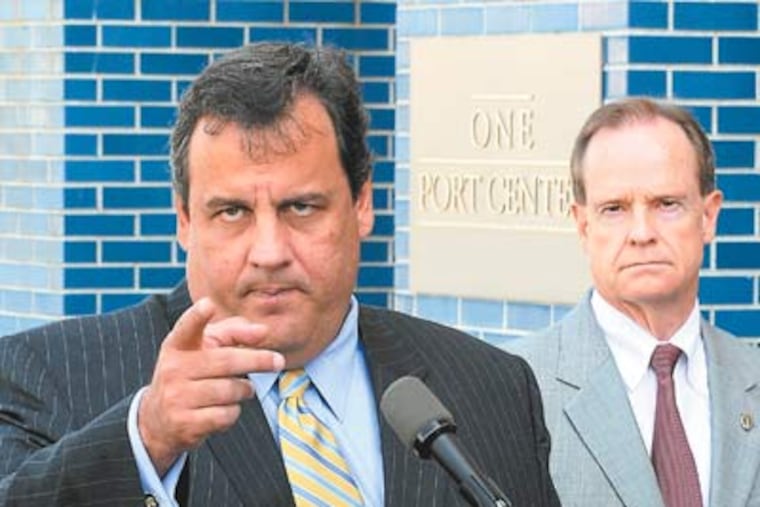
Saying he was running out of patience with the Delaware River Port Authority, Gov. Christie on Thursday vetoed several recently adopted policy changes, saying they did not go far enough to strengthen the agency's accountability and transparency.
After a hastily arranged visit to DRPA headquarters in Camden, Christie said he expected embattled DRPA chief executive John Matheussen to be an "agent of change" to speed reform - and keep his job.
"I am not going to permit this agency to operate the way it has historically operated," Christie said at a news conference, with Matheussen standing behind him. "If we don't see this agency getting back to work . . . then we're going to have to make changes."
Christie vetoed, as inadequate, measures to:
Exempt board members from new prohibitions on using their offices for political activity.
Allow former employees to work for DRPA vendors within two years after leaving the DRPA, as long as they don't work on DRPA issues.
Hire an outside firm to investigate the DRPA's practice of requiring insurance brokers to share their commissions with each other. Christie said the New Jersey comptroller should investigate instead.
"I will not accept inaction as an excuse," Christie said after an hour-long "very direct" conversation with Matheussen, whose three-year contract expired in July. Christie has said he will not permit the DRPA board to renew that contract until he is satisfied with changes at the DRPA.
Pennsylvania board member and Philadelphia labor leader John "Johnny Doc" Dougherty responded by saying he would introduce a resolution at the next board meeting calling for Matheussen's dismissal.
"I can only conclude that they haven't yet found a lateral political position for Matheussen or that the highly respected Lee Solomon isn't ready to wade into the DRPA swamp," Dougherty said in a letter Thursday to DRPA Chairman John Estey and Vice Chairman Jeffrey Nash.
Solomon, president of the New Jersey Board of Public Utilities and a member of Christie's cabinet, is a former Camden County prosecutor and Superior Court judge seen by some as a possible replacement for Matheussen.
"Matheussen has lost all credibility through his gross mismanagement of the authority," Dougherty wrote. "He has repeatedly lied to me and the other DRPA commissioners on many important issues."
Christie said he told Matheussen on Thursday: "I expect you to be a change agent. . . . If you're not part of the solution, you're part of the problem."
Matheussen said he got the message.
"The governor made it very clear that he expects the DRPA to take new courses of action," the chief executive said. "We'll be making a number of changes as time goes by."
The agency will impose a hiring freeze "for all nonessential employees," Matheussen said, and will seek to cut its 2011 operating budget by about $2.6 million. The current budget is $295.7 million.
The authority operates the Ben Franklin, Walt Whitman, Betsy Ross and Commodore Barry Bridges, and the PATCO commuter rail line between Philadelphia and South Jersey.
The DRPA has been under fire for pay-to-play and patronage practices, nepotism, high salaries and executive perks, and $500 million in controversial "economic development" spending over the last decade on such projects as museums, sports stadiums, and performing arts centers.
The bistate agency has 16 board members, eight each from Pennsylvania and New Jersey.
"We're going to try to move forward with the governor's recommendations," said Nash, also a Camden County freeholder and leader of the New Jersey delegation. "The vetoes were in line with the philosophy that he's expressed all along."
Estey, the board chairman, said he would review Christie's veto letters "in detail and I will continue to work with his office and my fellow commissioners to improve our operations."
All of New Jersey's board members are appointed to five-year terms by the governor, and the agency's chief executive officer traditionally has been appointed by New Jersey.
Unlike most of Pennsylvania's board members - six are gubernatorial appointees and two are on the board by virtue of their offices, the Pennsylvania auditor general and the Pennsylvania treasurer - the New Jersey members cannot be removed by the governor. All eight New Jersey board members were appointed or reappointed in the last year by then-Gov. Jon S. Corzine.
Christie said his staff notified Gov. Rendell of his plans to veto the DRPA actions. The Pennsylvania governor, who appoints the DRPA's chairman, does not have similar veto power.
Rendell spokesman Gary Tuma said Rendell "has not had a chance to talk to Gov. Christie about this yet, and therefore he doesn't know exactly why Gov. Christie thinks [the vetoed items] are inadequate."
Tuma said Rendell was especially puzzled by Christie's stand on political activity by board members, since many of the board members are also elected officials.
Christie said his first order of business with Pennsylvania's new governor in January will be DRPA governance, including the possibility of expanding the board or changing the length of the members' terms.
Christie's vetoes Thursday were focused on three DRPA actions at board meetings last month at which a series of rules changes were made to try to improve accountability and transparency.
The board had balked at Christie's request to forbid all high-level DRPA employees from "revolving door" departures by going to work for any company doing business with the agency for two years after leaving DRPA.
Instead, the board passed a measure precluding former employees and board members from working on DRPA matters for two years. That, Christie said, was not good enough.
"The public must be able to trust that commissioners or high-level DRPA employees are motivated solely by the desire to further the interests of the authority, not to obtain lucrative future employment with authority vendors or consultants, regardless of whether such employment involves DRPA or PATCO matters," Christie wrote in his veto letter.
Christie also rejected the board's effort to exempt its members from a new ban on performing political activities while on duty or using their offices for political purposes.
"This double standard only serves to increase the public perception that DRPA commissioners may misuse their offices for political gain," Christie wrote.
Estey said Thursday that the political activities issue was a problem for some DRPA board members.
"When a commissioner is also an elected official, I want to be sure we think through how a ban on political activity would impact the individual's service as a commissioner," Estey said. "While I support strong restrictions on political activity, I also want to be sure the restrictions are meaningful and enforceable."
Tuma said the Pennsylvania governor had similar concerns.
"It is difficult to understand what Gov. Christie is thinking about, because many board members are elected officials, some serving at the DRPA by appointment but others serving ex officio by virtue of their elected position," such as the Pennsylvania treasurer and auditor general, Tuma said.
The third issue, which Christie said Thursday was "the one that disturbs me the most," was an investigation into the unwritten practice of requiring New Jersey and Pennsylvania insurance brokers to divide their commissions with each other regardless of work performed.
The Graham Co., in Center City, says it has been required as a condition of doing business with the DRPA to share its commissions with Willis of New Jersey Inc. in Morristown, N.J. Every year, Graham says, it has been asked to "true-up" the difference between its commissions and those of Willis by sending a check to Willis.
This year, Graham contested the arrangement and has refused to pay $44,703 to Willis. Graham says it has paid Willis $514,530 since 2004.
Christie said he objected to the DRPA hiring out an investigation of the "true-up" practice:
"It cannot be considered the best use of toll-payer dollars for the DRPA to employ another law firm to conduct an investigation into its own affairs. Nor, in the current climate, would the toll-paying public likely accept as truly 'independent' the conclusions reached by an entity in the employ of the DRPA."
So, Christie said, he wanted "a full and thorough review" conducted by New Jersey Comptroller Matthew Boxer, a Christie appointee.
The DRPA board is not scheduled to meet again until Sept. 15. Christie said Thursday that board members "could certainly schedule a meeting sooner, and I think they should. . . . We need to move and move quickly."