Data centers, SEPTA, and ICE were the dominant issues at this year’s Peoplehood Parade
The annual West Philadelphia event uses art to build awareness and community, organizers said.
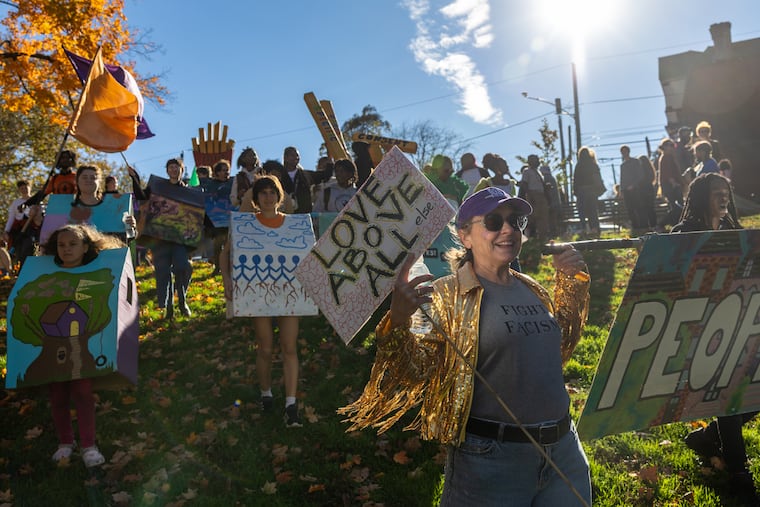
For West Philadelphians, the annual Peoplehood Parade is a familiar tradition — hundreds of people, children and adults, join an assemblage of puppets and art displays, chanting, singing and walking to Clark Park for a community pageant.
But 21 years after Liza Goodell got involved with Peoplehood, what really stands out to her is the community building that happens long before the day of the parade.
“I’m really proud of it. It’s super intentional,” said Goodell, of South Philly.
Goodell, 48, is co-director of Spiral Q, a nonprofit that helps local activists make art. For 26 years, the group has been the driving force behind the parade.
From its inception, the Peoplehood Parade raised awareness of local issues such as a need for HIV/AIDS resources and for bicycle lanes, Goodell said.
But a big change happened a few years ago, when Spiral Q welcomed different community groups into its studio space.
“It makes the process of Peoplehood just as important as the day,” Goodell said. “We’re trying to really make connections in the community.”
At a time when digital devices are all consuming, and when low-quality, AI-generated art is widespread, Goodell said, people have a strong desire to sit near one another, and use their hands to make something original.
As artists build puppets from found materials such as cardboard and house paint, they often discuss pressing local issues. In one sense, these issues haven’t changed all that much over the years, she said: Affordable housing, education, and funding people’s basic needs have remained top concerns.
However, around 2014, the parade began to get more focused, coalescing around Black Lives Matter after the 2012 killing of Trayvon Martin and acquittal of the shooter, George Zimmerman, said Spiral Q co-director Jennifer Turnbull.
The desire to coordinate the art displays and take on bigger issues only increased with the election of President Donald Trump in 2016, the COVID-19 pandemic 2020, and the reelection of Trump in 2024, Turnbull said.
“Being alive is kind of political right now for everyone. It’s always been political for folks on the fringes for sure. But now everyone is feeling that push and crush,” Turnbull said.
For the 2026 parade this Saturday, the community partners raised awareness about the environmental risks of data centers, as well as a longstanding issue — SEPTA funding.
The next two years will be a rare time when Democrats control the governor’s office and both chambers of the Pennsylvania legislature. Newly reelected Gov. Josh Shapiro has just pledged to better fund SEPTA and other transit systems. But to Turnbull, these political changes don’t have much effect on the parade’s need to continue raising issues on a local level.
“Just because we have a blue wave today doesn’t mean people still aren’t snatching folks,” Turnbull said, referring to federal Immigration and Customs Enforcement detaining people.
Turnbull estimated that over 18,000 hours of volunteer work went into this year’s parade designs. To her, that doesn’t just represent hours of work — it represents time that community members spent together sharing ideas.
As more people have felt the need to protest issues and find community, the parades have gotten larger, Turnbull said. Turnbull said last year they began with about 600 people. By the time they got to Clark Park, there were 1,200.
On Saturday, that enthusiasm was evident as drummers, dancing, and singing electrified the corner by the Paul Robeson House & Museum, where people gathered at the start of the parade line.
Tommy McShane, of West Philly, who previously worked on an art project with the Korea Peace Community Philadelphia, is now an apprentice at Spiral Q and participated in the parade.
“As a group, our unified goal is to end the Korean War, which is still going on after 70 years,” said McShane, who is Korean American. No peace treaty was signed after an armistice in the conflict in 1953.
The group this year is drawing attention to Hanwha Group, a South Korean company that has a shipbuilding operation in the Philly Navy Yard. McShane was protesting its weapons-making operations.
The 22-year-old artist said he’s equally interested in the community-building aspect of the parade. “It’s going to the park, while the leaves are changing, and you’re going to learn something about the community.”
As the parade kicked off, cardboard puppets frolicked above the pedestrians. There were cats on bicycles. Signs called to abolish ICE and reject data centers. Several people held up a subway train.
Julie Rea of Kensington, who had a sign supportive of public transit, said she’s excited that Gov. Shapiro has included transit funding in his upcoming plans.
“This is an opportunity to make the system safer, better, to extend it, to make it much more accessible,” Rea said.
Other art pieces were less overtly political. One participant, who gave just their first name, Miel, brought an elaborate narwhal made of painted cardboard and wheat paste, built on a furniture dolly.
Miel said the narwhal was initially constructed for the West Philly Dumpster Derby, a local Halloween-Eve tradition. The narwhal took eight people about three days of dedicated work to make.
For them, Miel said making something with friends was the best part.
“It was thrilling. Absolutely the most fun I’ve had all year.”