Showing once-lost souls the way back
As the credits roll for Cheech and Chong's Next Movie, Malcolm Drummond studies the names. "There," he says, pointing to the character "Welfare Recipient."
As the credits roll for
Cheech and Chong's Next Movie
, Malcolm Drummond studies the names.
"There," he says, pointing to the character "Welfare Recipient."
It's his name, albeit misspelled as "Malcolm Drummon."
He filmed the bit part in 1980 - a moment in a life so full he could give Forrest Gump a run for his money.
Malcolm, 74, had been a Broadway dancer, a soap-opera extra, and a Hollywood stunt man.
He was a cook, a drug and alcohol counselor, and a security guard.
He picketed in 1965 to open Girard College to black students and went to Uganda in 1974 with a U.S. delegation of civil-rights activists.
Today, Malcolm has a new role.
He is homeless.
It's not a label he wears comfortably, seeing himself more as a man in a bind. He lost his apartment last year and faced one health issue after another.
"A shelter was a means to an end," Malcolm said, "to get to where I am now."
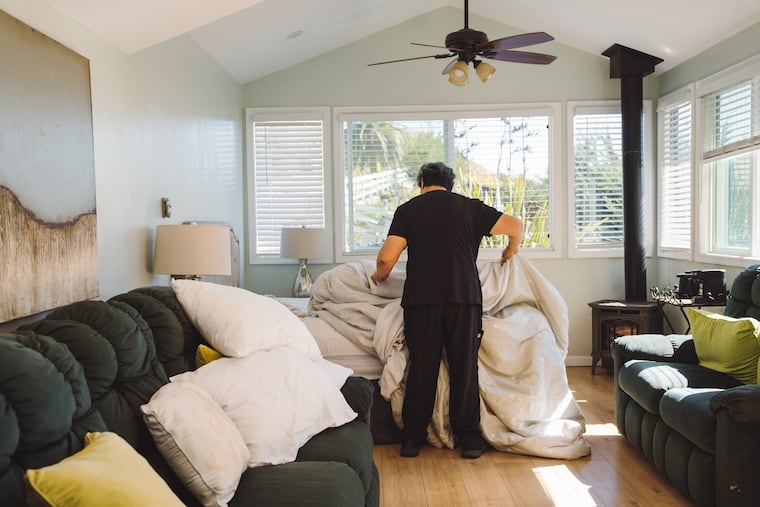
And where he is now is sitting in the clean, comfortable living room of a three-bedroom rowhouse owned by Christ of Calvary Covenant Church in West Philadelphia. He moved in last August - his third place in 18 months.
The pastor, the Rev. Rodney Rogers, a married father of four, wasn't using the house and offered it at a low rent to Malcolm and two other shelter residents.
The idea came from the Bethesda Project, a Philadelphia nonprofit that runs shelters and saw the possibilities in linking homeless people to churches or individuals with roofs to spare.
It was an easy sell for Rodney. From the time he came to the church nine years ago after graduating from Princeton Theological Seminary, he made certain that the congregation was connected to the neighborhood and its problems. Homeless outreach became one of his priorities, and the church started serving free meals once a month, which he hopes to increase to once a week.
Volunteering to help cook is Malcolm.
Last Saturday, he donned a white chef's coat to prepare eight turkeys for 142 people, some of them homeless, many of them just hungry. "Something inside me is saying this is what I need to do," Malcolm said.
His voice is raspy. He has a thin mustache and a small nose - totally remade, along with his cheekbones, after his face smashed through a windshield in an errant stunt for a TV pilot.
Malcolm said he learned how to cook in New York in the 1960s. When he wasn't dancing in Broadway musicals like
Hello, Dolly!
and
Golden Boy
, he worked in restaurant kitchens.
He was a self-taught hoofer from North Philadelphia. As a kid, he cut lids off cans and nailed them to his boots, dancing for money on a corner across from City Hall while a friend played a washboard.
In New York, Malcolm worked as an extra in soap operas, including
The Edge of Night
, before discovering there was bigger money in stunt work. Moving to Los Angeles, he had no trouble finding jobs on such television series as
Land of the Giants
and
Baretta
. He dodged falling fake bricks in
Superman
and gangsters in
Shaft
.
Stunt work was plentiful. So was cocaine. "I went from sniffing it to smoking it," said Malcolm, who landed in rehab for 14 months. "I became bigger than myself."
He burned through his money and owed the Internal Revenue Service, which still collects all his residual checks.
Fed up with Hollywood, he moved back home. "Film, Broadway, entertainment - they all said 'cocaine' to me," he said. He spent the next decade working for local agencies that helped recovering addicts and the mentally ill, and advocated AIDS and HIV education in the black community.
For years, Malcolm got a federal rent voucher for an apartment near Temple University, but his landlord kicked him out in July 2007, hoping to lease the place to higher-paying students.
Forced to go to a shelter, his health took a turn. He had surgery for prostate cancer, and an angioplasty for his heart disease.
He was living at Good Shepherd, a hospice for homeless men with health problems, when he learned about the offer from Rodney's church. Malcolm pays a third of his Social Security for rent - the government's standard percentage for low-income housing.
What the men get from the church is not only housing, Rodney said, but also a chance to connect. They are welcome to participate in services, but are not forced.
"Malcolm said to me he never thought he'd be useful to anybody again," Rodney said. "He has a community here and valued relationships."
Malcolm still hopes to get a place of his own. He has applied for public housing and put his name on waiting lists at senior-citizen apartment houses.
"As good as this is, I'm not comfortable, and I never want to get to the point where I am comfortable," he said. "It's not mine."