Netanyahu vows West Bank military operation after attack kills 2 Israeli soldiers
The prime minister said that a swath of Hebron, where the attack occurred, would be cleared of residents and demolished.
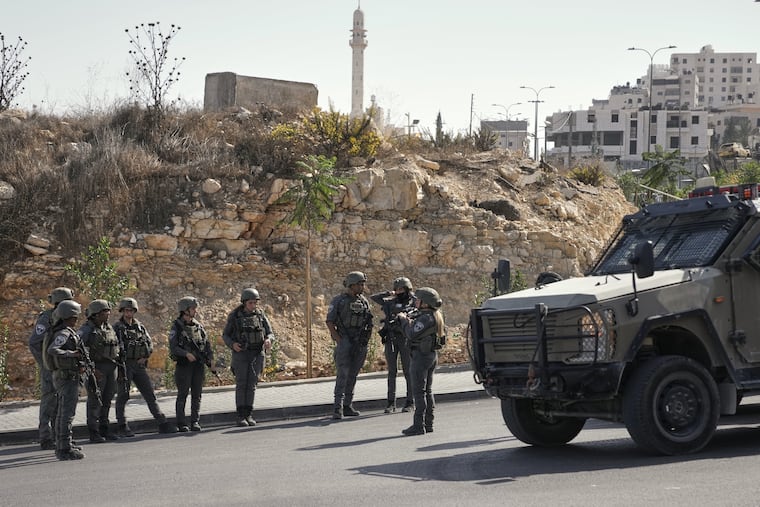
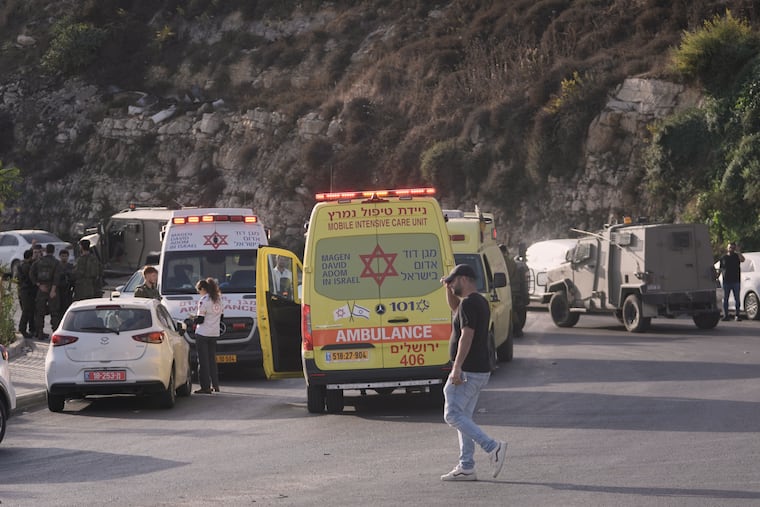
JERUSALEM — Two Palestinian gunmen attacked a road junction near Hebron on Friday, killing two Israeli soldiers and prompting Prime Minister Benjamin Netanyahu to order what he said would be the most intense military campaign in the Israeli-occupied West Bank in decades.
Three other soldiers were wounded, Israeli authorities said. Both Palestinian assailants were killed at the scene. The militant group Hamas praised the attack.
The shooting sent tensions soaring just days before an Israeli national election that has shaped up as a referendum on Netanyahu’s handling of security issues, especially the Oct. 7, 2023, attack by Hamas on southern Israel. The prime minister ordered the military to cordon off Hebron and prepare for a full closure of the West Bank. Numerous checkpoints around the territory were closed by midday Friday.
In a visit to Hebron, Netanyahu vowed to carry out an extensive military operation in the West Bank “unlike any seen since the Six-Day War” of 1967. He added that a swath of Hebron would be cleared of residents and demolished, in a repeat of an operation Israeli forces carried out last year in refugee camps in the West Bank cities of Jenin and Tulkarm.
The attackers were identified as Firas and Hamouda al-Ja’aba, two men from Hebron affiliated with Hamas, an Israeli security official said, speaking on the condition of anonymity to discuss details of a sensitive investigation. The Israeli military said it found a large quantity of ammunition in the assailants’ vehicle.
It identified the dead soldiers as Staff Sgt. Ron Yonatan Roytman, 23, and Sgt. Yuval Shai Svilem, 20.
A Hamas leader said the attack was aimed at the military checkpoint north of Hebron, about 20 miles south of Jerusalem.
In a statement, Hamas called the attack “a natural and legitimate response to the ongoing crimes and brutal assaults against our people, our land, and our holy sites in the West Bank and occupied Jerusalem, and to the continuing aggression against our people in Gaza.”
The West Bank shooting immediately sparked a reaction in Israel at a tense political moment, with Netanyahu having repeatedly warned voters of impending attacks and pitching himself as the candidate who could best guarantee their security by taking a hard line against Israel’s enemies.
“We warned a few weeks ago about attempts by our enemies to harm us, our citizens, and our soldiers ahead of the elections; that is what they tried to do here,” Netanyahu said in Hebron. “We will act to destroy this place, to change it completely. But to do something that has not been done until now — we are going to implement the successful and aggressive model we used in the refugee camps, which are essentially terrorist strongholds.”
For the incumbent prime minister and his coalition, West Bank settlers also represent a key voting bloc, and the government has been criticized for largely turning a blind eye to rising settler violence. After the shooting, some of Netanyahu’s far-right allies called for more support for Jewish settlers in the West Bank and a fresh military campaign there.
Netanyahu’s hard-right coalition partners frequently call for the West Bank’s annexation and the dissolution of the Palestinian Authority in the territory.
On Friday, the coalition partners accused the Palestinian Authority of abetting terrorism even though the Palestinian governing body, led by the Fatah party, is a rival to Hamas and often cooperates with the Israeli military in fighting the militant group.
“There is no alternative to a comprehensive military campaign in Judea and Samaria to dismantle the Palestinian Authority, collect the weapons, and eliminate the terrorists,” Finance Minister Bezalel Smotrich posted on X, using Israeli biblical names for the West Bank. “Exactly as in Gaza and Lebanon.”
National Security Minister Itamar Ben Gvir warned that Israel would face another major attack in the West Bank similar to the Oct. 7, 2023, incursion from Gaza.
“The next confrontation will erupt there, and we must act before it’s too late,” Ben Gvir said. “The Palestinian Authority must be dismantled, demilitarized, and its terror infrastructure eliminated. The blood of our soldiers will not go unanswered.”
On Friday, Netanyahu appeared to make an electoral pitch to Israel’s settler right, praising them as serving Israel by establishing 100 new communities and farms in the West Bank. And he praised them for “standing in the breach” in the West Bank. “You are a role model for the people of Israel, you are a role model for the State of Israel,” he said. “We are going to destroy the terror infrastructures, and we are going to build the settlement infrastructures.”
Former general Gadi Eisenkot, the main opposition candidate, said he was praying for the recovery of the wounded and commended the soldiers’ heroism. Eisenkot holds a slight lead over Netanyahu in most polls.
During this election season, Eisenkot has faulted Netanyahu for failing to prevent the Oct. 7 attack despite warnings from Arab leaders and Israel’s own intelligence agencies, and failing to oust Hamas from power in Gaza, despite a devastating war.
This week, Eisenkot said at a campaign event near the Gaza border that, if elected, he would remove Hamas from power in Gaza within 18 months through the U.S.-led peace and reconstruction process or through military force.
Hamas, which has armed fighters and political leaders in both Gaza and the West Bank, said in its statement Friday that it would not lay down its arms until the end of Israel’s “aggression.”
In July, Hamas leaders tentatively agreed, pending Israel’s agreement, to demilitarize in Gaza as part of U.S. President Donald Trump’s peace plan.
The agreement was hailed by Trump as a major diplomatic breakthrough, although critics in Israel and elsewhere questioned whether Hamas would give up its weapons, given that armed resistance has been central to its political platform.