The Maya collapse was blamed on drought, but the full story is more complicated
The new findings haven’t dispelled the evidence that climate change undid the Maya civilization. But it has added important nuances that are even more applicable to understanding changes today.
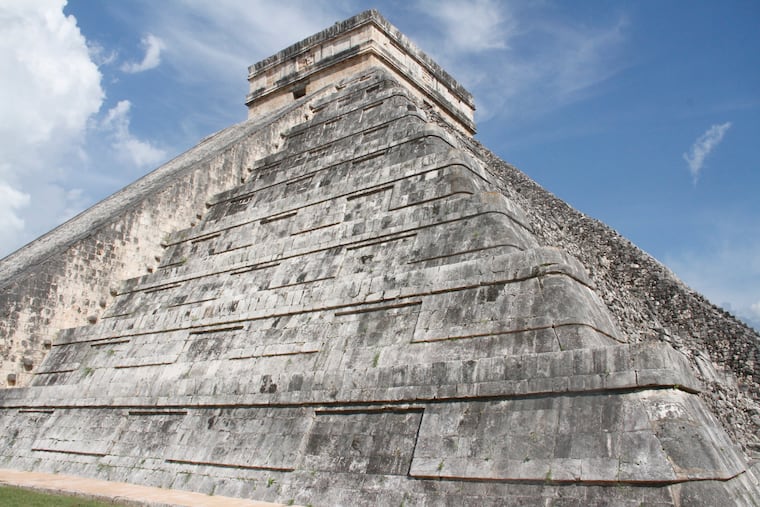
MEXICO CITY — The answer, it appeared, was drought. That was the theory, proposed by scientists three decades ago, to explain why the Maya civilization, one of antiquity’s mightiest, plunged into widespread collapse, without any obvious explanation.
The enticing argument held that a succession of historic droughts between 760 and 910 A.D. desiccated the Maya civilization, which spanned Belize, El Salvador, Guatemala, Honduras, and Mexico. An exodus from its cities followed and, in the words of one research article, “millions of Maya disappeared from the earth.”
But scholarship has increasingly presented a more complicated picture.
A batch of studies over the last year has bolstered a growing body of research that is challenging the long-standing view that drought alone was the driving factor.
A study published last year found that the prominent Maya site Itzan, in Guatemala, was mostly abandoned without ever experiencing drought. Another argued that drought during an earlier period might have actually had the inverse effect, pushing more people into cities. One more published in September said an analysis of 294 Maya sites across Belize yielded counterintuitive results: The sites that had experienced more rain had been deserted before the dryer ones.
Taken together, the research is part of a shift in how researchers have come to consider one of antiquity’s great mysteries, awakening yet another fierce debate in academia over the effects of climate on civilizations, and why they fray.
“There was a single, easy answer, and then we went and complicated it,” said Alec McLellan, an anthropologist at Western University in Ontario and an author of one of the studies. “There are still many disagreements in the field.”
For history’s other civilizations and great empires, the stories of collapse have come into increasingly clear focus. The Byzantine Empire fell when the Ottomans captured its capital, Constantinople, in 1453. The Incas and Aztecs in the Americas, meanwhile, were undone by European diseases, Indigenous divisions, and Spanish conquest.
But the case of the Maya stands apart. It wasn’t an empire, but an interconnected collection of city-states in a vast geographic area that warred and traded with one another. They rose over several centuries — villages growing into cities, cities growing into power centers, replete with ornate pyramid structures, complex political orders, and mathematical and astronomical achievements that surpassed those of much of the ancient world. Then between 760 and 930, many of their great cities went dark one by one — although Maya people stayed in the region, and remain there today.
A full explanation for the decline has long eluded researchers. The Maya had an advanced writing system, but few of its written records provide clear evidence about the collapse.
“The records were burned by mostly Spanish missionaries,” said Matt Waters, an environmental scientist at Auburn University. “Very few of the manuscripts survived, so a large amount of what we know has been gathered from archaeology, from carvings and statues.”
To fill in the gaps, researchers have had to search for circumstantial evidence. Beginning in the 1960s, scientists undertook palynological methods of inquiry, studying microscopic spores and pollen preserved in the soil and sediment to learn more about the region’s climatic history. But because the Maya were such avid deforesters, altering the natural landscape, the analyses yielded muddled results.
In the mid-1990s, a breakthrough came.
By studying oxygen isotopes preserved within the lake sediment of Lake Chichancanab in the Yucatán Peninsula, researchers were able to obtain a clearer history of the region’s climate, showing that the civilization had been punished by droughts found to be among the worst in the past 7,000 years — which overlapped with the period when the Maya cities were being deserted.
The question of whether climate change extinguished the civilization has made the Maya a hot field of research, as the ravages of global warming have become more acute. As many as 30 papers on the topic were at one point being pumped out every year, one research article noted, many focused on the collapse.
Benjamin Gwinneth, a geographer at the University of Montreal and author of one of the recent studies, said the new raft of findings hasn’t dispelled the evidence that climate change undid the Maya civilization. But it has added important nuances that, if anything, are even more applicable to understanding the effects of climate change today.
The droughts alone might not have been sufficient to have undone the civilization, he said. But they might have exacerbated other causes of decline, or forged new ones.
The Maya city-states were deeply entwined, he said, with trade and migration channeling back and forth. Even if the droughts had not been evenly distributed across Mesoamerica, the spared pockets would still have been vulnerable to their second-order effects — political instability, warfare, mass migration. Those stressors could have pushed even rainy cities past what the local societies could tolerate, as mutually reinforcing crises rippled into each other.
“The research challenges the idea that people [in the Maya site Itzan] were abandoning the site because there was no water,” Gwinneth said. “But maybe the lack of water elsewhere” led to or compounded political instability.
“I’m a big multi-stressor person when it comes to the Mayans,” added Waters, the Auburn researcher. “Modern societies rarely have just one stressor, and the Maya are a fantastic and true analog.”