Activists want bullets to carry bar codes
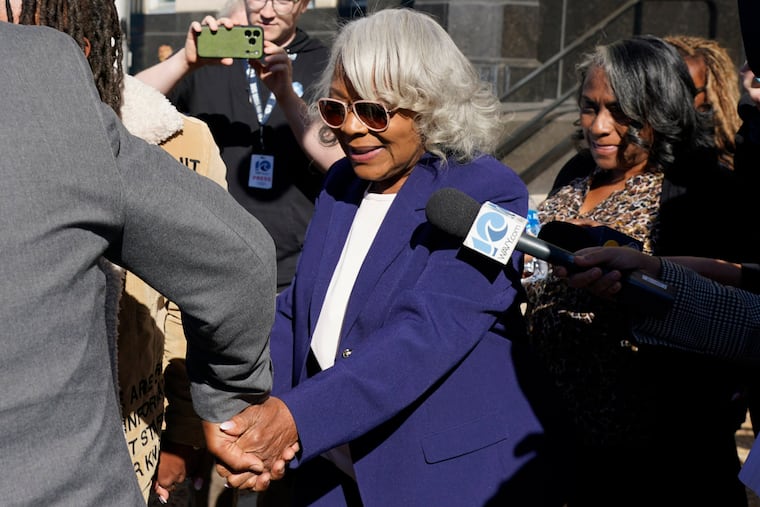
Yvonne Carrington Payne and Carolyn Funches have cooked Thanksgiving dinners for the homeless, raised money for needy families, and set up a shelter for battered women.

Yvonne Carrington Payne and Carolyn Funches have cooked Thanksgiving dinners for the homeless, raised money for needy families, and set up a shelter for battered women.
"We don't play around," said Carrington Payne, 70. "When people see us coming, they know we get things done."
Now, in what surely will be their toughest challenge, the Chester duo are taking on the gun lobby.
Specifically, they want bar codes on bullets as a way of tracking killers and reducing gun violence.
"There are too many unsolved shootings," Funches said. "Take the bullets and trace them back. It will connect people to who bought the ammunition."
Carrington Payne and Funches are still "tweaking" what they would like included in a law to that effect. At the moment, they envision requirements that every bullet sold in the state be encoded and that buyers have a gun permit, be at least 18, and have a driver's license.
They even have a name for their proposal: Carla's Law, after Carrington Payne's 17-year-old daughter, who was killed in 1988 by a stray bullet fired during a nearby gang fight.
Five teenagers were found guilty of aggravated assault in Carrington's death and received stiff prison sentences, but the person who fired the bullet that felled the Chester High School cheerleader was never identified.
Carrington Payne, with Funches, decided to keep her daughter's memory alive through community action. They have met with Chester Mayor Wendell Butler and Senate Majority Leader Dominic Pileggi (R., Delaware) to see what could be done.
"Anything we can do to deter the acts of violence in cities, we should all embrace that," said Butler, who backs the women's efforts.
Erik Arneson, a spokesman for Pileggi, said the "concept deserves to have a hearing and deserves consideration."
The notion of encoding ammunition is not new.
Eighteen states - including Pennsylvania and New Jersey - have introduced legislation for marking ammunition. None of the bills has passed.
Pennsylvania Democrats introduced a bill in the House to encode ammunition in 2008.
The bill never got out of committee.
Former Gov. Ed Rendell, a longtime supporter of gun control, says he backs any efforts to enhance law enforcement's ability to track down and successfully prosecute people who use guns to commit crimes.
"If this technology is real, it should be put to the legislature and passed immediately," Rendell said.
The technology does exist.
A Seattle company, Ammunition Coding System, has produced a limited edition of the marked bullets.
"It is a noninvasive way to help law enforcement track people down who are using guns improperly," said Steve Mace, the company's cofounder.
The National Rifle Association (NRA) begs to differ.
With billions of rounds of ammunition already on U.S. streets, any encoding program would be ineffective, said John Hohenwarter, an NRA spokesman. In addition, the NRA sees this as backdoor handgun registration.
Alan Gottlieb, spokesman for gun lobby the Citizens Committee for the Right to Keep and Bear Arms, said encoding bullets was impractical, given the costs and record-keeping required.
G. Terry Madonna, a longtime political analyst at Franklin and Marshall College, said there was tremendous inertia when it comes to gun-control legislation in Pennsylvania, with its many gun owners and hunters.
Bar-coding bullets "is not an issue that would gather enough support even among gun-control advocates," he said.
Area police generally support the idea but also see pitfalls in the application of the law.
Michael J. Chitwood, Upper Darby's superintendent of police, said most guns and bullets used in violent crimes were stolen or acquired though a straw purchase.
"I think it is a problem bar coding will not solve," Chitwood said.
Capt. Raymond Evers, a spokesman for the Philadelphia Police, was supportive.
"I think anything positive will help in the amount of gun violence we have," he said.
About 80 percent of Philadelphia's murders are the result of gun violence, he said.
"I love the idea," said Darren Alston, Chester's police chief. He calls bar-coding bullets another investigative tool that would give police a starting point when looking for suspects. "If it can be pushed through, it will be a blessing."
Carrington Payne is not deterred by the daunting task of passing legislation many see as a long shot.
"We should have been working on this a long time ago," she said. "Something has got to happen."