In 1902, Roman team stood up against racism
By Chris Gibbons Patricia Corkery heard the story many times from her uncles John and Maurice. The two were students at Roman Catholic High School in 1902, both members of the basketball team. Their new coach, William Markward, a Spanish-American War veteran, had gathered the team after receiving a disturbing letter from the league in which Roman played.
By Chris Gibbons
Patricia Corkery heard the story many times from her uncles John and Maurice.
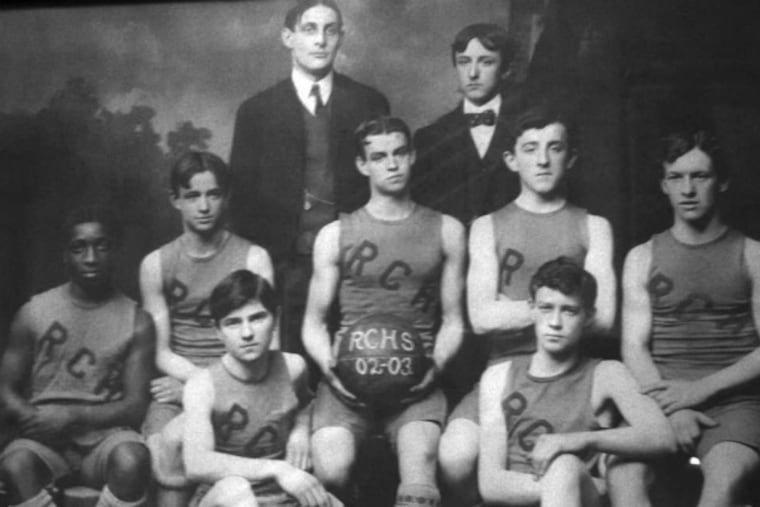
The two were students at Roman Catholic High School in 1902, both members of the basketball team. Their new coach, William Markward, a Spanish-American War veteran, had gathered the team after receiving a disturbing letter from the league in which Roman played.
The team was primarily composed of poor Irish Catholic boys from Philadelphia's inner-city neighborhoods, immigrants themselves or the sons and grandsons of immigrants. One boy's background was very different. John "Johnny" Lee was the son of a former slave. He was the first African American to play basketball in that league.
As Markward, a former pro basketball player, towered over the seated boys, he began to read the letter. The league was threatening to ban Roman if Lee, a "Negro" player, remained on its roster. Given the times, this stance was not unusual. But the team's response was.
In her letter to Roman's alumni association on the incident, Patricia Corkery wrote that team captain John Corkery was the first to stand up and speak: "If Johnny Lee doesn't play, then I don't play." One by one, each of the other players rose and said the same. Markward, famous for stressing the importance of how to live over how to play, must've beamed with pride. "Roman stood with Johnny and the league backed down," Patricia Corkery wrote.
From that moment on, John Corkery and Lee were friends, both remaining active in Roman's alumni association. Lee would never forget the courageous stand that Corkery and his other teammates took for him, and when John Corkery died in 1929, Johnny Lee was heartbroken. Patricia fondly remembers the touching scene that took place at her home every year on the anniversary of her uncle's death.
"Growing up in the Port Richmond area of Philadelphia in the late '20s and early '30s, my world was white - mostly Irish Catholic," Patricia Corkery recalled in her letter. "Only one African American crossed my path. It was once a year [that John Lee] came to our house and I had to be on my best behavior. Always. I had to be dressed up and with my best manners for this visit. John Lee came to our house on the anniversary of my Uncle John's death . . . and paid a tearful visit to the pictures of Roman's team still on our walls."
Over the years, Billy Markward would turn down numerous college coaching offers, remaining at Roman until 1942. Along the way, his teams won an incredible 20 championships. He achieved legendary status not only at Roman, but in the Philadelphia region, and the prestigious Markward Award is presented annually to Philadelphia's top Catholic League scholar-athlete.
As for Johnny Lee, breaking down racial barriers became something of a family trait. Johnny's granddaughter, Sister Cora Marie Billings, was the first African American to enter a community of nuns in Philadelphia, and the first to join the Sisters of Mercy. She was also the first African American woman to serve as a pastoral coordinator in the U.S. Catholic Church, assigned to St. Elizabeth's in Richmond, Va.
"My great-grandfather [George Lee] . . . worked as a slave, owned by the Society of Jesus," Billings wrote in the July 7-14, 2014, issue of America Magazine. "I know that our church and our world are not as they once were and they are not where I want them to be. But my hope is things will continue to get better."
Another of Lee's lasting legacies at Roman is readily evident when reviewing the success that the school has achieved in basketball since 1968. Largely due to the contributions of many great African American players during that span, Roman has won an unprecedented 18 Catholic League championships, and its current team is nationally ranked.
Looking at one incident from 1902, we can appreciate how far our nation has progressed in eliminating discrimination. However, recent incidents from Ferguson, Mo., to New York are sobering reminders of how easily we can be divided by race. Perhaps before we can find an answer and move forward, we need to look back and remember the pledge that was made in the school at Broad and Vine Streets more than 110 years ago. For what the members of Roman's basketball team understood then, but what many of us fail to realize today, is that the primary reason for our failure to progress is ignorance, and the first step in defeating it is to stand together and confront it.