Far above Washington, a crew works to repair last of earthquake’s damage
The Washington National Cathedral was damaged by an earthquake in 2011, and crews are now close to completing repairs to its soaring central tower.
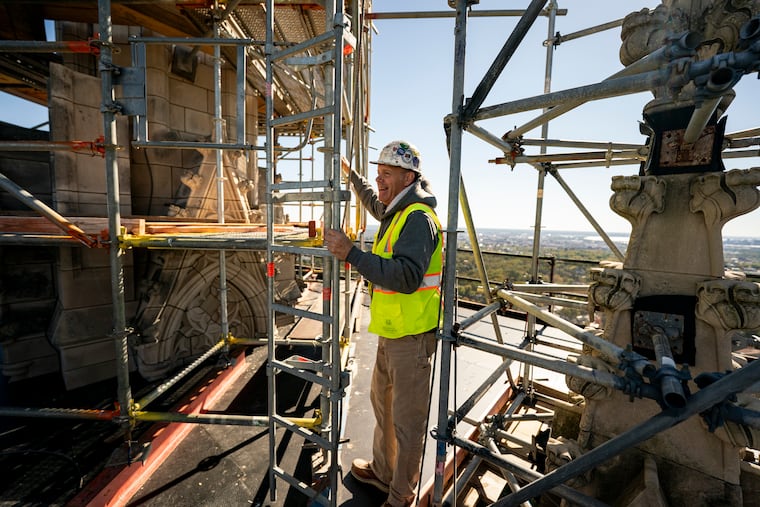
Perched 676 feet above sea level, wooden planks and metal pipes line a deck atop Washington National Cathedral, giving those on it a unique view of the swath of green below.
This is where crews will spend the next three years repairing the central tower, named the Gloria in Excelsis Deo tower — the final phase of more than a decade of work to restore the cathedral after an earthquake rocked the East Coast in 2011. They’ll fix pinnacles, the Gothic spires on the corners of the tower, and finials, the ornaments that cap them, made of stone that twisted, cracked, or came loose in the quake.
Joe Alonso, the cathedral’s head stonemason, said teams have worked their way around the building in sections over the years. But working high in the sky, amid environmental pressures such as high winds and lightning, is the toughest job yet.
Still, the stonemason of more than 40 years said he is determined to restore the landmark in the D.C. skyline “back to the way it was,” and even stronger. The work is expected to conclude by the end of 2029.
“I look at the tower as my, what’s the word, magnum opus,” said Alonso, 65.
A Post reporter and photographer were given exclusive access on the tower in late October to see the work being done.
Donors have contributed $60 million to fund the repairs and restoration, work that has included structural enhancements to withstand any future natural hazards.
“It’s a national landmark, and it’s worth being put back together. It’s worth being made whole,” said Washington National Cathedral Dean Randy Hollerith. “Whatever we needed to do to make it whole, however long it took us to make it whole, we were going to do it, and we’re glad we’re almost there.”
‘Masonry triage’
On Aug. 23, 2011, a rare 5.8-magnitude earthquake shook the D.C. region.
While there were no deaths and few injuries, historical stone monuments took a hit. The Washington Monument closed for nearly three years after the quake left cracks and loosened parts of the structure.
At the cathedral, Alonso and stone carver Sean Callahan toured the building to assess the damage.
The cathedral itself had largely withstood the earthquake. But large pieces of stone had fallen off, and other sections had rotated and shifted as energy from the quake shot through the walls, Alonso said, describing it as like the “cracking of a whip.”
The worst damage was at the top of the central tower, which has been standing 301 feet tall since it was completed and dedicated in 1964.
Alonso said when he and Callahan got up to the roof, they saw “devastation” — broken stones and an angel, still intact, that had fallen.
The work of stabilizing the cathedral began immediately, Alonso said. Workers had to pull some pieces off of pinnacles and remove any dangers. The central tower pinnacles had been structurally compromised and needed scaffolding.
“We were doing masonry triage,” Alonso said. “We’re like, ‘OK, this one can wait. OK, no, but no, no, that one can’t.’”
Alonso said teams repaired the lower parts of the building first, in part because the central tower would be the most complex and expensive spot to access. Once they divvied it up into manageable sections, the first major phase of repairs started in 2014 on the east end.
The work atop the central tower began in January. Crews built a hoist system that can hold up to 6,000 pounds to let workers bring stone pieces — many weighing a couple of hundred pounds — back to the top of the central tower.
They’ve also constructed the deck lining the tower to serve as a work platform. A fully enclosed workshop will be added, too.
So far this year, crews have mainly been erecting scaffolding to prepare for the stone work to begin in March, Alonso said.
Stonemasons will restore the pinnacles, for example, which are missing their finials. Carvers are working to re-create those.
Alonso is more than familiar with how to piece the cathedral back together. Hired out of a local union hall in 1985, he laid the final stone for the cathedral’s west towers in 1990. It occurred 83 years to the day from when the first stone was laid for the structure on Sept. 29, 1907.
“The cathedral has always been this, you know, ‘the cathedral,’” Alonso said. “It was the ultimate, the ultimate expression — it always is — of masonry.”
Still, while the masonry work is familiar, the height of the central tower presents the real trouble, Alonso said.
When the pinnacles twisted and fell from the earthquake, they took the lightning rods with them. So the cathedral has enlisted the help of a “lightning guy” for the next phase of work. “We have to be constantly weather aware, more than we ever were down low,” Alonso said.
Even dropping something from above becomes a concern. Crews have built tunnels over the south side of the cathedral to catch any debris, Alonso said.
Work will also pause around December for the winter.
While the structure may look the same on the outside, crews are working to make it much safer and stronger, Alonso said. Each pinnacle across the cathedral will be or has already been reinforced with steel rods and cementlike grout.
Continuing tradition
As masons build and construct above, carvers Cameron Hawkins and Brianna Castelli, both 27, spend their days on the ground in a workshop to re-create stone finials for the top of the tower’s pinnacles, among other repairs.
Their work centers on historical restoration, meaning the pair must get the new finials as close to the original style as they can. Using a finial that survived the earthquake as a pattern, the carvers said they have to preserve the ornate and high Gothic work of the past and resist any temptation to go with their personal style.
“It’s one of the oldest professions, so there are times where I’m carving, I’ll be facing a challenge or an issue and thinking about it, and realize that people hundreds or even thousands of years ago might have faced that same issue using the same tools, more or less,” Hawkins said.
Callahan, a master stone carver who has worked at the cathedral for more than 20 years over two stints, said he didn’t think he’d see his work come back around in his lifetime. The cathedral had only been completed for 21 years when the earthquake hit.
“It’s kind of weird, being in the ’80s, thinking this is going to last a thousand years, and in my own career time, I’m resetting my own work,” said Callahan, 61. “So that was a surreal experience.”
As they planned the restoration, Callahan said officials weren’t sure how the cathedral could afford to build everything back to its earlier look.
Hollerith, the cathedral’s dean, said they worked hard to raise the money to restore the building, which he called “such a beautiful piece of art.”
“Whenever you find beauty, I think you find God, quite frankly,” he said. Hollerith said that while at its heart, the cathedral is an Episcopal Church and a Christian community, his dream is “that everyone would think of that cathedral as their cathedral, because it is their cathedral.”
Long a spot for important interfaith events, the cathedral in recent years has become more intentionally inclusive. Cathedral leadership have created more community events, such as yoga and art shows, and become more outspoken in protection of immigrants and LGBTQ people.
“We think it’s really important to take the values of our faith, dignity, justice, the inherent worth of every human being, truth-telling, and to lift up those values,” Hollerith said. He said uplifting those values is central to democracy.
Reaching this final phase of renovations feels “fantastic,” said Hollerith. Whether flying into the city, traveling on the parkway or coming over the Memorial Bridge, the legendary pinnacles will be restored for all to see, he said.
Inside his office, he has the fallen angel from the central tower that Alonso and Callahan spotted that day on the roof after the quake 15 years ago.
Soon, she’ll be back in her place.