These aren't Charlie and Ruben's Phillies anymore
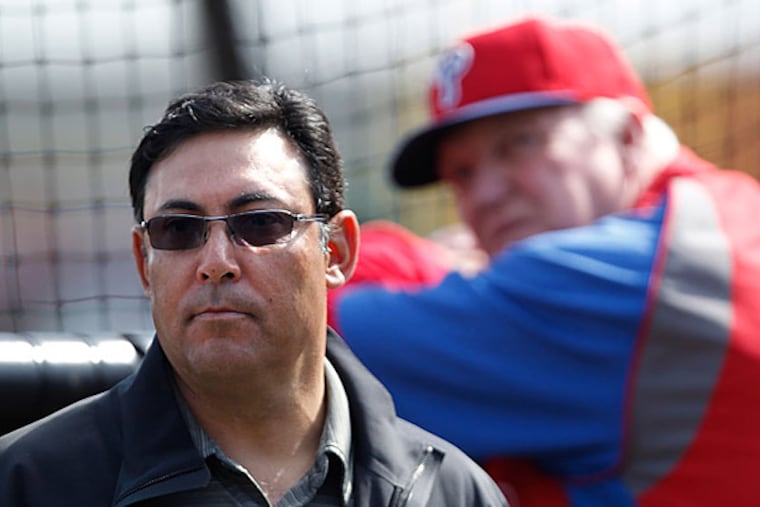
"It's really not all that different from every year. Our goal is to try and be in the postseason every year, I stated that when I took the job. Whether we get there or not kind of depends on my performance and the players' performance. We do this as a team; we win as a team, we lose as a team."
--Ruben Amaro to MLB.com
Ruben Amaro said this the other day, in 2013, after a year with 73 wins, 29 games with Michael Martinez, the worst finish since 2000 and the manager getting fired before the end of the season.
Not every team makes the playoffs every year; not every team is able to make the playoffs every year. Therefore, not every team should have the goal of making the playoffs every year - despite what they need to say to sell tickets. If a team gets some unpredicted momentum and some unheard of breakout years, then they should ride that as long as it lasts. But the goal for the 2014 Phillies shouldn't be to make the playoffs. It should be to lay the groundwork for rebuilding a team that already doesn't work.
Charlie Manuel was the right manager for the mid to late 2000's Phillies; a team of young, powerful hitters waiting for their pitch. They thrived in his laid-back clubhouse and loved him for the way he put his players first, as if he didn't know any other way to his job. As the years went on, Manuel started having to make more and more decisions, until eventually, he was in the dugout of a new, pitching-first club who needed to live off small ball. This was not what he signed on for.
Manuel's firing could have happened a little more smoothly, but it's hardly been argued that it didn't need to happen.
Ruben Amaro also inherited a team of slightly older, but still young, hitters in their primes, and with that fertile offense in play, he took control of a team whose goal was to win now. They could feasibly win it all, and Amaro was given the creative license to bring in any further pieces he thought would help.
Four years later, the team is no longer a Raul Ibanez or Cliff Lee away from contention. The core players don't need lengthy extensions, they need careful rehab and bags of ice.
"Our goal is to try and be in the postseason every year, I stated that when I took the job."
When Amaro took the job, the Phillies being in the postseason every year wasn't a laughable concept. But all of his memos all still say "win now," so he's going to keep general managing as if that's possible.
Like Manuel, Amaro may have even been the right GM at the time. He seemed to know how to touch the tower without knocking it over. He added Ibanez in 2009, who made him look like a genius for the first half. He traded for Lee, then traded for Roy Halladay, then signed Lee in free agency. He went small, then dreamed big - there were blockbuster deals involving the Phillies! Players wanted to come here - good players! Truly, it was a magical era.
Time started chewing away the effectiveness of former MVPs, injuries started swallowing full chunks of the schedule, and then Amaro was left with holes. Big holes. Holes that a GM whose training lies in blowing up and rebuilding might be able to fill, but not one who looks at Laynce Nix and thinks, "Two years, definitely." A GM might have to make holes into bigger holes before starting to fill them; he might have to trade Jim Thome to make room for Ryan Howard.
But at this point, the Phillies aren't a hobby that a GM could tinker with and fix on the weekends, and they don't have the assets to wait calmly for their near future, or trade for the another team's future that's already here. Since Amaro can't fill the room with All-Stars anymore, he's just filling the room. This is not his specialty.
You can make the argument that a manager's effectiveness on a team in general is questionable, and his firing often has more to do with the illusion of change than an actual philosophical shift. The players are the ones on the field, but when they are less broadly talented than in the past, more in depth strategy is required than "Here's this stick, go hit the ball." Manuel, like most competent managers, could manage a team full of young, pleasant, potent, disease-free hitters. Amaro could general manage that same team, with minimal moves required to keep them on top.
But once Manuel was required to get creative with role playing, bullpen management, etc., he faltered. He relied on veterans when younger guys were around. He made his decisions based on trust and feelings, which as a career baseball man, he can get away with from time to time. But the gaping holes in the Phillies can't be filled with instinct, or a gritty veteran, or Delmon Young, and Manuel didn't have the make-up to manage these shallow new Phillies.
Years ago in the front office, a hotshot "arms dealer" was lounging in the bleachers for a photo shoot. Amaro couldn't do anything wrong; now, there's not a lot anybody could do right. The Phillies need a rebuilding specialist, someone who can recognize that this thing is over and it's time to send everybody home; somebody who can stop throwing fourth-year options to 38-year-old catchers and start plowing ahead without trying to force a "win now" culture in a third-place clubhouse. Like Manuel, Amaro may have been right once, when it was hard to make the team go wrong, but in a more intricate, struggling environment, a new philosophy should be in place.
Sadly, this philosophy seems organization-wide. The Phillies really do believe they can win now. Which is odd, given that even in the offseason, they still seem like they're losing.