New Phillies hitting coach Peter Fatse brings experience with stars and analytics, but he’s already short on time
Fatse has spent his entire career watching the Phillies from afar. Now, with a lockout looming, he won’t have long to make an impact.
The Phillies had the second-oldest lineup in baseball in 2026.
With an average age of 30.2 years, their hitters were only behind the Dodgers’ 30.9 years. And it’s been a while since the veteran-laden team has had a new voice at hitting coach.
That’s what Peter Fatse is expected to provide, as he steps into a role formerly held by Kevin Long since 2022. Fatse was hired to manager Don Mattingly’s staff earlier this week, with Joe Cronin and Edwar Gonzalez named as his assistant hitting coaches.
“I think hitting is always a collaboration with the player,” Fatse said at his introductory news conference on Friday. “I think obviously with players with 10-plus years in the big leagues, it’s even more the case. They have more runway in their careers. So I think it’s just understanding those things.”
Fatse joins Carlos Mendoza, the Phillies’ new infield and third base coach, as the two notable additions to the coaching staff after the club’s wild-card exit in October.
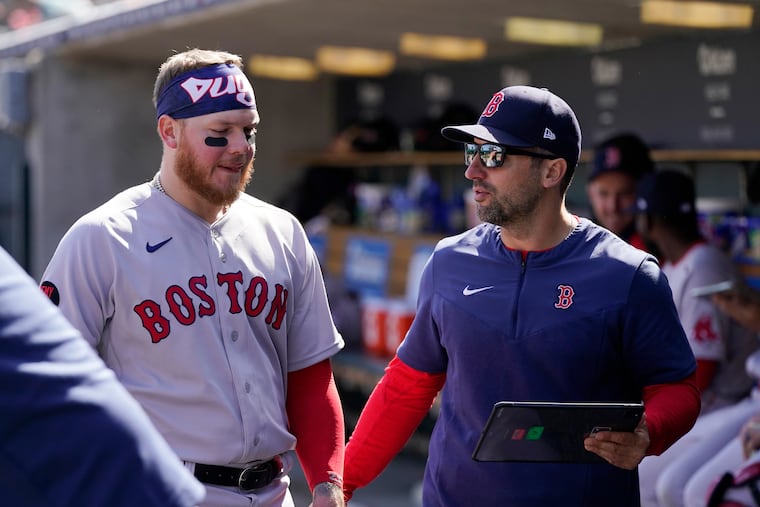
And Fatse has plenty of experience dealing with veteran stars in his previous stop. He joined the Red Sox as assistant hitting coach in 2019, was promoted to hitting coach in 2021, and served in that role until he and the remainder of Alex Cora’s staff were fired in April.
Fatse pointed to players like J.D. Martinez, Christian Vázquez, Mitch Moreland, and Kevin Pillar as veterans he worked with early on in Boston that helped him refine his approach for coaching experienced players.
“The ‘why’ is the most important part to me as a coach,” Fatse said. “You have to understand why somebody does something or what has helped them throughout their career get to this point. Because my mentality is you have to understand, appreciate those things, before you just jump in and make an assumption.”
Fatse views relationship building as one of the most important parts of his job. But this offseason, the timeline will be compressed with the collective bargaining agreement ending on Dec. 1. During the lockout that is expected to follow, teams will be unable to communicate with players until a new CBA is reached.
» READ MORE: A (likely long) lockout looms again for MLB. Why a salary cap is at the center of it all. Again.
That means Fatse has a month to start connecting with the Phillies hitters. He has already been exchanging text messages with them, and expects to start traveling to meet players at their offseason homes in person soon.
“Earning that trust is really important,” Fatse said. “So we’ve already started the communication process, starting to work through what those trips are going to look like, kind of prioritize those things, but that is all in the works within the next couple weeks.”
Fatse has spent his coaching career until now in the American League, which meant watching most of the Phillies from afar during interleague play. But he did briefly coincide with Kyle Schwarber in Boston in 2021. The slugger was traded to the Red Sox at the trade deadline that year, and after returning from injury, helped the club advance to the American League Championship Series.
“Honestly, one of the best teammates I think I’ve been around too,” Fatse said. “It was a very short time, and obviously we were in a chase, and the way he kind of galvanized that group.”
While the Phillies were searching for Long’s replacement, one of president of baseball operations Dave Dombrowski’s top priorities was finding a candidate who is able to understand and use analytical information and tools at their disposal.
“I do think it’s imperative that a lot of the contemporary methods that are available to us are being used,” Dombrowski said.
Fatse fits that bill. After he was let go from the Red Sox, he joined the Tampa Bay Rays as a hitting consultant for the remainder of the 2026 season. While there, Fatse worked closely with their research and development department.
» READ MORE: Phillies 2027 catchers outlook: Free-agent options, prospect forecast, and more
He worked primarily with Rays analysts on KinaTrax, a motion-capture technology that provides teams with biomechanical data on their hitters and pitchers. Fatse was already familiar with the system from his time in Boston.
“How can we use this information to get more granular, deeper within the swing?” Fatse said. “And basically get a better understanding of the individual aspects within a swing that we can use for whatever: modeling, coaching, development. So I spent a lot of time in that space.”
Now the Phillies hope Fatse can use those skills to help revitalize an offense that finished 21st in baseball in batting average (.240), 23rd in on-base percentage (.312), and 24th in slugging (.395).
One of the simpler stats Fatse likes to keep a close eye on as a barometer for where his team is at collectively is OPS. The Phillies had a .707 marker as a team in 2026, ranking 22nd in MLB.
“The teams that are putting themselves in a position to score more runs are going to be on base more,” Fatse said. “And [slugging], obviously, is one of those things that kind of ebbs and flows with the season. And I generally, just basic baseline, will look at that.
“Obviously, you can look at your expected statistics that are more reflective of the quality of contact you make, and things like that. But generally, just at its simplest level, OPS is a is a pretty strong indicator of run scoring.”
» READ MORE: Reliever Tim Mayza on why he re-signed, how ‘The Sheriff’ nickname suits him, and more | ‘Phillies Extra’ Q&A
The Phillies lineup also infamously has a tendency to expand the strike zone, and their 32.6% chase rate in 2026 ranked 27th in baseball.
According to Fatse, the approach to reducing that typically has to be individualized for each player.
“I think it’s an opportunity for this group,” Fatse said.

As the Phillies’ representative in the players’ union, Garrett Stubbs is on the front lines of baseball’s upcoming labor dispute. The backup catcher, who was designated for assignment on Thursday, joined Phillies Extra to discuss why the players won’t go for a salary cap, sitting in on early negotiations, when baseball might be played in 2027, and (spoiler!) his plans to create content during the looming lockout. Watch here. Watch here.
You can also subscribe to the podcast version of Phillies Extra on Spotify or Apple Podcasts.
Previous episodes: Tim Mayza | Aidan Miller | Scott Franzke | Larry Andersen | Matt Klentak | Jeff Francoeur | Luke Murton | Mike Hazen | Tony Gwynn Jr. | Kevin Stocker