At what price, Robert Covington? | David Murphy
On an open market, Covington's representatives could make a strong argument that their client is worthy of a contract that pays him $16 million to $18 million annually.
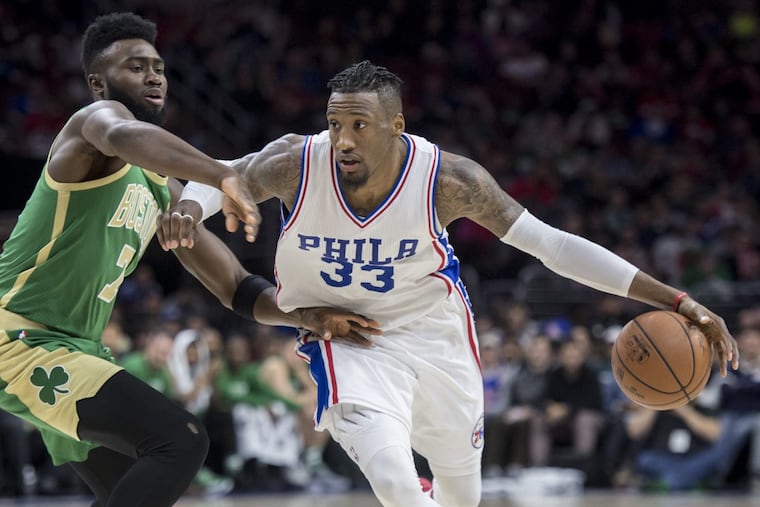
The NBA has yet to release its 2017-18 schedule, but feel free to circle Nov. 15 as one of the most important dates on the Sixers' calendar. That's the three-year anniversary of Robert Covington's signing of his first contract, which is when he and the team are free to rework his 2017-18 salary within the framework of a multi-year extension. Must-see TV? Perhaps not. But for a Sixers team looking to avoid a five-car financial pileup in the coming years, the Covington negotiations could end up playing a significant role.
First: there will be negotiations. The Sixers have given every indication that they value Covington's unique blend of size and perimeter defense, and that they view him as a viable piece of their rotation moving forward. In fact, the smoke suggests that talks have progressed passed the public platitudes stage. On Monday, the Sports Business Journal reported that Covington has switched agents, enlisting the services of powerhouse agency CAA. Less than 24 hours earlier, Sixers president and general manager Bryan Colangelo was on ESPN referencing that aforementioned date while discussing his swing man's future in terms that belied plenty between the lines.
"We do have some flexibility with our cap situation right now, where we still have some money held back," Colangelo said during ESPN's broadcast of the Sixers' summer league game against the Spurs on Sunday night. "On Nov. 15, he'll reach an anniversary date, and it may be a nice play for both of us if we were to possibly look at a renegotiation and an extension. It's something to talk about, it's something that will need to be negotiated but it might be the best play for all sides. But once again, to have a contract on the books at a below market value going forward with the flexibility there with the play on that kind of a contract might be a good solid piece for us as we move forward, because we really do think he's an unbelievable piece for us, in terms of being an elite defender, three-and-D guy, good shooter, can probably be a better shooter, but the way he's developed as a defensive player has been the most impressive thing to me."
Consider the situation from Covington's end of the table and one can easily read Colangelo's comments as a window into where the negotiations stand here in the early going. On an open market, Covington's representatives could make a strong argument that their client is worthy of a contract that pays him from $16 million to $18 million annually. Yet that kind of outlay would push the Sixers into dangerous territory, assuming it includes a guarantee of four years.
Given Covington's unique skill set and the difficulty in quantifying individual defensive performance, there aren't many tailor-made parallels to draw upon in assessing his market value. There simply are not many guys who stand 6-9 and shoot 35 percent from three-point range while playing elite perimeter defense. Hence, why the Sixers would love to keep Covington in the fold.
The two most instructive comps might be Khris Middleton and Wilson Chandler, both of whom are similarly-sized three-and-D players who've signed contract extensions within the last couple of years. They are not identical players, but we can view them as end points that bound the spectrum where where Covington's skills reside.
Middleton, who signed a four-year, $70 million contract extension with the Bucks before to the 2015-16 season, has been a better shooter by a significant margin, and is at least in Covington's realm as a defender. The season before he signed his extension, he trailed only Tony Allen and Kawhi Leonard among perimeter defenders in ESPN's Real Defensive Plus/Minus metric. Chandler is a lesser player across the board, which is why the four-year, $46 million deal he signed before the 2015-16 season is a good floor for any Covington contract.
| Age | Height | MPG | FGA/G | 3P% | EFG% | SPG | RPG | Contract | AAV | % Cap (Yr 1) | |
| Robert Covington | 27 | 6-9 | 28.5 | 10.5 | .354 | .501 | 1.6 | 5.6 | |||
| Khris Middleton | 24 | 6-8 | 30.6 | 9.9 | .403 | .518 | 1.2 | 3.8 | 4/70 mil | 17.5 | 25.0 % |
| Wilson Chandler | 28 | 6-8 | 31.1 | 12.0 | .339 | .496 | 0.8 | 5.3 | 4/46 mil | 11.5 | 16.5 % |
| Danny Green | 28 | 6-6 | 24.4 | 7.6 | .420 | .565 | 1.0 | 3.3 | 4/40 mil | 10.0 | 14.2 % |
In 2017-18 dollars, Chandler's contract would equate to roughly four years and $65 million, or 16.5 percent of a $99 million salary cap. Anything less than that, you'd have to consider a team-friendly contract, with respect to the current market. Of course, agents are rarely satisfied with deals that warrant such a designation.
The Sixers do have some leverage. While Covington could play out this season and hit the open market next summer, going that route would see him bank just $1.5 million in salary for 2017-18. That's a pittance when compared with the risk he'd be assuming. First, he'd be hitting free agency at 28 years old, which could affect teams' valuations of him on the back end of any deal. Were he to suffer a significant injury, his earning potential would take a serious hit. Even if he remains healthy, there are plenty of scenarios in which his minutes drop, given the additions of Markelle Fultz, Ben Simmons and veterans J.J. Redick, Jerryd Bayless and Amir Johnson. Take into consideration his uneven year-to-year shooting performances and it's a legitimate question whether the difference between the Sixers' best offer and whatever he would garner on next summer's open market is worth playing out the season. One would think it'd have to be a significant split, particularly given the difference between earning $1.5 million in 2017-18 and whatever Year 1 of a new deal would pay him.
At least, that's the pitch that Colangelo will likely make to Covington's new representatives.
The Sixers should have little problem accommodating the first few years of a Covington extension. But as you'll see below, the thing isn't a no-brainer.
Joel Embiid is already eligible to sign an extension for up to 25 percent of the team's cap space, and it seems like only a matter of time before the Sixers lock him up to just such a deal. While that should have little impact on what the they are able to do in 2018-19 and 2019-20, things could start to get tight in 2020-21, which would either be Year 3 or Year 4 of any Covington extension.
At that point, Simmons and Dario Saric will both be eligible for contract extensions. Nobody can say for sure what kind of deal they will be in line for, but that cuts both ways: they should certainly be planning as if Simmons will be pulling down a max-level deal. But if Covington's Year 4 (2020-21) salary accounts for 17 percent of the salary cap, the Sixers would suddenly be left with just 24 percent to dole out to the rest of the roster. That's already less than would be required to sign a veteran free agent to a max contract. And that's before we even consider Saric.
Projected salary cap percentages
| 2017-18 | 2018-19 | 2019-20 | 2020-21 | 2021-22 | |
| Joel Embiid | Rookie4 | .25 | .24 | .23 | .22 |
| Ben Simmons | Rookie2 | .06 | .07 | .25 | .24 |
| Markelle Fultz | Rookie1 | .08 | .09 | .11 | .25 |
| Robert Covington | .17 | .17 | .17 | .17 | ?? |
| Dario Saric | Rookie2 | Rookie3 | Rookie4 | ?? | ?? |
| Total | .56 | .57 | .76 | .88 |
That's a long way off, but you still have to plan for it.
But as Colangelo mentioned, the Sixers have some flexibility given the cap room they have this season. From the club's point of view, the ideal outcome would probably be a deal that runs through 2020-21 and features a considerable amount of cash paid out over the next couple of seasons, with some savings on the back end. For instance, the Sixers currently have somewhere in the neighborhood of $16 million in cap space for 2017-18. Suppose they used that money to bump Covington's salary from $1.5 million to $16 million this season, and, in exchange for that immediate liquidity, got a discount on the last year of the deal so that they could still accommodate the signing of a max-level veteran at some point in the next couple of off seasons.
Even then, there is a viable conversation to be had about whether such an outlay would fit Colangelo's stated goal of maintaining maximum flexibility for future additions. Sam Hinkie stole a lot of draft picks from teams who didn't look far enough down the road when doling out contracts in the here and now.