Gina Hinojosa’s win in the Texas governor’s race is both historic and explained by history
Hinojosa's win was less a long shot, and more a long time coming, given the history of Texas Chicana organizing.
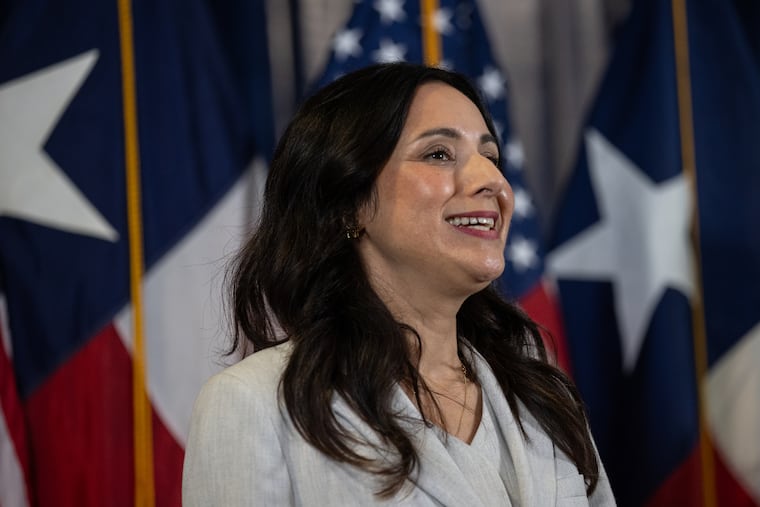
Gina Hinojosa—a name few outside of Texas knew before this election cycle—made history Tuesday night after winning Texas’s governor race, part of a Democratic sweep of state-wide offices in 2026. Hinojosa will became the first Latina ever, and the first Democrat since 1995, to hold that office. She accomplished what many considered impossible, running a contentious gubernatorial campaign to defeat three-term Republican Governor Greg Abbott in a state largely considered a conservative stronghold.
In truth, Texas’s political history is much more complicated. The state’s annexation into the United States in 1845 and the Treaty of Guadalupe Hidalgo (1848, ending the Mexican-American War) brought unprecedented numbers of new settlers—U.S. Southerners, ethnic Germans, and ethnic Polish among them—to the area, displacing Mexicans who had been there for generations. After the U.S. Civil War and Reconstruction, Southern Democrats dominated Texas politics and maintained their control through the regimes of Jim Crow and Juan Crow through much of the 20th century.
But even that isn’t the whole story. Through the 20th century, examples abounded of grassroots, political resistance to racial injustice, economic exploitation and political repression. At mid-century, cross-racial alliances among Black, Mexican and poor white Texas residents forged meaningful changes on the streets and the ballot box. Of critical importance to such changes were the efforts of Chicana (Mexican American) women, whose long fight for political power as liberal feminists in the state renders Hinojosa’s victory as something a long time coming.
In the early 20th century, Mexican Americans in Texas were viewed and treated as outsiders in their own land. Some naturalized or native-born U.S. citizens began to form civic organizations like the Order of the Sons of America (OSA, founded in 1921), laying the foundation for the League of United Latin American Citizens (LULAC) in 1929. LULAC, now considered the oldest Latino civil rights organization in the United States, fought racial discrimination, opposed school segregation, encouraged political participation and demanded Mexican American voting rights—all through the court system. What’s more, in 1948, Texas Mexican American veterans who had served in World War II established the American G.I. Forum to demand veterans’ benefits, labor rights and voting rights.
While these organizations made critical contributions to the Mexican American civil rights movement, they tended to prioritize the experiences of upper- and middle-class men. But Mexican American women in Texas were also activated. They organized campaigns, registered voters, raised funds and founded women’s auxiliaries. This supportive political labor laid the blueprint for future generations of women to build upon.
By the 1960s and 1970s, the expanding Chicano and women’s movements were transforming social, cultural and political life across the country. While the Democratic Party had increasingly positioned itself as the party of civil rights and sought the votes of Black and Mexican American voters in Texas, younger Mexican Americans, now calling themselves “Chicanos/as,” were frustrated by their still limited access to political power. In the face of police brutality, economic exploitation, continued political exclusion, gender inequality and erasure of their history and culture, they took to the streets calling for “Brown Power” and formed grassroots organizations across the Southwest. Chicanas were part of this fight, but they went further. They challenged sexism in movements that shut them out of decision making, and they prioritized fighting for their own self-determination and autonomy.
The La Raza Unida Party (RUP) formed as a liberal third party in South Texas in 1970, and Chicanas were at its center from the start. Not all ethnic Mexicans aligned themselves with the RUP; many remained with the Democratic Party. But through the RUP, women were able to exercise political power. Chicanas like Evey Chapa played major roles in crafting the party’s platform, which prioritized support for the Equal Rights Amendment and the recruitment of women within the party. Going one step further, the RUP became the first political party to actively recruit Chicanas to run for office themselves. In 1972, Marta (Martha) Cotera ran for the State Board of Education in District 23, and Alma Canales ran for lieutenant governor under the RUP banner.
The RUP eventually spread from South Texas across the rest of the state, and even to the U.S. Southwest, Midwest and beyond. It further expanded its reach when its Chicana members joined the National Women’s Political Caucus, founded in 1971 to encourage women to run for public office and engage more deeply with the U.S. political process. In short, the RUP helped develop a blueprint for Mexican American political representation, but it also established the framework and network to ensure Mexican American women’s central role in political leadership.
Chicanas’ organizing work in South Texas and beyond created an opening for them to participate in mainstream politics. In 1976, Irma Rangel launched her campaign for state representative for District 49. Her campaign centered the working people of Texas with the slogan “Representation for a Change.” She understood the economic hardship, lack of quality education and racial discrimination that South Texans endured. And she understood the importance of women’s rights. Rangel became the first Mexican American woman elected to the Texas House of Representatives and assumed office in 1977. Rangel helped fight for women’s rights, established a pharmacy school in Kingsville, Texas, and co-authored the “Top Ten Percent” bill that transformed higher education in Texas. She didn’t shy away from battle, and she sought opportunities to work in a bipartisan manner.
Like Rangel, Hinojosa grew up in South Texas, specifically Brownsville, where today ethnic Mexicans are the majority-minority and Mexico’s border is within driving distance. As an adult, she climbed the ranks in state politics, first winning a seat on the Austin ISD School Board and then in the Texas House of Representatives in District 49. All the while, she continued to work as a civil rights and union lawyer, advocating for everyday people at the grassroots level.
In 2025, Hinojosa set her sights on the governor’s office and campaigned with the slogan “No te dejas,” or “Don’t let them.” It’s a familiar dicho (saying) in the Mexican community and something I grew up hearing my mother say. Hinojosa too said she often heard it from her grandmother, as I’m sure many ethnic Mexican women have. When we say “No te dejas,” we’re saying don’t give up, speak up, fight back, walk in your truth.
Like the Texas Chicanas of the 1970s who came before her, Hinojosa “no se dejaron”—she didn’t let them shut her out, silence her or stop her. Hinojosa’s win may register as a major upset in Texas politics—but there has always been more to Texas than Republican men. Yes, she ran at the right time, but her victory is part of a movement decades in the making and one that will continue for decades to come.
Tiffany Jasmin González is an assistant professor of history at the University of Kansas, where she teaches and writes on modern American history and Latina/o history.
Made by History takes readers beyond the headlines with articles written and edited by professional historians. Opinions expressed do not necessarily reflect the views of The Inquirer.