Camden is a winner in New Jersey’s $60.7B budget. Who are the losers?
Here's how the city of Camden, Rowan University, businesses, parents, and seniors fared in New Jersey's first budget under Gov. Mikie Sherrill.
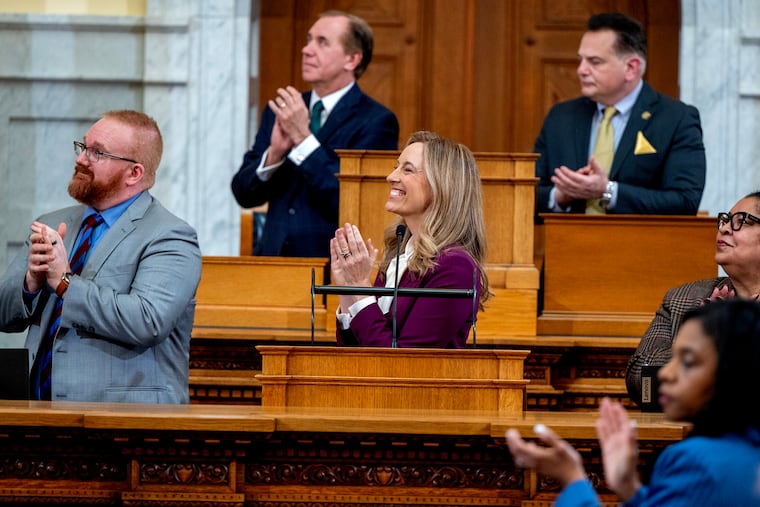
Gov. Mikie Sherrill signed the New Jersey budget for fiscal year 2027 Tuesday night, shortly before the clock ran out on the constitutionally mandated deadline.
The budget ranks as the largest in state history, but Sherrill also contends it is the most “fiscally responsible” in decades in part because it fully funds the state pension program and doesn’t come with widespread tax increases for residents.
Lawmakers approved the budget on Tuesday after adding millions in legislative add-ons Sunday night, a move that countered Sherrill’s earlier vows to change the culture in Trenton. But she softened her stance as the deadline neared and she conceded that lawmakers know their districts best.
South Jersey Democrats defended the spending, which Republican lawmakers criticized as “pork.”
“I know sometimes it gets disparaging names, but I think one of our responsibilities as elected officials is to be responsive to the needs of our communities,” said Sen. Troy Singleton, a Burlington County Democrat.
But the last-minute shuffle didn’t result in the transparency Sherrill originally promised, with some legislators saying they weren’t sure of the details they were voting on. The budget passed mostly along party lines in the Democratic-dominated legislature. Sherrill and legislative leaders touted record funding for schools and property tax relief programs.
“I know the process needs work,” Sherrill said at a Tuesday night news conference. “It takes too long. It could be much more transparent, but we took steps in the right direction this year.”
Here are some of the winners and losers in the budget.
Winner: Camden City and County
South Jersey obtained funding for projects across the region with Camden scoring one especially big-ticket item: $9 million for property acquisition and demolition. The funding is for a county-run program focused on removing vacant, unusable, or otherwise deemed dangerous properties in the city.
Louis Cappelli Jr., the director of the Camden County Commissioners, said in an interview that the county has demolished more than 1,200 residential and commercial buildings over the past decade as part of this effort, mostly with state money. He said the program’s mission is to encourage the city’s redevelopment.
“The city is in desperate need of new housing, especially market-rate housing, and by creating opportunities for development on these properties, we believe we will draw the interest of residential developers to build in Camden City,” he said.
The city of Camden was also allocated $250,000 for a statue of Martin Luther King Jr., which Sherrill promised the city ahead of her inauguration. This project was a priority for the governor, who systematically struck a pen through legislative projects but dedicated funding to the statue in her proposal earlier this year.
Several organizations that serve Camden city and county received hundreds of thousands of dollars in the budget.
The Camden Coalition of Healthcare Providers received $500,000 for a program that connects emergency department patients to outpatient behavioral care and $750,000 for a program that helps people experiencing homelessness obtain housing. Joseph’s House, a homeless shelter in the city of Camden, received $600,000, and a separate spending bill also sends $650,000 to a new construction homeownership project.
The budget also allocates $300,000 for job training for youth and young adults, $75,000 for a program dedicated to improving school attendance in the city of Camden, and $25,000 for a new county program that supports formerly incarcerated people reentering their community.
It also includes $3.2 million for structural improvements for a bridge at Route 30 and Somerdale Road and $12.1 million for the Camden County LINK Trail, a planned 34-mile multiuse trail.
Loser: High-income seniors
Senior homeowners who earn between $200,000 and $500,000 a year will no longer qualify for the nascent Stay NJ property tax credit program under the new income cap. They just began receiving checks for the program this year.
Sherrill proposed scaling back the expensive program in her budget proposal earlier this year, which caused some tension because the new program was championed by Assembly Speaker Craig Coughlin, a Middlesex County Democrat and a key budget negotiator.
But Sherrill and legislative leaders found a compromise by giving higher payments than she proposed for those who make less money, and an even lower income limit than she proposed for the program.
Qualifying taxpayers will get refunded up to half their property tax bill up with maximum refunds ranging from $4,000 to $6,500, depending on their income, with those earning more getting less.
You win some, you lose some: Rowan University
Rowan University is receiving less money than it did this year, but significantly more money than Sherrill initially proposed. At the end of the day it’s a win for the university, which saw significant cuts reversed.
Sherrill’s initial proposal included about $125 million, but legislators brought the total up to nearly $135 million — a drop from the $155 million the state gave the school this year.
Sherrill zeroed out funding for Rowan’s new veterinary school but legislators successfully got $6.2 million for the program — still less than the $8 million it received this year and a far cry from the $20 million the school requested.
State Sen. John Burzichelli, a Gloucester County Democrat, said the money is enough for the school to at least “keep the lights on,” for the veterinary school and the medical school funding is “sound.”
Sherrill also proposed cutting all state funding for Virtua Health College of Medicine and Life Sciences. Legislators restored $2 million to the program — half of what it received this year and much less than the requested $12 million.
The Rowan-Virtua Child Abuse Research Education and Service Institute (CARES) program, which provides medical and mental healthcare to children who have experienced abuse, had all its $1.85 million funding restored after Sherrill initially zeroed it out.
In anticipation of the governor’s proposed cuts, Rowan sent employees layoff notices and announced the closure of its Vineland office. A union representing CARES employees has called on Rowan to reverse these changes.
But Rowan spokesperson Jose Cardona said the university “will evaluate next steps and very soon determine the most responsible path for operations, staffing, and long‑term sustainability.”
The bill that passed alongside the budget with funding from this fiscal year sent nearly $15 million going to Cooper Medical School of Rowan University and support to Cooper University Hospital. That bill also sends $5 million to Cooper University Healthcare’s South Jersey cancer program, which got an additional $27.4 million in the new budget.
Winner: Parents
Legislative leaders secured a 25% increase in the state’s child tax credit program, which is claimed by 217,000 tax filers with children, according to the governor’s office.
The expansion, which will be in place over the next three tax years, bumps each tax credit tier by 25%. So, for example, a household that previously got the highest tier of $1,000 will receive $1,250 and households that got $800 will get $1,000.
Sherrill, a former member of Congress and mother of four, said she saw positive impacts of the national tax credit, “giving parents more money for childcare and summer camps, so their kids can thrive while they’re at work.”
Loser: Businesses
What Sherrill touted Tuesday night as closing “corporate loopholes” and asking employers “to pay their fair share in healthcare,” the business community saw as an attack.
The budget includes Sherrill’s proposals to introduce new fees for businesses with at least 50 employees on Medicaid, an effort that was led in part by Assembly member Carol Murphy, a Burlington County Democrat, in the legislature. It also imposes limits on two methods businesses use to deduct losses from their taxes.
Hilary Chebra, the director of governmental affairs for Chamber of Commerce Southern New Jersey, criticized these policies, as well as a bill passed by the legislature that bans food surveillance pricing as it’s written.
“Employers aren’t reacting to a single tax increase or one new regulation,” she said. “They’re responding to all of it at once.”
She said these measures will have more severe consequences in South Jersey for small and family-owned businesses that compete with businesses in Pennsylvania and Delaware.
Tom Bracken, the president & CEO of the New Jersey Chamber of Commerce, said businesses were given “minimal support” and that the budget did not focus on supporting economic growth. He said the policies Sherrill championed in the budget “send the wrong message” to employers that New Jersey should be working to attract.
“The negative financial and reputational consequences of these policies will make it more difficult for New Jersey to be competitive — and competitiveness is essential if the state economy is going to grow,” he said.