Pa. lawmakers and Gov. Josh Shapiro have approved a $50.8 billion state budget, delaying action on key issues
Top leaders failed to agree on issues that have seen broad agreement in both chambers, such as repealing a sales tax exemption for data centers. They may revisit them in the fall.
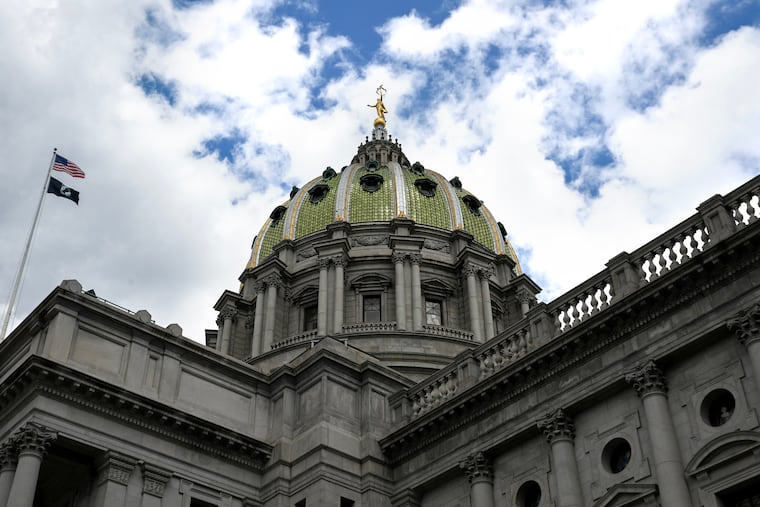
HARRISBURG — Gov. Josh Shapiro signed a $50.8 billion state budget on Sunday following the rushed passage of the overall deal by the General Assembly that lawmakers said helps address the state’s affordability crisis but delays action on some of the most significant issues before the legislature.
The agreement, which was due at the beginning of the month, marks an improvement from last year’s nearly five-month budget impasse in the split legislature that required school districts, counties, and social service providers to take out expensive loans or close altogether.
“We managed, as the [vote count] indicates, to find compromise without compromising our core values,” Shapiro said during a news conference Sunday evening, before signing his fourth budget as Pennsylvania’s governor.
The deal was hashed out over weeks in closed-door meetings among top leaders and includes new transparency requirements for data centers, publicly funded housing projects, and public transit agencies. Lawmakers also agreed to a long-sought cost-of-living adjustment totaling approximately $168 million per year for some Pennsylvania retired teachers, police officers, and firefighters — some of whom have not seen an increase to their monthly pension payments in more than 20 years.
More education funding, data center requirements
Pennsylvania will have invested nearly $2 billion in new school funding through its adequacy and tax equity formulas since 2024. That’s when lawmakers first employed the new calculations to close a $4 billion “adequacy gap” after a landmark court ruling that found the state was illegally underfunding students in low-income districts. This year’s installment of adequacy funding topped $565 million, as part of an effort to prevent districts from having to raise property taxes on already low-income residents. The additional investment sends $136 million more this year to the School District of Philadelphia.
Legislative leaders failed to agree in the final budget on other issues that have seen broad support in both chambers, such as repealing a sales tax exemption for data center projects, allowing local moratoriums on data center projects, or banning cell phones in K-12 schools. They may revisit the issues during the fall legislative session.
Instead, they approved a new reporting requirement that will force data centers to submit annual reports detailing their water and energy usage. The companies will face a $10,000-a-day fine for failing to submit their reports.
The General Assembly also voted to close a sales-tax loophole that allowed online sellers to avoid paying Philadelphia’s local 2% sales tax on items sold in the city. Mayor Cherelle L. Parker had requested that the loophole be closed as part of her own budget pitch in a move estimated to bring an additional $1.5 million to the city.
No decision on skill games
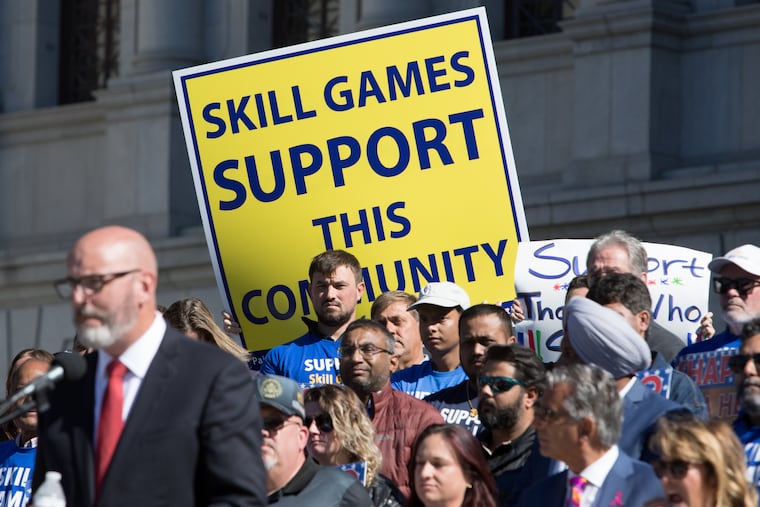
But the budget does not address some of the most pressing issues before the General Assembly, including whether to tax and regulate skill games or allow the more than 70,000 gambling machines in Pennsylvania bars, corner stores and fraternal organizations to become illegal come October. The state has until then to decide how to approach the machines after the state’s Supreme Court last month determined that skill games, which have for years operated in a legal gray area, are slot machines and should be regulated as such. They also punted on finding a long-term funding solution to fund mass transit until next year, when a two-year fail-safe runs out.
» READ MORE: How ‘skill games’ exploded across Pennsylvania — and sparked a multimillion-dollar political fight
Shapiro, a first-term Democrat facing reelection this year, proposed a $53.3 budget in February that for a fourth time emphasized top Democratic initiatives such as raising the state minimum wage to $15 per hour or legalizing recreational marijuana. He also proposed other initiatives, such as a $1 billion critical infrastructure fund to help the state drive out public dollars to build more housing and energy generation, which did not see funding in the final budget deal.
State Sen. Nikil Saval (D., Philadelphia) was among the two Democrats who opposed the state budget, in part because it did not make the ambitious investments needed to address the state’s limited affordable housing stock.
“We cannot defer at this moment,” added Saval, the chair of the Philadelphia delegation in the Senate, in his floor remarks before the vote.
Lawmakers also declined to create any new generators of revenue for Pennsylvania, and deferred addressing the state’s multibillion dollar structural deficit until future years.
‘Met in the middle’
The overall deal passed with bipartisan support in the GOP-controlled Senate, 44-6, and in the House, where Democrats hold a narrow majority, 167-35.
“We have met in the middle,” said Senate Majority Leader Joe Pittman (R., Indiana). “I am proud of this product, despite what some naysayers may say.”
The 2026-27 budget, which is a 1.4% increase in spending over the prior fiscal year, has no widespread tax increases. It also largely relies on accounting maneuvers like spending down unused or underused dedicated funds to address the structural deficit instead of pulling from the state’s emergency savings account.
One of the accounting moves to balance Pennsylvania’s budget includes delaying two months of payments totaling $1.3 billion to insurance companies that fulfill the state’s ballooning Medicaid programs until the next fiscal year. Without those delayed payments, the budget would total closer to $52.1 billion.
Several GOP House members opposed the budget, arguing it is unbalanced and only postpones tax increases to future years if spending isn’t cut.
State Rep. Brad Roae (R., Crawford), called the final budget a “fake number.” State Rep. Charity Grimm Krupa (R., Fayette) called it “voodoo math.” And State Rep. Marc Anderson (R., York) said the state was “cooking the books.”
But broadly, both Democratic and Republican members called the budget a reasonable compromise, acknowledging that they will have additional work to do in the fall legislative session and during next year’s budget negotiations to balance the state’s finances. During speeches on the Senate floor, several Republican senators quoted The Rolling Stones’ song “You Can’t Always Get What You Want,” emphasizing the second half of the refrain: “You might find you get what you need.”
State Rep. Jordan Harris (D., Philadelphia) also turned to music to represent his position on the budget deal, paraphrasing Anthony Hamilton’s “Do You Feel Me” as a response to his constituents’ concerns about affordability by sending more state dollars to school districts to help them avoid property tax increases and raising monthly pension payments for retirees.
“I am glad to stand today to support it, to let the people of Pennsylvania know, baby, the message is getting through,” Harris added.
Pennsylvania Legislative Correspondents’ Association Intern Ethan Young contributed to this article.