A handful of state reps are suspending their pay during the Pa. budget impasse. Here’s why.
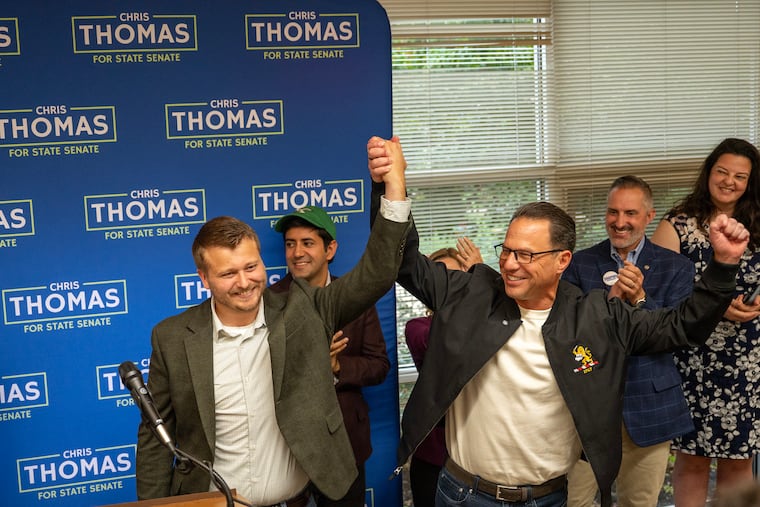
Three state representatives from the Philadelphia suburbs aren't pocketing their pay during the budget impasse in Harrisburg.

A small group of Pennsylvania lawmakers are forgoing their paychecks as the state’s budget impasse prevents money from flowing into schools and other crucial services.
Democratic Gov. Josh Shapiro, the Democratic-led House, and the Republican-led Senate have been stuck in negotiations for more than two months past the June 30 budget deadline. SEPTA, facing a financial crisis absent additional state funding, has implemented service cuts as the lawmakers fail to resolve the stalemate.
The situation has forced districts to begin the school year without state payments, prompting questions about whether legislators deserve to be paid in the meantime.
“If we’re not paying school districts and nonprofits, then we should be taking the same medicine we’re making others deal with,” said Rep. Jeremy Shaffer (R., Allegheny).
Just 10 out of 203 members of the Pennsylvania House, including three who represent the Philadelphia suburbs, decided to pause their paychecks when the chamber’s chief clerk’s office gave them the option earlier in the summer. All senators have received their pay per usual.
Pennsylvania state lawmakers are among the highest paid in the country, receiving salaries of $110,000, plus per diems or expenses. Chamber leaders are paid even more.
Shapiro has criticized legislators for showing up to the Capitol not much more than two dozen days since he proposed his budget more than 200 days ago. He said he believes “there should be consequences for lawmakers failing to show up for work and doing their jobs.”
Lawmakers — and all state employees, for that matter — did not get paid during budget impasses until a 2009 Supreme Court ruling.
Lawmakers from both parties are pausing their paychecks this year, including Democratic Reps. Tim Brennan and Perry Warren of Bucks County, and Melissa Shusterman of Chester County.
They were joined by a Cambria County Democrat and six House Republicans, including Shaffer. None of the legislators who represent Philadelphia took the option.
Some legislators believe suspended pay should be a requirement, but others see it as a personal decision.
Seven House lawmakers — five Republicans and two Democrats — sponsored a bill that would suspend pay for legislators, the governor, and the lieutenant governor until a spending package is approved.
Just one member from the Philadelphia region is a sponsor: Rep. Brian Munroe, a Bucks County Democrat. Munroe, who reported income from his Radnor police pension and TD Bank last year, did not suspend his own pay this year, but said it was only because he missed the deadline to do so.
Munroe is skeptical that the bill could actually pass but said it sends a message to chamber leaders who are actually in the negotiating room. He also said there needs to be “some semblance of pressure,” adding that a requirement to stay in Harrisburg could be another method.
Many lawmakers have other sources of income through investments or work as lawyers, consultants, or landlords, but others report their job in the legislature as their only form of income.
“Believe it or not, a lot of reps live paycheck to paycheck. … Are they going to support basically putting the power into someone else on whether or not they’re going to be able to afford to pay their mortgage and keep their lights on?” Munroe said.
“If you think about it through that lens, do I think it’s eventually going to get to the floor? I don’t think it would, because there’s too many members that live under those circumstances,” he added.
Warren said he is skipping out on his pay in solidarity with organizations in his district like victim assistance groups, senior centers, and the YMCA. But he doesn’t believe suspended pay should be an incentive or sanction, also pointing to differences in lawmakers’ socioeconomic statuses.
“I don’t think it’s a good thing to put lawmakers in a position that their ability to fund their lives is dependent upon them passing legislation that may not be in the best interest of their constituents,” said Warren, who reported income in 2024 from a law firm, credit card rebates, and investments. “I don’t think it’s good to forcibly put financial pressure on someone to make a decision that impacts others.”
But some lawmakers fed up with a gridlocked legislature believe it needs serious change. Among them is Shaffer, who agrees with Shapiro that legislators are not doing their jobs and should face consequences.
“If we were doing our job, then schools would be getting their money on time, nonprofits would be getting their funding, and the state would have a budget,” said Shaffer, who reported income from Bentley Systems and various banks and investment companies last year.
But while House Democrats and Senate Republicans blame each other, Shaffer blames the system itself.
Along with suspending pay, the freshman Republican believes the state should pass two-year budgets, implement fixed session dates, downsize the legislature — which is the largest of its kind in the country — and enact term limits. He argues that the system does not have any incentive to pass a budget and that per diems incentivize lawmakers to keep dragging things out. He believes the bill will get more support after the budget is passed to prevent another impasse next year.
“There’s a growing frustration among both sides that we cannot allow this to continue to happen year after year after year,” he said.
Brennan, a Bucks County Democrat who suspended his pay but did not sponsor the bill, said it was a personal decision but declined to comment further.