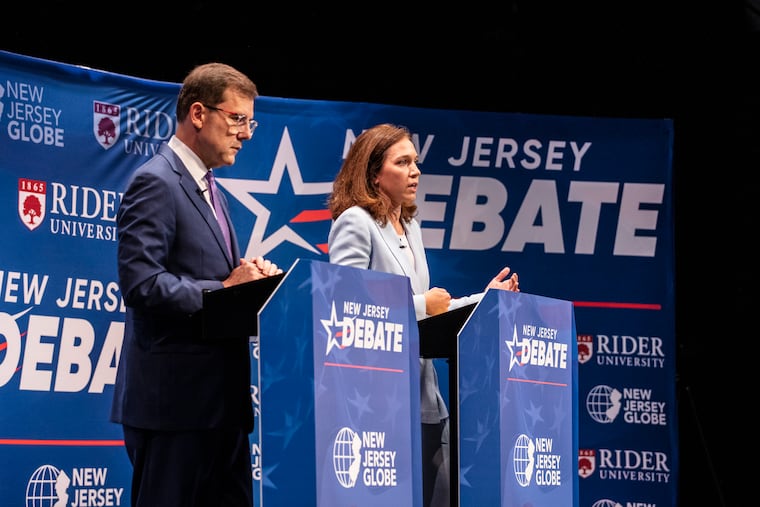
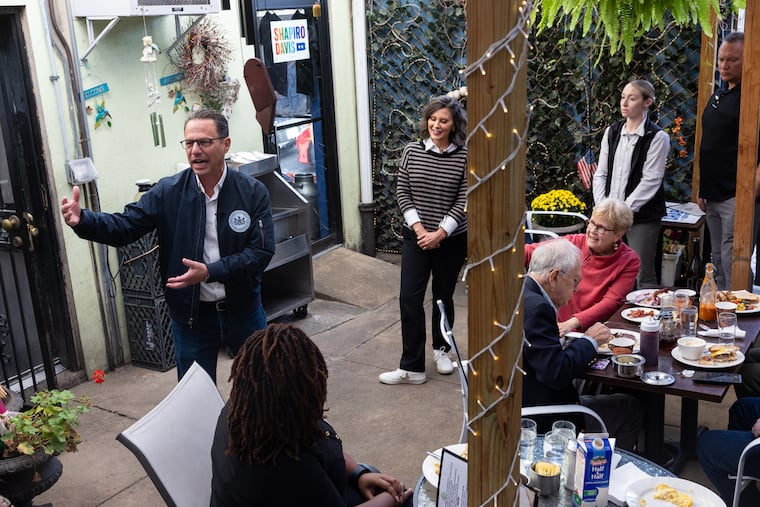
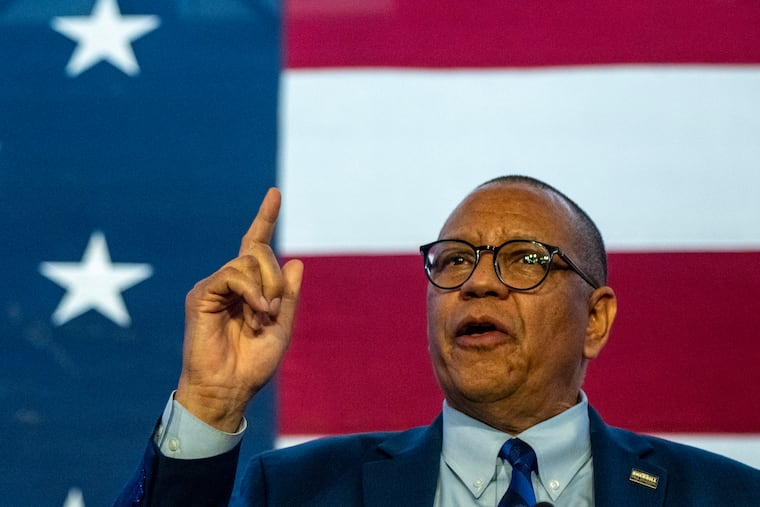
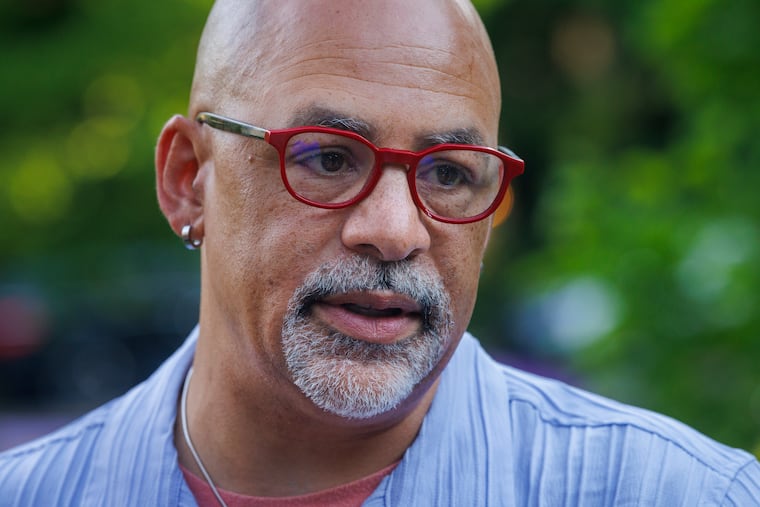
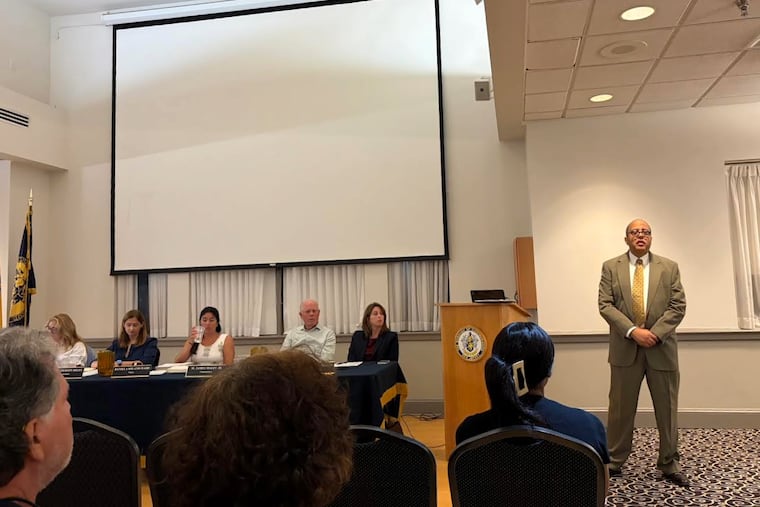
Sharif Street and Chris Rabb are asking Philly voters to send them to Washington. As state lawmakers, they’ve had very different styles.
The 3rd Congressional District contenders both became state lawmakers in 2017 and have made their records central to their campaigns.
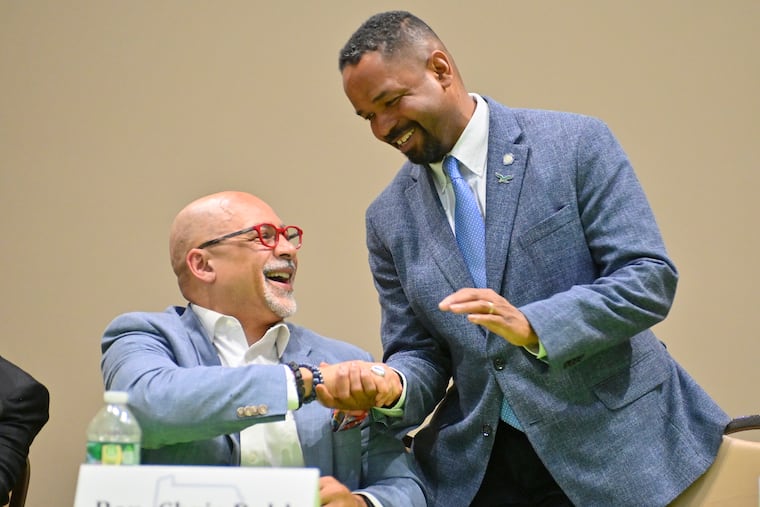
Nearly a decade ago, Chris Rabb and Sharif Street walked into the Pennsylvania Capitol for the first time as elected officials and quickly staked their ground in different ways.
Street, a lawyer and scion of a powerful political family, went to work introducing bills to make technical changes in areas like election and vandalism laws, to decriminalize the possession of small amounts of cannabis, and to end life sentences without the possibility of parole.
Rabb, who had taken on a local Democratic machine to get to Harrisburg in the first place, put out feelers for legislation that would make lawmakers pay a $100,000 fine if they are convicted of a crime, increase taxes on wealthier Pennsylvanians, and limit police assisting U.S. Immigration and Customs Enforcement at the start of President Donald Trump’s first term.
The two Philadelphia Democrats would both go on to have more losses than wins. In a closely divided General Assembly where Republicans have kept unilateral control for six of the last 10 years, relatively few Democratic-led bills cross the finish line.
But as Street and Rabb face off in Tuesday’s tightly contested race to represent the 3rd Congressional District, the candidates’ legislative records — and their distinct governing styles — have become central to their pitches as they pursue one of the most Democratic-leaning seats in the country.
A third front-runner, physician Ala Stanford, has not served in elected office but is endorsed by outgoing U.S. Rep. Dwight Evans and other local members of Congress.
Rabb, a self-proclaimed “radical” and “rabble-rouser,” has emphasized ideas he has helped advance in Harrisburg, like a 2020 police accountability law and a proposal to abolish the death penalty that passed the Pennsylvania House but not the Senate.
“I believe in pragmatic progressivism,” Rabb said during an interview with The Inquirer Editorial Board last month.
Street has underscored a need for finding consensus — like in his long, unrealized effort to legalize recreational marijuana — and constituent services. While Rabb makes inspiring speeches and is “a little over the top sometimes,” Street said he is focused on pressing problems like healthcare costs, food insecurity, and housing.
“I even get excited listening to some of [Rabb’s] speeches,” Street said. “But I actually can offer real legislative solutions to real problems that really exist.”
Marc Stier, a longtime advocate for progressive policies who has worked with and admired both candidates, said Street and Rabb have personified different types of legislators in Harrisburg.
Street pores over the details. He gets in the weeds of legislation while trying to create coalitions across parties, said Stier, who served as director of the progressive think tank Pennsylvania Policy Center until earlier this year.
“Sometimes, that’s a good thing,” Stier said. “Sometimes, with regard to the redistricting bill he was involved in, it would have been a bad thing if they moved forward with it.”
Street has distanced himself from the redistricting proposal, a draft of a new congressional map that he worked on with a top Republican in 2021. It was never formally introduced, but Street received criticism from fellow Democrats for floating a map that would have drawn U.S. Rep. Brendan Boyle, a Philadelphia Democrat, into the same district as Republican U.S. Rep. Brian Fitzpatrick, of Bucks County.
» READ MORE: Sharif Street’s record leading Pennsylvania Democrats faces renewed scrutiny in Philly congressional race
Rabb, on the other hand, has looked to “play big ball, not small ball” — tackling major issues in ways that can eventually move the needle, Stier said.
“He’s been doing the work that is absolutely critical to moving legislation forward — not this year, not next year, but in the future. And that’s just a different role,” Stier said. “Who one should support in this election depends on which role you think is more important at this stage in our political life.”
A difference in style and focus
None of the dozens of bills Rabb and Street have authored and formally introduced since they took office in 2017 have been signed into law with their names on them, according to an Inquirer review of legislative archives.
They have each claimed a wide variety of successes anyway, particularly with ideas they wrote or shaped that made their way into other laws.
Rabb often leads that conversation with the police misconduct database he introduced in 2018. Aimed to prevent officers with problematic backgrounds from being hired without their new department knowing their record, Rabb’s idea was folded into another bill that became law in the wake of George Floyd’s killing by Minneapolis police in 2020.
For Street, it starts with Pennie, the state-level public insurance marketplace that replaced the nationwide option created by the Affordable Care Act. Street has said repeatedly that as the ranking Democrat on the Banking and Insurance Committee, he led the effort to write and pass the bill that lowered healthcare costs for hundreds of thousands of Pennsylvanians. The version that was signed by then-Gov. Tom Wolf, however, was a Republican-sponsored House bill that gained relatively quick consensus and passed both chambers unanimously.
Stier, who said he briefly considered a public campaign to support the bill, described it as not a very “heavy legislative lift.”
“That was mostly an administrative effort, and it really wasn’t controversial,” said Stier, who is supporting Rabb’s campaign but said he believes Street would also be an effective member of Congress.
State Sen. Vincent Hughes, a Philadelphia Democrat who is sometimes aligned with Stier’s former group and has endorsed Street, dismissed critics who have minimized Street’s role in the healthcare law. He said he watched as Street took the lead among Senate Democrats to meet with cabinet secretaries, Republicans, and Democrats to negotiate the bill.
“It’d just be a bold-faced lie if you said that he didn’t do the work,” Hughes said. “That’s kind of like his thing. To put in that kind of a grind to try to figure out various niches, various ways to do that kind of work from a policy perspective.”
Street, in an interview, said he looks to strike deals and meet Republican colleagues where they are, including by traveling thousands of miles across the state to visit them in their districts.
Hughes called him a “relentless” and solutions-oriented lawmaker. With Hughes’ role as the top Democrat on the Appropriations Committee, the pair have worked together closely to bring funding into the city — including for food services, housing, and a recent announcement of $23 million in new violence intervention and prevention grants.
“You just can’t raise hell. Not when you’re elected,” Hughes said, describing Street as “solutionary” rather than “revolutionary.”
“That is the mistake of many when they get elected,” Hughes said. “You raise hell, that’s fine. But you also have to spend even more time figuring out how to get to some solutions, how to get some results, how to get some help to the people that you represent into the broader community.”
Rabb and his supporters have stressed a more boundary-pushing approach.
“From climate change to fighting mass incarceration, he was always trying to model the policies that might seem initially like lonely fights, but then broadly became common sense,” said State Sen. Nikil Saval, a Philadelphia Democrat who credited Rabb for being an early champion in several policy areas.
Abolishing the death penalty. Mandating a transition to 100% renewable energy generation production by 2050. Statewide prohibitions on assisting federal immigration officers. Rabb has been an outspoken advocate and drafted legislation on each, Saval noted.
Rabb has said he is proud that some of his bills have not seen the light of day but might become reality in the future.
Multiple people who have served with Rabb and who spoke on the condition of anonymity said his decisions at times not to work with other mainstream Democrats have hurt his ability to build more relationships in the Capitol.
Rabb and his allies have said he has made those relationships when he needs to, and when they align with his values. Asked during a forum in late April why his colleagues have not elevated him to a leadership position after almost five terms, Rabb claimed he “turned it down” because he did not want to have to collect campaign donations from corporate donors.
Saval said Rabb had developed “distinctive ways of operating” as a lawmaker. He knows how to build social movements and has a belief in “working-class people’s power” in ways that other legislators in the state Capitol do not, Saval said. He also recognizes the importance of maintaining key relationships to make progress, Saval said.
“He was a mentor to me,” said Saval, who was elected for the first time four years after Rabb. “He helped me kind of understand the landscape of, for example, criminal justice reform, and where Republican legislators stood on certain issues.”
From cannabis to criminal justice
Though Rabb and Street are Democrats who ultimately agree on almost every policy, their lists of proposed bills offer a glimpse into the differences in the policy areas they have gravitated toward.
Street has been the face of his chamber’s push to legalize recreational marijuana, working with State Sen. Dan Laughlin (R., Erie) while routinely hitting a wall against the Senate’s Republican leadership.
Rabb has thrown his weight behind a tax reform plan that would lower the state’s flat 3.07% income tax while increasing taxes on gains through dividends, estates, trusts, gambling, and more. He has also floated a plan to provide financial reparations to the descendants of enslaved people.
Both have focused on criminal justice reform. Rabb’s bill to explicitly ban law enforcement officers from consensual sex with people they have arrested became part of another law in 2020. Street’s bill to prohibit officers from using chokeholds unanimously passed the Pennsylvania Senate in 2020 but stalled in the House.
They have also at times claimed credit for getting the same bills over the finish line, including the police misconduct database that Rabb describes as a signature achievement.
The database launched in 2021 with both Rabb and Street smiling next to each other during a photo op. Officials touted the system’s ability to contain data from 1,300 agencies and up to 35,000 officers, though Rabb and others later acknowledged loopholes made it less effective than originally intended.
Street told The Inquirer Editorial Board that he was “proud that my colleague Rep. Rabb supported that in the House, but it was my legislation to help get that done.”
Bringing it up again during the a debate hosted by WHYY in April, Rabb responded by recounting how — after Floyd’s killing — he and other progressives briefly shut down the House floor to demand action and then struck a deal with the Republican speaker.
“We’re going to have to disagree on this,” Rabb told Street.

- Meet the Democrats vying to replace Dwight Evans in Congress
-
Ala Stanford is banking on a healthcare message to break through crowded Philly primary for Congress
-
Big money is flooding into the Philly congressional race as all three front-runners hit the airwaves
-
How two Philly congressional candidates are quietly guiding super PACs in plain sight