How two Philly congressional candidates are quietly guiding super PACs in plain sight
State Sen. Sharif Street and State Rep. Chris Rabb are using a tactic called "redboxing" on their campaign sites, which convey messaging strategies and advertising solicitations aimed at super PACs.
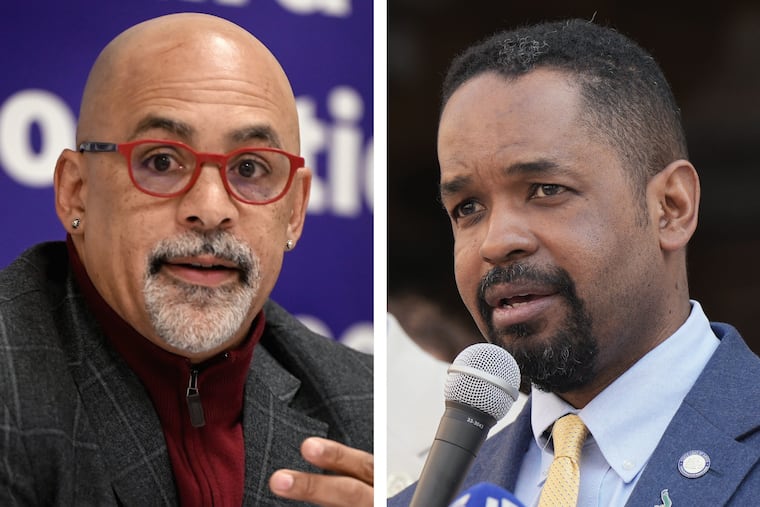
The Democrats running in Philadelphia’s fiercely contested race for Congress have spent months drawing up detailed strategies to persuade voters in the final weeks before the open May primary election. But two of the front-runners are not keeping those plans close to the vest.
Instead, they posted them on their websites.
The detailed memos featured on campaign sites for State Sen. Sharif Street and State Rep. Chris Rabb — which include messaging priorities, ideas for attacks ads, and voter information down to the ward level — are not for voters. Rather, they are directives to outside groups that federal law bars campaigns from coordinating with directly.
Street and Rabb, two of the top Democrats running to represent Pennsylvania’s 3rd Congressional District, are each using an increasingly common campaign tactic called “redboxing.” Campaigns fill an obscure page on their website with messaging strategies and advertising solicitations aimed at political action committees that support their candidate. The directives are often framed in red-bordered boxes.
The memos are seen as a legal loophole for candidates to coordinate with super PACs, also known as independent expenditure groups, which can raise and spend unlimited amounts of money and are often funded by wealthy donors and special interests.
Candidates, on the other hand, must abide by strict contribution limits and can raise comparatively less money. Street and Rabb’s campaigns each said that redboxing is a necessary tactic to remain competitive and one outcome of a flawed political system.
Super PACs could shape the final weeks of the race ahead of the May 19 election.
Ala Stanford, a physician, is being backed by a Washington-based super PAC that supports “pro-science” candidates and has spent more than $2 million on advertising in the mail, online, and on television to boost her bid. Stanford’s campaign website does not have a detailed red box, but it does have video footage that her supporting super PAC used in at least one television commercial.
» READ MORE: Ala Stanford gets $1.4M boost from national super PAC in her bid to replace Dwight Evans in Congress
Neither Street nor Rabb have seen an infusion of outside spending in their favor. However, both clearly expect super PAC support — in Street’s case, from a coalition of building trades unions, and in Rabb’s, from national progressive organizations.
“Not all independent expenditures are the same,” said Alon Gur, Rabb’s campaign manager. He added that Rabb has “never taken a dime of corporate PAC money,” and wants Citizens United — the 2010 Supreme Court decision that ushered in the modern super PAC era — “overturned immediately.”
Redboxing is an especially notable tactic in Philadelphia, one of the only major jurisdictions in the nation where municipal candidates are barred from doing so. The city’s Board of Ethics in 2022 banned the practice ahead of the highly competitive 2023 mayoral race.
But congressional races are overseen by federal authorities. The Federal Election Commission interprets its own regulations to say that, essentially, campaigns may state their strategic needs to super PACs if they do so in full public view.
For example, Rabb — who has made decrying the role of money in politics a core part of his political identity — has a red box on his website that steers outside groups toward specific parts of his legislative background and calls for attacks on Stanford.
» READ MORE: Ala Stanford and Chris Rabb are trading accusations as AIPAC becomes a flash point in Philly’s U.S. House race
The box breaks down messaging strategies by time frame, suggesting, for example, what message voters need to hear about Rabb and Stanford in the five weeks before Election Day.
It says the campaign wants to mobilize voters under age 45, as well as residents who live in Rabb’s Northwest Philly-based state House district.
“These voters respond well to our broad messaging, Rabb’s progressive policy platform, and endorsements in addition to contrast around Israel/Palestine,” reads the guidance.
The red box instructions on Street’s website are even more detailed.
One target audience is described as Black voters in 19 specific wards who voted at least once in a general election in the last four years but did not vote in a primary election over that time.
Another says that advertising in the mail and on television should target “Black women over age 35 in West, Northwest, and South Philadelphia” while digital ads should be geared toward “white, Asian, and Latino voters under age 60 in Northwest, Center City, and South Philadelphia.”
Shanna Ports, senior legal counsel for campaign finance at the nonpartisan Campaign Legal Center, said Street’s website has “the most granular targeting information I’ve ever seen in a red box.”
Ports said redboxing is just one coordination tactic that the FEC has allowed through a lack of enforcement. She said the increasingly brazen use of red boxes on candidate websites creates a political environment in which monied interests wield more sway over elected officials.
“When candidates can tell super PACs exactly how to spend their money, it makes them value that super PAC spending even more,” she said, “and in turn it makes them feel more beholden to the large special interest donors that fund super PACs.”
Anthony Campisi, a spokesperson for Street, said the campaign is “committed to following the law.”
He said it’s “unfortunate” that super PACs — some of which are called “dark money” groups because they obscure the true identities of their funders — play a prominent role in modern politics.
“We’re forced to compete in the world that exists rather than the world that we wish exists,” Campisi said. “As a result, we’re going to take advantage of all of the latest strategies in order to win.”

- Meet the Democrats vying to replace Dwight Evans in Congress
-
Ala Stanford is banking on a healthcare message to break through crowded Philly primary for Congress
-
Big money is flooding into the Philly congressional race as all three front-runners hit the airwaves
-
How two Philly congressional candidates are quietly guiding super PACs in plain sight