Ala Stanford is banking on a healthcare message to break through crowded Philly primary for Congress
Dr. Ala Stanford is accentuating her lack of political experience and running as the outsider candidate in a field of political veterans vying to replace Democratic U.S. Rep. Dwight Evans in Congress.
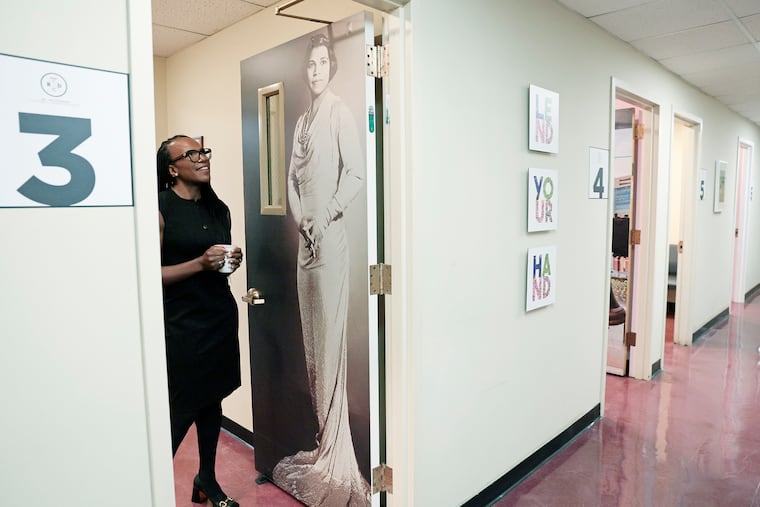
At times, Ala Stanford feels like she doesn’t quite fit in.
She is a pediatric surgeon — albeit very well-known — who is running for political office for the first time, trying to win a seat in Congress that for decades has been held by a seasoned Philadelphia politician.
At campaign events, when the top Democrats in the congressional race are chitchatting among themselves, Stanford has found herself on the margins. Often, she felt more comfortable talking medical procedures with Dave Oxman, the other physician in the race, than whatever the sitting state representatives have going on in Harrisburg.
Oxman dropped out Wednesday and endorsed Stanford, making her the hands-down most prominent outsider in a race that is stacked with political veterans.
To amass support ahead of the crowded May 19 primary election — the likely deciding contest in one of the nation’s bluest congressional districts — Stanford will have to chart a path that beats both the Democratic establishment and the progressive left, which have chosen other candidates in the wide-open race.
Stanford, 55, knows her lack of political experience makes her stand out, and she is accentuating it on the campaign trail. She is highlighting her career as a physician, and she says she will fix a healthcare system her opponents failed to address in their years as public officials. Her candidacy comes as an increasing number of medical professionals are running for office across the country, and as thousands of Pennsylvanians have dropped their healthcare coverage due to rising costs.
She has kept pace with three sitting lawmakers who are also running for the seat, in part by lending her campaign $250,000 of her own money.
Stanford also has a cadre of healthcare workers uplifting her. She has won endorsements from prominent doctors, as well as a national super PAC, 314 Action, which backs candidates with backgrounds in science and has poured $1.5 million into a pro-Stanford campaign.
» READ MORE: Ala Stanford gets $1.4M boost from national super PAC in her bid to replace Dwight Evans in Congress
The group so far has funded five weeks of television commercials reminding voters that Stanford founded the Black Doctors COVID-19 Consortium. In the throes of the pandemic, she set up mobile testing sites in majority-Black communities and ran vaccination clinics to inoculate thousands of Philadelphians, a grassroots effort to fill gaps left by government-funded programs.
Today, she runs a primary care health clinic in North Philadelphia that bears her name.
It is a compelling story that has been told many times — across national media, on podcasts, and in Stanford’s own memoir.
What has not been told is why it means she should represent the 3rd Congressional District, which covers much of Philadelphia, over her opponents, who have spent years in politics.
“People get so comfortable doing things the same way, the same way, the same way,” she said in a recent interview at her health clinic. “And no one likes change. But the city needs this. The city needs some change.”
Other candidates say Stanford does not have a monopoly on talking about healthcare. State Sen. Sharif Street, another front-runner in the race, has touted that he and other government officials helped secure funding for Stanford’s pandemic operation.
“During COVID, he was very proud of his work,” Street spokesperson Anthony Campisi said, “to ensure that Dr. Stanford’s vaccination efforts received the support they needed so that we could get vaccines into arms quickly.”
Stanford’s opponents also clearly know that her status as a physician may be an asset.
She submitted paperwork to appear on the ballot as “Dr. Ala Stanford.” But on Tuesday, a member of the Democratic City Committee — which endorsed Street — filed a petition in state court, saying Stanford’s name should appear without the “Dr.” in front of it.
In the coming days, a judge will decide.
Leaning on healthcare as a core issue
Stanford does not fit neatly onto the ideological spectrum.
Of course, she is not conservative. She does not call President Donald Trump by his name — he’s “47″ — and she uses words like tyranny and running amok to describe the current White House.
But unlike some of her opponents, she is not of the Philadelphia Democratic establishment. She said she feels like the city’s long-entrenched party apparatus had always planned to endorse Street, the former head of the state party and the son of a Philadelphia mayor.
Stanford is also not of the populist left. She believes Palestinians “deserve to have safety and freedom” but thinks it is inflammatory when her progressive opponent, State Rep. Chris Rabb, calls Israel’s war in Gaza a “genocide.”
“I know when you use the G-word how hurtful it is to a group of people,” she said. “It’s like someone saying the N-word around me. I don’t want to hear that. And every time you shout that from the rooftops, how many people are you hurting?”
What she does believe is that government systems have failed underserved communities, and that most domestic issues can be traced back to inequities in healthcare — points she has consistently emphasized in her campaign.
She has hammered Republicans for not extending pandemic-era subsidies that ensured people on Affordable Care Act health plans did not pay more than 8.5% of their income for care. She has advocated for universal healthcare. And she has harshly criticized Health and Human Services Secretary Robert F. Kennedy Jr., who has long been skeptical of vaccines.
“In this country, wealth is linked to homeownership, homeownership is linked to education, education is linked to health outcomes, and health outcomes are all exacerbated by racial injustice,” Stanford said during a recent candidates forum. “So when you talk about one, you talk about all.”
» READ MORE: How Affordable Care Act premiums are estimated to rise across the region
Stanford is careful to say that her focus on healthcare does not mean she cannot discuss housing, immigration, or the war in Iran.
But it is clear that she feels most comfortable talking about what she knows best. Her supporters say that is an asset in the 3rd Congressional District, which has a disproportionately high number of people who rely on public healthcare systems.
More than one-third of the district’s residents, or more than 284,000 people, were on Medicaid as of December, according to the Pennsylvania Department of Human Services. Among Pennsylvania congressional districts, that is the second-highest proportion of residents on Medicaid. (The highest is the 2nd Congressional District, which also includes parts of Philadelphia.)
The state estimates that more than 30,000 people in the district could lose their healthcare as a result of changes to Medicaid eligibility and coverage under Trump’s One Big Beautiful Bill Act.
There were also more than 80,000 people in the district who last year had health coverage under the Affordable Care Act, either through expanded Medicaid eligibility or a plan purchased through the marketplace.
That number is also likely lower now since ACA subsidies expired this year and premiums rose. Statewide, one in five people who bought plans last year from Pennsylvania’s marketplace, Pennie, opted out for 2026.
Stanford’s supporters think Philadelphia voters will trust a doctor to ensure affordable access to healthcare. They point to a survey released this month by the Annenberg Policy Center at the University of Pennsylvania that found 86% of respondents said their primary healthcare provider is trustworthy.
Erik Polyak, the executive director of 314 Action, said Stanford’s background differentiates her in a Democratic primary in which most candidates align on key issues.
“Voters want healthcare decisions made by people who understand patients and the science,” he said, “and not politicians chasing headlines.”
Oxman, Stanford’s now-former opponent, said physicians running for office can help rebuild a Democratic Party that has “lost the trust of so many people.”
“So many people see us as not centered on their needs, particularly their economic needs,” he said. “If the Democrats are going to build a party that has a chance of winning in Center City Philadelphia and in central Pennsylvania, it’s got to regain the trust of the voters.”
New to politics, but not government
It was the spring of 2020, and the bills were piling up.
Stanford, who was born in Germantown, had given up her well-paying day job as a surgeon to work full-time with the Black Doctors Consortium. She ran COVID-19 testing clinics in Philly parking lots and churches, and amassed about $200,000 in bills, saying she couldn’t “let one person lose their life for a test that costs $100.”
That was the beginning of her pandemic experience with the government.
A lot of it was begging. As Stanford tells it, she peppered government officials with emails, reporting how many people she and her volunteers had tested that day and asking for help securing funding.
U.S. Rep. Dwight Evans was immediately responsive. He connected Stanford with the White House, other members of Congress, and top insurance companies. And he publicly called on then-Gov. Tom Wolf and then-Mayor Jim Kenney to allocate funding to Stanford’s organization, citing the group’s outreach to predominantly Black communities and its work to address distrust of medical institutions.
The money came in several months later. It was finally enough for Stanford to pay for testing, compensate her staff, and prepare to vaccinate thousands of Philadelphians.
» READ MORE: Ala Stanford, surgeon who helped lead Philly’s COVID response, is running for Congress with Dwight Evans’ backing
Fast-forward five years, and Evans has endorsed Stanford to replace him in Congress as he retires after decades of public service. His backing has been invaluable to Stanford, and it surprised some political observers who expected him to endorse one of the politicians he had served alongside.
Stanford said Evans’ support has not convinced some Democratic voters. Some tell her they plan to vote for Street, citing his family name, or they say that “it’s his turn now.”
“What about if he is not what’s best for the people?” Stanford said. “Doesn’t that factor in?”
She tells voters that, despite being new to the campaign trail, she is not new to government. She worked as a regional director for the Department of Health and Human Services under former President Joe Biden, who appointed her to the role. And she leads medical services at the Riverview Wellness Village, the city-owned drug recovery center opened last year by Mayor Cherelle L. Parker’s administration.
Still, Stanford very much sees herself as a doctor.
She often works out of a corner office in the North Philadelphia health center, and she still is alerted when the temperature of the vaccine refrigerator dips a degree too low. She has, on more than one occasion, tended to someone experiencing a medical emergency while she was campaigning.
She knows that overseeing day-to-day operations at the health clinic will not be possible if she is in Congress. A succession plan is in place.
“It’s just about, how can I have more significance at a larger scale? Congress is definitely a way to do it, but it might be somewhere else,” Stanford said. “That is, if I don’t win. But I want to win. I should win.”

- Meet the Democrats vying to replace Dwight Evans in Congress
-
Ala Stanford is banking on a healthcare message to break through crowded Philly primary for Congress
-
Big money is flooding into the Philly congressional race as all three front-runners hit the airwaves
-
How two Philly congressional candidates are quietly guiding super PACs in plain sight