Sharif Street’s record leading Pennsylvania Democrats faces renewed scrutiny in Philly congressional race
Under Street's leadership, Democrats saw the party's voter registration advantage erode and took major electoral losses.
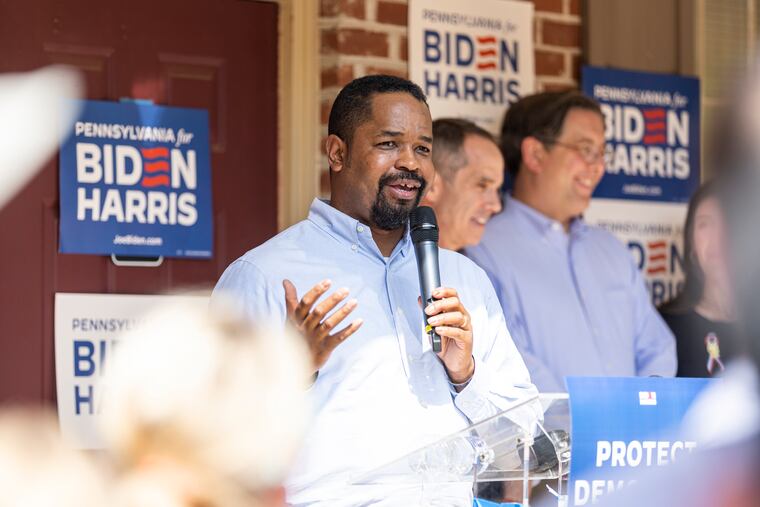
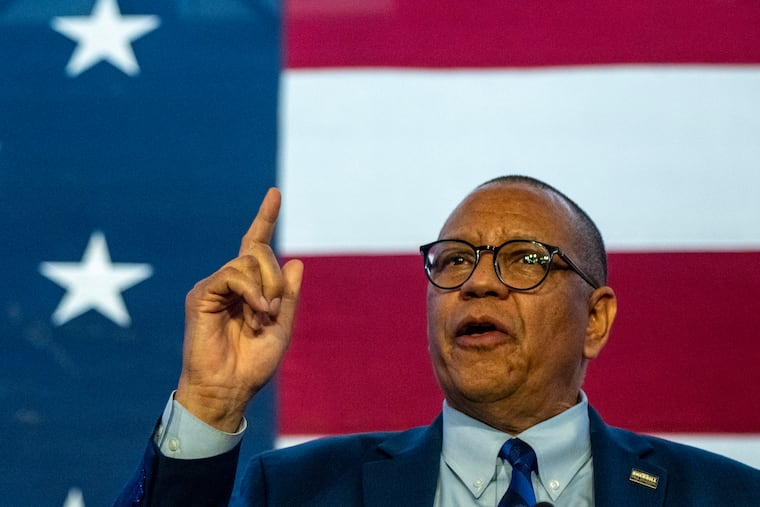
When State Sen. Sharif Street was elected to be the first Black chair of the Pennsylvania Democratic Party in 2022, he inherited a fractured coalition led by some powerful people who had outwardly opposed his ascent to the role.
At the time, Gov. Josh Shapiro, who backed another candidate for the post, said publicly that an elected official like Street should not run the party because they could blur the lines between what’s best for the organization and their personal ambition.
Now, after Street spent three years leading the state party before stepping down amid a run for Congress, some still question his time at the helm.
During his tenure from June 2022 to August 2025, voter registration among Democrats in the state dropped precipitously, fundraising stagnated, and Pennsylvania Democrats had a disastrous 2024 that saw all five of the party’s statewide nominees lose. Some insiders blamed organizational gaps and said state party leaders failed to bring the coalition together.
Street, 52, the scion of an established political family from North Philadelphia who is now locked in a tightly contested race for a seat in Congress, was chair of the state Democratic Party during a volatile period for the party nationally. He absorbed the blame for failures that were not unique to Pennsylvania, such as the erosion of registered Democrats and then-Vice President Kamala Harris’ loss to President Donald Trump in the state.
As the race for the 3rd Congressional District seat enters its final days ahead of the May 19 primary election, Street’s opponents have made his leadership of the party an issue.
State Rep. Chris Rabb, a five-term lawmaker and one of the other top candidates, says on his website that “Street was too busy looking out for himself to run the state Democratic Party, which saw ‘bruising losses’ under his leadership and resulted in massive Republican gains at all levels of the ballot.”
But Street and his allies say that the 2024 red wave in Pennsylvania was not the fault of the state party or its chair.
“When we win, it’s never the chairman’s glory. When we lose, it’s always the chairman’s fault. Both are bulls—,” said Valerie Kean-Staab, a longtime state committee member from Crawford County.
During a recent debate, Street said that national Democrats in 2024 were too focused on “esoteric values” instead of kitchen-table issues like the economy and public safety. He pointed out that during that election, Pennsylvania Democrats maintained their slight edge in the state House and did not lose ground in the state Senate.
Anthony Campisi, a spokesperson for Street’s campaign, said that while Street was a leader of the state party — including his time serving as vice chair before he ascended to chair — Democrats flipped the state House, improved their share in the state Senate, and won competitive races for seats in Congress.
As for 2024, Campisi said, “because of Sharif’s hard work and the message of Democrats at the state level, we fared better than other states did during a very difficult year.”
» READ MORE: Trump didn’t just win Pa. He carried down-ballot Republicans with him, and ushered a red wave.
However, Street’s critics point to plenty of failures that year specific to Pennsylvania’s Democratic Party, including losing a U.S. senator, three row offices, and two members of Congress.
Their frustrations with his leadership were not a secret — and they were made public long before the 2024 election, aired in Politico a year into Street’s tenure.
“He was asleep at the switch while the Democratic registration advantage over Republicans shrunk radically,” said J.J. Balaban, a Democratic strategist based in Philadelphia. “It would be a record of failing upwards if he gets elected to Congress.”
The same critics say their initial concerns about Street’s dueling ambitions were validated when he announced he was running for Congress last year and said he intended to continue on as leader of the state party. He did not step down until August, after Shapiro and Democratic National Committee chair Ken Martin took the extraordinary step of publicly calling on him to do so.
The new chair is Eugene DePasquale, a close ally of Shapiro who ran for attorney general in 2024 and lost.
In a recent interview on The Downballot podcast, DePasquale said that when he took control in September, the party was so cash-strapped that it could not make payroll just two months away from a high-stakes Supreme Court retention race.
“So that was my first sort of 10 minutes as state party chair,” DePasquale said. “We did a lot of work, obviously, to turn that around.”
Balancing the state party with personal ambition
Street’s closely watched run to replace retiring U.S. Rep. Dwight Evans in Congress has laid bare the loyalties — and limits — of his political alliances.
He has been endorsed by the Democratic City Committee and virtually every establishment-aligned Democrat in the city, including Mayor Cherelle L. Parker. The powerful building trades unions are backing him, as is the teachers union.
But Street has not won backing from a single sitting member of Congress in the area. In fact, three of them — including Evans, who held the seat for 10 years — are backing one of his opponents: first-time candidate Ala Stanford, a physician.
» READ MORE: Three members of Congress are backing Ala Stanford in the Philly primary, exposing a divide among Democrats
Shapiro has not weighed in. Neither has U.S. Rep. Brendan Boyle, who represents the eastern half of the city and hails from Northeast Philly.
It wasn’t long ago that Boyle and Street were openly warring. Amid a 2021 redistricting battle, The Inquirer reported that Street — then vice chair of the party — worked with a top Republican to draft a new congressional map that would have drawn Boyle into the same district as Republican U.S. Rep. Brian Fitzpatrick, who represents a Bucks County swing district.
The map would have created an incumbent-free district in Philadelphia where Street could have run. Boyle and other critics said the map was slanted toward Republicans.
But it was never formally introduced, and Street now distances himself from it.
“He doesn’t take responsibility for that map,” Campisi said. “That was one of dozens of maps that were going back and forth between Democratic and Republican staffs on the committee and with leadership.”
Campisi said Street was in favor of a different map, backed by Senate Democrats, that would have given the party an advantage in 10 out of the state’s 17 congressional districts and expanded the number of majority-Black districts.
Still, the draft map was a major reason that Street faced outward opposition when he ran for party chair in 2022. And it’s one peril, some critics say, of having an elected official with their own political aspirations serve as leader of the party.
Elected officials do, at times, lead political parties. The head of the Pennsylvania GOP is Greg Rothman, a sitting state senator. Nationally, most state party chairs are full-time political operatives, former elected officials, or hold local roles, such as serving on a county commission.
“In an ideal world,” said J.J. Abbott, a Democratic strategist, “you have someone who can really focus 100% of their attention and interest on what’s best for the state party.”
‘Raising money has become a bigger challenge’
Several Democratic consultants, who spoke about Street’s stewardship of the party on the condition of anonymity to preserve relationships, said that having an elected official lead the state party can negatively impact fundraising. When the same person is raising money both for the party and their own campaign apparatus, donors may pick one or the other.
The state party faced some notable financial problems under Street’s leadership, including a round of layoffs in 2023, and, at times, it had little cash in reserves. When he stepped down last year, the party’s federal political action committee had less than $24,000 on hand, according to campaign finance records.
However, it is common for state parties to have spikes and dips in the amount of money in the bank. Cash from national committees typically flows to state parties in major election years, and that money is to be spent in the cycle for which it is allocated. In the years in between major elections, parties typically see less cash flowing from national groups.
Over time, there has also been a nationwide shift in how political campaigns are financed. The ecosystem has become less centralized around state parties as independent expenditure groups, also known as “super PACs,” have proliferated.
Joe Foster, a Street supporter and a member of the state committee from Montgomery County, said that trend has made fundraising more complicated.
That is especially true in Pennsylvania, he said, where statewide candidates do not have contribution limits. Big donors may choose to set up a super PAC instead of routing money through the state party.
“Raising money,” Foster said, “has become a bigger challenge for virtually everybody.”
Throughout the congressional campaign cycle, Street has raised more money than both of his top rivals.
Overseeing voter registration losses
When Street took over as party chair, Democrats were already losing ground in voter registration.
For 30 years, there were more registered Democrats than Republicans in Pennsylvania — in 2016, Democrats had about 916,000 more registered voters. But that advantage eroded in the Trump era, in part because white working-class voters fled the party in droves.
The losses accelerated during Street’s tenure and while former President Joe Biden was in the White House. In 2022, when Street took the helm, Pennsylvania Democrats held a registration advantage of about 550,000 voters, according to state data. By 2025 when he stepped down, that number was cut to about 178,000.
A voter’s party registration is not a guarantee of how they will vote in a given election, but it is a useful indicator. In Pennsylvania, third-party and unaffiliated voters have become the fastest-growing segment.
Campisi said Street acknowledges that the number of registered Democrats declined during his time leading the party. He pointed out that a contingent of voters who registered with third parties or are now unaffiliated did so because they are to the left of the average Democrat and still vote for the party’s nominees over Republicans.
Street’s priority, Campisi said, was “winning over new voters to register them as Democrats as opposed to spending a lot of time with voters because they were to the left of the party.”
» READ MORE: Republicans were on track to lead Pa. voter registrations for the first time in 30 years
Democratic voter registration sank in several other swing states over the same time period, including in North Carolina, Arizona, and Nevada. But Pennsylvania’s losses, which made up about 4% of the overall electorate, were the steepest among those states.
Shortly after DePasquale took over, the trend line shifted in Pennsylvania, and Democrats began outperforming Republicans in new voter registrations. Party officials said in March that the shift may have been the result of new investments by the state party coupled with backlash to Trump.
DePasquale, who did not respond to a request for comment, has said previously that party leaders for years did not prioritize partisan voter registration. Instead, the party partnered with outside nonprofit groups that aim to register voters but must be nonpartisan.
He said in September that he would end that practice and instead invest in efforts to register Democrats specifically.
Kean-Staab said that while DePasquale is prioritizing registering new Democrats, Street was more focused on get-out-the-vote efforts and engaging disenchanted members of the party.
“Each chair has a difference of what they’re building,“ she said. ”Neither one is right, neither one is wrong."

- Meet the Democrats vying to replace Dwight Evans in Congress
-
Ala Stanford is banking on a healthcare message to break through crowded Philly primary for Congress
-
Big money is flooding into the Philly congressional race as all three front-runners hit the airwaves
-
How two Philly congressional candidates are quietly guiding super PACs in plain sight