Mayor Cherelle Parker’s administration inches closer to issuing city bonds for her H.O.M.E. initiative | City Council roundup
Council on Thursday formally introduced the H.O.M.E. budget resolution, a key checkpoint that had been holding up Parker's plans to issue $400 million in bonds this fall.

The latest version of the initial spending plan for Mayor Cherelle L. Parker’s housing initiative includes $5 million more for the construction of new units and $8 million less for the preservation of existing homes.
Those changes and numerous other tweaks to Parker’s plans for the first year of her Housing Opportunities Made Easy, or H.O.M.E., initiative were hashed out between Council President Kenyatta Johnson’s office and the mayor’s team over the last three months.
Johnson on Thursday formally introduced the H.O.M.E. budget resolution, a key legislative checkpoint that had been holding up the administration’s plans to issue $400 million in bonds for the initiative this fall.
”The Parker administration is pleased that our HOME program statement has been introduced in City Council today and referred to committee,” Angela Brooks, Parker’s chief housing and urban development officer, said in a statement. “We look forward to continuing to engage with Council under Council President Johnson’s leadership on the HOME project statement and upcoming hearing.”
Council approved almost all the legislation related to the H.O.M.E. program in June, including a bill that authorizes the administration to issue $800 million in bonds to fund numerous projects aimed at building or preserving housing units. But Council inserted a provision into that bill requiring the administration to get lawmakers’ approval of the city’s plans for spending bond proceeds in the coming year.
Parker sent a draft of the budget resolution in July, but Johnson did not formally introduce it until Thursday. The delay may mean that the city could have to wait until 2026 to issue the first round of bonds. Parker initially planned to sell the initial $400 million tranche this fall.
“We can continue to go through the process of getting some issues and concerns addressed from the administration,” Johnson told reporters after Thursday’s Council meeting. “We are making progress. That’s what led to the introduction — hence, today."
What was the meeting’s highlight?
H.O.M.E. renovation: The changes in the latest version of the first-year H.O.M.E. budget increase funding for housing production from $19.4 million to $24.3 million, and reduce funding for housing preservation from $37.5 million to $29.6 million.
The latest proposal also increases the budget for Philly First Home, a program that gives eligible Philadelphians $10,000 for a down payment, from $8.7 million to $10.7 million. And it bumps funding for services that help resolve tangled titles, or legal complications over homeownership, from $1.3 million to $2.2 million.
Johnson said there could be further changes. The resolution is tentatively planned for a committee hearing on Nov. 12, he said.
“We’re still going the process, and so it’s not a done deal as of yet,” Johnson said.
Councilmember Jamie Gauthier, who chairs the Housing Committee, introduced the resolution on Johnson’s behalf.
Gauthier has enthusiastically supported Parker’s housing plan. But she has also pushed the administration to direct more money toward programs that serve Philadelphians on the lower end of the income scale. Parker, meanwhile, has sought to expand income eligibility requirements, in some cases, to more middle-class residents.
So far, no changes have been made to lower eligibility requirements for any of the programs, or to otherwise target more of the spending to low-income households.
Gauthier said in a statement Thursday she is hopeful “further tweaks” will ensure “that the HOME Plan does not disadvantage the 200,000+ Philadelphia households on the brink of homelessness.”
“If we do not help families who are one rent increase or unexpected maintenance cost away from homelessness stay in their homes today, taxpayers will foot an even higher bill when they end up living on the street tomorrow,” she said.
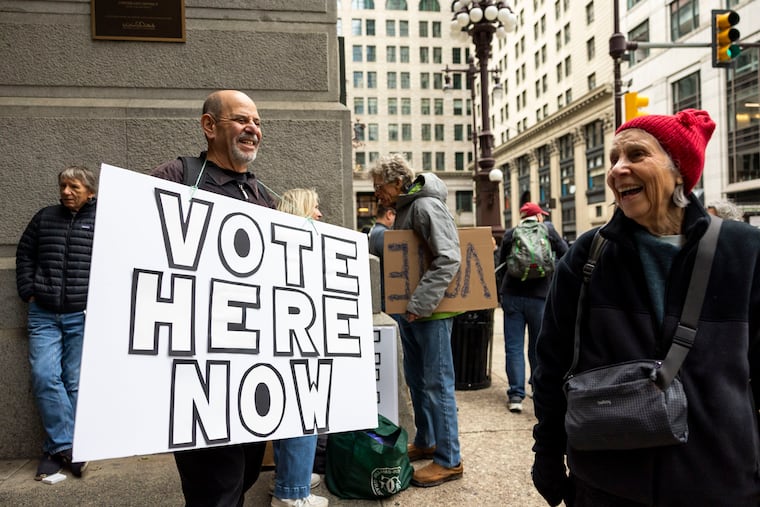
A coalition of left-leaning advocacy and neighborhood groups has also urged Parker to target a majority of the spending to programs that help impoverished households.
“Do the right thing. Prioritize high-risk households first. Our lives depend on it,” Dianna C. Coleman, a Southwest Philly resident and activist with One Pennsylvania, said at a rally earlier this month.
What else happened?
Retirement referendum: Philadelphia could soon have a government-administered retirement savings program for small businesses to offer employees who lack access to employer-sponsored plans.
Johnson introduced legislation to create the program Thursday, framing it as a way to reduce poverty among older Philadelphians. The creation of the program and a related board that would oversee investments would require a change to the city’s Home Rule Charter, meaning voters would have to approve it through a ballot question.
If the program, which Johnson is calling “Philly Saves,” becomes a reality, businesses that have at least one employee and have been operating in the city for at least two years can be covered. Employees would contribute between 3% and 6% of wages, and the savings would go into personal IRA accounts.
Pay per paper: Council also Thursday passed a bill requiring that stores charge customers a 10-cent fee per paper bag, but its fate is uncertain now that it’s headed to Parker’s desk.
Parker has not said if she will sign the bill, and a top member of her administration recently expressed opposition to the fee. If Parker issues a veto — it would be her first since taking office nearly two years ago — Council could, in theory, override it with 12 votes out of the 17-member body.
» READ MORE: A new 10-cent fee on paper bags has cleared Philly City Council, but Mayor Parker’s support is uncertain
But the bill, which was authored by Councilmember Mark Squilla, faced an unusual level of opposition in Council on Thursday, passing 10-5.
Two members were absent, meaning their votes would be decisive in a potential veto-override situation if every other member voted the same way. Members who opposed the bill said Thursday that they were worried about its impact on poor residents.
Squilla said an added cost burden is not his aim.
“The goal of this bill and legislation is to bring your own bag, not to charge you 10 cents for a bag,” he said. “So it’s really a behavioral change.”
Time is a flat circle: After more than two years of community discussion about where to put the Greyhound bus terminal that was previously on Filbert Street in Center City, it appears poised to go right back to where it used to be.
The Philadelphia Parking Authority is planning to renovate the former terminal and run it on behalf of the city. Its board must still approve the plan.
» READ MORE: Greyhound bus terminal will return to Filbert Street after two years of tumult
Councilmember Mike Driscoll, who chairs Council’s transportation committee, introduced legislation Thursday to assess fees on buses for using the loading bays at the location and to authorize the parking authority to collect the fees.
Quotable
A SNAP emergency: City Councilmember Rue Landau called on the mayor and the governor to declare a state of emergency over the potential suspension of SNAP benefits, saying such a designation would allow the city and state to draw down emergency funds to fill gaps in food access.
» READ MORE: Federal shutdown may bring a halt to food assistance for half a million Philadelphians
Landau, who represents the city at-large and has been one of Council’s most vocal opponents of President Donald Trump’s administration, said the city “cannot wait.”
“President Trump’s harmful policies and political games,” she said, “are resulting in SNAP restrictions, cuts to benefits, and now stopped payments because of the shutdown.”
Staff writer Tom Fitzgerald contributed to this article.