All 17 City Council members may be running for reelection. That would be the first time in at least 75 years.
The 2027 primary is 18 months away, and plenty can happen before then. Past lawmakers have declined to seek reelection for a variety of unexpected reasons.
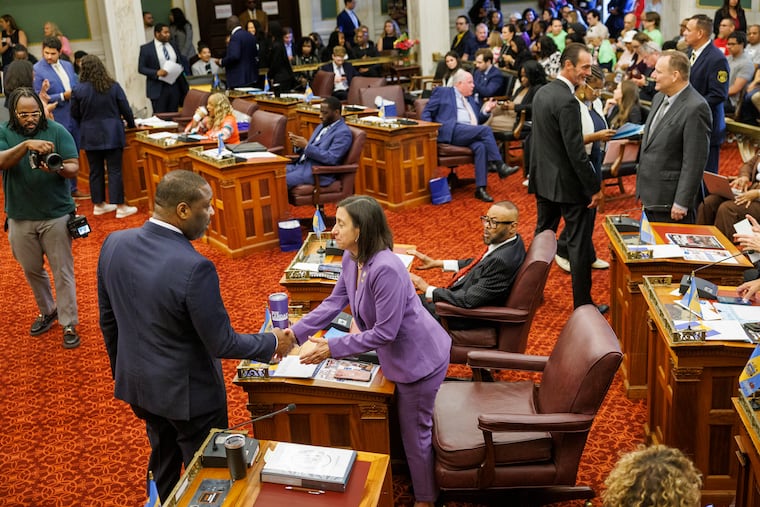
All 17 of Philadelphia’s City Council members have indicated they will seek reelection in 2027. And if they follow through, that election would mark the first time all members simultaneously asked voters for new four-year terms since the city’s Home Rule Charter was adopted in 1951.
The 2027 primary is more than a year away, and plenty can happen before then. Past lawmakers have declined to seek reelection for a variety of unexpected reasons, such as receiving an appointment to another post or being indicted. And while incumbents usually prevail in Council elections, several current members are likely to see serious challengers.
» READ MORE: Philly City Council is the least experienced it’s been in 40 years
Still, if the incumbents all run and prevail, Philadelphia could potentially see for the first time in its modern political history a cohort of Council members serving more than four years together.
In some ways, it makes sense that this crop of Council members might be the first to achieve that feat. Council is remarkably inexperienced at the moment, with 12 of its members having served less than two terms. And it appears no current Council members are expected to resign their seats to run for other offices until after 2027, given that none have entered the race for Philadelphia’s open U.S. House seat next year and that Mayor Cherelle L. Parker is in her first term and unlikely to face a reelection challenge from Council’s ranks.
“It’s no surprise this City Council all wants to return,” said John C. Hawkins, a City Hall lobbyist. “They are much younger and newer than previous iterations, and they’re feeling confident that they and their leadership are representing their constituents well.”
While many voters may not start paying attention to who is running for Council until much closer to the primary, potential candidates and political insiders are already hard at work trying to figure out which seats will be open or vulnerable and who might run in the 2027 election cycle.
» READ MORE: Inside Pennsylvania Society: Power schmoozing, budget ballads, and midterm jockeying in Manhattan
A majority of Council members were in New York City last weekend for the annual political hobnobbing fest known as Pennsylvania Society, where Council’s recent spat with Parker over her housing initiative was a major topic of conversation.
In addition to being an opportunity for special interests to wine and dine the state’s political class, Pennsylvania Society also serves as a breeding ground for rumors about future elections. This year, there was little if any talk of vacancies emerging on Council.
O’Neill to seek 13th term
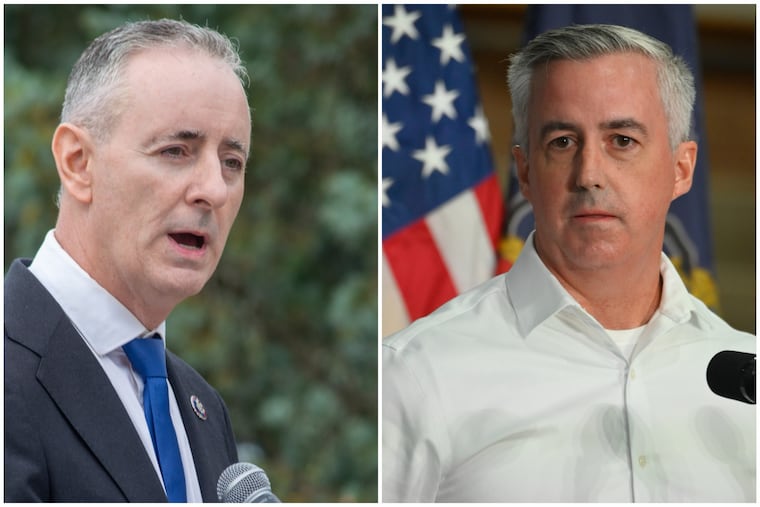
In the run-up to every recent city election cycle, speculation has swirled around whether Councilmember Brian J. O’Neill, the body’s lone Republican member and by far its longest-serving, will run for reelection.
O’Neill, who turns 76 later this month and was first elected in 1979, said he is up for the challenge of extending his own record by seeking a 13th four-year term.
“I am definitely running,” O’Neill said Monday. “If my health or my wife’s changed, that would be a big factor. Right now, she’s pretty healthy, and so am I.”
O’Neill said he decided long ago that if he could no longer knock on doors while campaigning, he would call it quits. After shoveling snow for more than two hours last weekend, O’Neill said, he is confident that won’t be a problem.
What is most remarkable about O’Neill’s longevity is that he is one of the few district Council members who regularly face opposition. That’s because his Northeast Philadelphia-based 10th District is the only one in deep-blue Philly that could be considered purple.
In fact, a majority of voters registered with parties in the district are now Democrats. But O’Neill has successfully swatted away a series of Democratic challengers, doing so most recently in 2023 against Gary Masino, who led the sheet metal workers’ union.
O’Neill, who avoids partisan political debates in Council and focuses almost entirely on Northeast Philly neighborhood issues, expects another challenge in 2027. But he is not concerned.
“I try not to think about it because I could never have predicted any of the races I’ve had,” O’Neill said. “It’s a waste of energy because no matter who runs against you, they all present different situations.”
Turnover turns to incumbency
Since the 2019 election cycle, six Council members have resigned to run for mayor, three retired, two lost reelection campaigns, and one stepped down after being convicted on federal corruption charges.
The Council members who are viewed as potentially vulnerable include some of the newest and some who must navigate ideologically divided constituencies.
Councilmember Jimmy Harrity, one of seven Council members who represent the entire city, was the last-place finisher among Democrats in the 2023 primary, putting a target on his back for the 2027 primary.
In the last two election cycles, Councilmembers Kendra Brooks and Nicolas O’Rourke of the progressive Working Families Party won at-large seats set aside for minority-party or independent candidates. The GOP, which had held those seats for 70 years, may seek to mount a comeback.
Councilmember Cindy Bass, a centrist who represents the 8th District, which includes parts of North and Northwest Philadelphia, narrowly eked out a win over progressive Democrat Seth Anderson-Oberman in the 2023 primary and may see another challenge from the left in 2027.
And Councilmember Jeffery “Jay” Young Jr., who represents the North Philadelphia-based 5th District, has already drawn a potential challenger.
» READ MORE: Seven Democrats tried to replace Darrell Clarke on City Council. Only one made the ballot.
Young won his seat without opposition after being the only candidate to qualify for the ballot in a bizarre scenario triggered by former Council President Darrell L. Clarke’s last-minute decision not to seek reelection in 2023.
In 2027, he could be the only incumbent facing a competitive election for the first time. In announcing his intentions to run against Young, attorney Jalon Alexander said in September that he aims to correct what he sees as “a lack of accountability from a Council member who ran uncontested.”
All signs point to yes
Council members do not have to make their reelection campaigns official for more than a year, and they gave a variety of answers when asked if they planned to seek new terms.
“I can’t see a reason why I wouldn’t,” said Council President Kenyatta Johnson, who represents the 2nd District in South and Southwest Philadelphia.
“I’m strongly considering yes,” said Councilmember Curtis Jones Jr., whose 4th District includes parts of West and Northwest Philadelphia.
Councilmember Isaiah Thomas, who holds an at-large seat, said yes, and added, “What I like is the fact this legislative body as a collective is so young.”
Councilmembers Nina Ahmad, Harrity, O’Rourke, Jamie Gauthier, Rue Landau, Quetcy Lozada, and Mike Driscoll all simply affirmed they would likely run. And numerous City Hall insiders told The Inquirer they expect all members to seek new terms.
Young gave perhaps the most puzzling answer.
“It’s not up to me to make that decision,” he said. “It’s up to the people of the 5th District.”
Asked how he would discern whether voters wanted to keep him before the next election, Young said he would gauge support by doing outreach in his district. But he also said he would personally like to serve another four years.
“I like doing my job,” he said.
2031 mayoral election race on horizon
Even if they all win reelection, it is unlikely that this group of Council members will stay together for future elections.
One major driver of Council turnover is the City Charter’s “resign to run” rule, which requires city employees to step down if they want to campaign for an office other than the one they hold. Consequently, mayoral elections are a major driver of resignations.
» READ MORE: Philly City Council is advancing legislation to let members keep their jobs while running for Congress
Assuming Parker wins reelection in 2027, she will be unable to seek a third consecutive term in 2031, and several current members are likely to throw their hats in the ring to replace her.
Johnson, Thomas, Gauthier, and Majority Leader Katherine Gilmore Richardson are all seen as potential contenders for that race.