Philadelphia lawmakers are skeptical of delivery robots cluttering Center City sidewalks
The robots have their fans, but some critics say they are too much on already crowded Center City sidewalks.
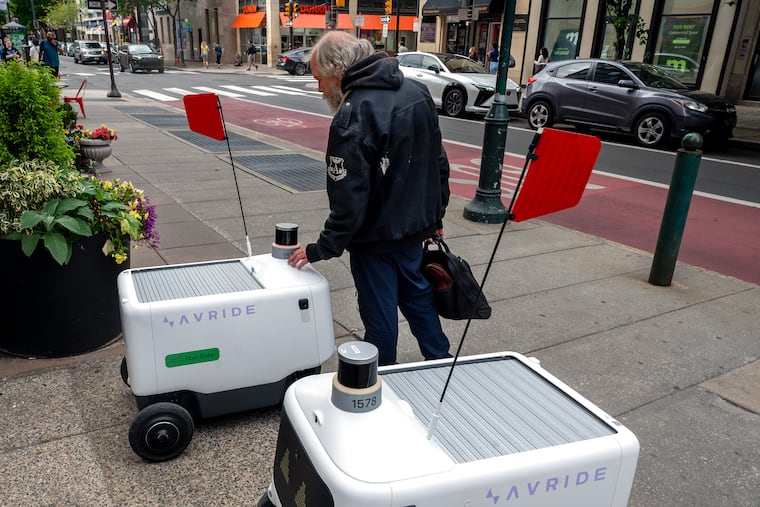
Some Philadelphia lawmakers want to do something about those Uber Eats delivery robots in Center City.
The slightly anthropomorphic white boxes have garnered mixed reactions, with some people charmed by their stuttering movements and heart eyes and others annoyed by the slow-moving vehicles cluttering up already narrow sidewalks.
Those more censorious of the robot overlords have an ally in Councilmember Jeffery Young, who last Thursday introduced a series of regulations on food delivery companies. Included is a provision tacking on a $1,000 surcharge to each delivery of food or goods “by autonomous delivery units … using the sidewalk.”
The delivery companies would pay the charge under Young’s legislation, although the fee is so onerous that it would effectively force the robots out of service (and potentially invite a lawsuit).
“If we are going to give these vehicles permission to drive on our sidewalks, then I think we need to regulate that a little bit more,” Young said in a Council speech on Thursday.
The autonomous 150-pound bots rolled out in March, serving about two dozen volunteer restaurants, according to Uber. Philadelphia is the 12th city to have the white robots that can flash passersby with their heart eyes.
As part of its pilot, Uber said at the time, the fleet of autonomous delivery robots would operate within the area bound by Race, Spruce, 18th, and Front Streets. Restaurant owners on the delivery platform say Uber has since quietly expanded its robot service to include the rest of the restaurants in that geographic boundary, with the option to opt out.
The internet is full of videos of the bots being “overwhelmed,” struggling to navigate crowds of people, suddenly stopping in the middle of the sidewalk to try to navigate obstacles or running red lights.
Young represents a large swath of Center City, and the robot regulation is packaged with legislation that would require licenses for e-bike riders. It would mandate that delivery companies create a registry for their e-bike users to ensure there is liability in case of accidents.
“We need to have smart, balanced legislation that protects the public safety, supports workers, and ensures that these corporations take responsibility for the systems and technologies they profit from,” Young said in his Thursday speech. He did not respond to e-mailed questions about his legislation.
Young isn’t the only local politician skeptical of the delivery robot pilot.
State Rep. Ben Waxman, whose district includes the area where Uber Eats has rolled out its pilot, wants City Council to consider limiting where the bots operate.
In a letter to Council President Kenyatta Johnson on Friday, Waxman requested that Council consider legislation that orders the Streets Department “to prohibit or significantly limit the operation of personal delivery devices in the most congested portions of Center City where their operation would constitute a hazard.”
Johnson was not available for comment.
At a minimum, Waxman asked Council to identify “high-risk pedestrian areas,” such as narrow sidewalks and major commercial corridors, and restrict the bots from operating in those areas.
The delivery robots have attracted criticism for creating traffic jams on the sidewalk in already crowded areas like Rittenhouse Square.
The bots are governed by a 2020 law that gives regulatory powers to the Pennsylvania Department of Transportation.
Cities can’t create additional licensing requirements and are limited in the restrictions they can impose on the bots. The statute does allow cities to impose restrictions if the bots pose a safety hazard, which Waxman argues they do.
He noted how the bots often share the sidewalks with seating, strollers, and people using wheelchairs. Waxman said many of his constituents have peppered him with questions and concerns about the robots.
Waxman told The Inquirer he would defer to City Council on where Uber Eats could operate the bots.
“I would say my biggest thing right now is this all needs to slow down. We can’t get to a situation where all of a sudden we have these bots everywhere, and there’s nothing that we can do about it,” he said.
Uber representatives did not respond to a request for comment.
Young’s bill hasn’t been scheduled for a hearing, and Council begins its summer recess in June. Further regulatory efforts would have to wait until the fall.
The pushback against delivery robots comes as City Council has also expressed concerns about the arrival of autonomous car company Waymo, which is expected to begin selling rides in Philadelphia soon, and as a larger pushback is brewing against artificial intelligence and automation.

