Democrats gain edge as Trump drags down GOP, new poll finds
The economy ranked as the top issue for voters. Only 14% of voters said the economy was better than it was a year ago — down from 31% who said so in January.
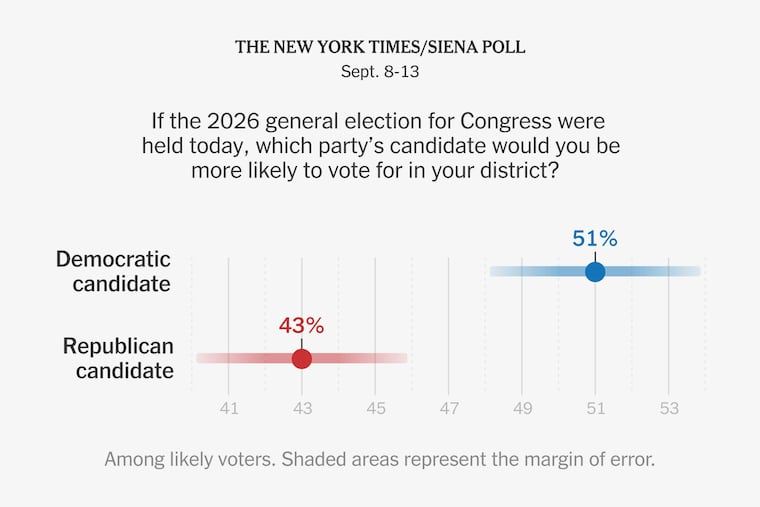
With fewer than 50 days until the midterms, Democrats have developed a clear advantage over Republicans as the president has lost the public’s trust on the economy, according to a new national poll from the New York Times and Siena University.
President Donald Trump’s lingering unpopularity and intense frustration over his management of cost-of-living issues, in particular, have deepened Republican vulnerabilities as Democrats push to win control of both the House and Senate.
Likely voters favored Democratic candidates over Republicans by close to 9 percentage points in their congressional district — a metric that is closely watched by both parties as a leading indicator of political momentum.
Trump’s approval rating continued to languish at 38% among likely voters, essentially unchanged from the lows it sank to after he went to war with Iran. A majority of voters disapproved of Trump’s handling of every major issue included in the poll: the economy, immigration, tariffs, the war, and, especially, the cost of living.
And voters said they trusted Democrats more than Republicans on not just healthcare and foreign wars but also on the two issues that powered Trump’s 2024 victory: immigration and the economy.
The political conditions found by the poll suggest the makings of a potential Democratic wave in November. But that outcome is far from assured. Thanks in part to gerrymandering, relatively few House seats are truly competitive, and in the run-up to the midterms, Republicans drew new House maps in several states favorable to their candidates. And even a nearly 9-point advantage would not guarantee flipping some of the Senate seats Democrats are counting on in 2026 — Texas, Ohio, Alaska, Iowa — which Trump won by double digits in 2024.
Still, independent voters have especially soured on Trump. Just 10% of them said the economy was better today than a year ago and only 27% approve of Trump’s job performance overall. And in the fight for Congress, 57% of independent voters said they planned to vote for a Democrat compared with only 34% for a Republican.
The cost of living is dragging down Republicans more than any other issue, as even some Republican voters lose faith in Trump’s economy. Only 28% of voters said they approved of how Trump has managed matters related to affordability.
Even Trump’s most loyal and durable demographic base — white voters without college degrees — disapproved of the president’s handling of the cost of living by a wide 21-percentage point margin.
And opposition to Trump is intensifying. The survey was the first Times/Siena poll in his second term to find a majority of voters, 52%, saying that they “strongly” disapproved of him.
The war in Iran, which has driven gas prices above $4 a gallon, is also weighing down the president. More than three-quarters of independent voters said they disapproved of his handling of the conflict, and so did nearly a quarter of Trump’s own 2024 voters.
Yet the survey found that the GOP’s vulnerabilities extend beyond Trump.
Voters see Republicans broadly as more extreme, more elitist, and more corrupt than Democrats, according to the poll. And while voters continue to have doubts about both parties, they aligned more with the Democratic Party on both cultural and economic matters than the Republican Party in the survey.
One glimmer of good news for Republicans is that the political situation has not deteriorated further since the spring. Yes, Trump is unpopular. But he is not more so than he was five months ago. The Democratic Party is viewed as too far left. And Republicans are generally outpolling Trump — including on how they would handle particular issues.
Still, by an 11-point margin, voters said they would prefer for Democrats to control Congress after the November election.
“All I know is right now, the Republicans are in power and I’m not really seeing the change I wanted to see,” said Elizabeth Gloden, 21, an independent college student in Arizona who voted for Trump in 2024 but is planning to vote Democratic this year. “I’m Gen Z. I am in the area where we want to move out of our parents’ houses, but we can’t because everything costs a million dollars,” she added. “I think it’d be a good idea to just see the other side what they can do.”
There were indications that the Democrats were winning back groups they had lost ground with in the 2024 presidential race. The current Democratic strength in the battle for Congress was being driven heavily in the poll by younger voters (those under 30 favored Democrats by 35 percentage points), Hispanic voters (43 points) and independent voters (23 points) — all groups the party had seen sagging support from two years ago.
Trump’s approval rating among voters under 30 stands at an abysmal 18%.
The economy ranked as the top issue for voters. Only 14% of voters said the economy was better than it was a year ago — down from 31% who said so in January.
The erosion among Republicans is especially stark. While 72% of Republicans said in January that the economy was better than it had been the prior year, only 29% of Republicans said so now.
Trump has tried to wave off those concerns. “This has been the most successful two years financially and every other way in the history of the presidency,” Trump claimed in his address last week at a convention in Dallas.
Voters are not buying it.
“I actually feel really gaslit because I’m constantly hearing from Republicans, from conservatives just in the media in general, that ‘don’t believe your lying eyes, everything’s great, wages have increased,’ all of these different things,” said Meghan Demetrios, 40, an independent voter in South Carolina.
“I feel like I’m super poor in America,” she continued. “I got a new career job about nine months ago, and I was so proud of myself and so excited. And I thought everything was going to get a little bit better. And I turn around, and I find that every single bill I have has gone up.”
She plans to vote Democratic this year.
All told, 71% of voters disapprove of how Trump is handling the cost of living while 28% approve — a net disapproval of 43 percentage points, which is 13 points worse than it was January.
Economic hardship appears to be especially hampering the GOP among lower-wage earners.
Those earning less than $50,000 were more than twice as likely to say they would vote for a Democratic congressional candidate this fall rather than a Republican, 63% to 31%.
That would represent a dramatic shift from 2024, when Trump narrowly carried that group, according to exit polling.
More than half of voters said they worry more about Republicans in Congress allowing Trump to go too far, while 39% said that they worry about Democrats trying to move the country too far to the left.
Adding to the party’s problems, Republicans face an enthusiasm gap: 61% of Democrats said they were almost certain to vote, compared with 56% of Republicans.
One of the Democratic Party’s potential vulnerabilities is being seen as outside the mainstream. The share of voters who see Democrats as too far left has grown to 50%, up from 47% earlier this year. (But likely voters were more likely to describe the Republican Party as “extreme” than the Democratic Party.)
And a 51% majority of voters had an unfavorable view of socialism — one reason Trump’s convention in Dallas repeatedly used that label.
“The Democrats have always done a horrible job of supporting their own cause because they can’t get out of their own way,” said Thomas Lappin, 48, a Democrat who lives in Austin, Texas, and who wished his party would move strategically to the center. “I feel like they’re just doing this again and every time they get their act together, they just somehow screw it up again.”
About a tenth of all voters, including Democrats, Republicans, and independents, say they disagree with both parties when it comes to economic issues. This year, Democrats seem to be winning them over, at least for now.
James Witherington, 41, left the Army after two decades last year and is now a real estate investor in Colorado Springs. He called his voter registration — he’s a Republican — a “loaded question” these days, considering his frustrations with Trump, whom he called “an egomaniac.”
“This is an unnecessary war,” he said. “Do I hate Iran? Yes. Should we destroy them? Yes. But now is not the time.”
But Witherington said he is still planning to vote for his local Republican congressman, Jeff Crank, whom he knew by name. “He emails me about veterans problems,” he said.
“The extreme left has gone too far,” he said. “The extreme right is like the high school jock bully. But most people are in the middle. Most people are just walking down the hall.”
This article originally appeared in the New York Times.