Pelé, Brazil’s mighty soccer king and one of the greatest players ever, has died at 82
Pelé spent nearly two decades enchanting fans and dazzling opponents as the game’s most prolific scorer with Brazilian club Santos and the Brazil national team.
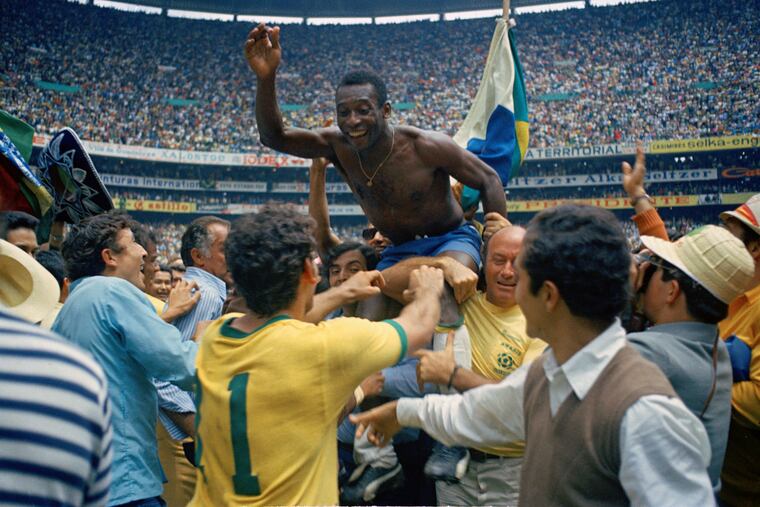
SAO PAULO — Pelé, the Brazilian king of soccer who won a record three World Cups and became one of the most commanding sports figures of the last century, died Thursday. He was 82.
The standard-bearer of “the beautiful game” had undergone treatment for colon cancer since 2021. The medical center where he had been hospitalized for the last month said he died of multiple organ failure as a result of the cancer.
“Pelé changed everything. He transformed football into art, entertainment,” Neymar, a fellow Brazilian soccer star, said on Instagram. “Football and Brazil elevated their standing thanks to the King! He is gone, but his magic will endure. Pelé is eternal!”
A funeral was planned for Monday and Tuesday, with his casket to be carried through the streets of Santos, the coastal city where his storied career began, before burial.
Widely regarded as one of soccer’s greatest players, Pelé spent nearly two decades enchanting fans and dazzling opponents as the game’s most prolific scorer with Brazilian club Santos and the Brazil national team.
His grace, athleticism and mesmerizing moves transfixed players and fans. He orchestrated a fast, fluid style that revolutionized the sport — a samba-like flair that personified his country’s elegance on the field.
He carried Brazil to soccer’s heights and became a global ambassador for his sport in a journey that began on the streets of Sao Paulo state, where he would kick a sock stuffed with newspapers or rags.
In the conversation about soccer’s greatest players, only the late Diego Maradona, Lionel Messi and Cristiano Ronaldo are mentioned alongside Pelé.
Different sources, counting different sets of games, list Pelé's goal totals anywhere between 650 (league matches) and 1,281 (all senior matches, some against low-level competition.)
The player who would be dubbed “The King” was introduced to the world at 17 at the 1958 World Cup in Sweden, the youngest player ever at the tournament. He was carried off the field on teammates’ shoulders after scoring two goals in Brazil’s 5-2 victory over the host country in the final.
Injury limited him to just two games when Brazil retained the world title in 1962, but Pelé was the emblem of his country’s World Cup triumph of 1970 in Mexico. He scored in the final and set up Carlos Alberto with a nonchalant pass for the last goal in a 4-1 victory over Italy.
The image of Pelé in a bright, yellow Brazil jersey, with the No. 10 stamped on the back, remains alive with soccer fans everywhere. As does his trademark goal celebration — a leap with a right fist thrust high above his head.
Pelé's fame was such that in 1967 factions of a civil war in Nigeria agreed to a brief cease-fire so he could play an exhibition match in the country. He was knighted by Britain’s Queen Elizabeth II in 1997. When he visited Washington to help popularize the game in North America, it was the U.S. president who stuck out his hand first.
“My name is Ronald Reagan, I’m the president of the United States of America,” the host said to his visitor. “But you don’t need to introduce yourself because everyone knows who Pelé is.”
Pelé was Brazil’s first modern Black national hero but rarely spoke about racism in a country where the rich and powerful tend to hail from the white minority.
Opposing fans taunted Pelé with monkey chants at home and all over the world.
“He said that he would never play if he had to stop every time he heard those chants,” said Angelica Basthi, one of Pelé's biographers. “He is key for Black people’s pride in Brazil, but never wanted to be a flagbearer.”
Pelé's life after soccer took many forms. He was a politician -- Brazil’s Extraordinary Minister for Sport -- a wealthy businessman, and an ambassador for UNESCO and the United Nations.
He had roles in movies, soap operas and even composed songs and recorded CDs of popular Brazilian music.
As his health deteriorated, his travels and appearances became less frequent. He was often seen in a wheelchair during his final years and did not attend a ceremony to unveil a statue of him representing Brazil’s 1970 World Cup team. Pelé spent his 80th birthday isolated with a few family members at a beach home.
Born Edson Arantes do Nascimento, in the small city of Tres Coracoes in the interior of Minas Gerais state on Oct. 23, 1940, Pelé grew up shining shoes to buy his modest soccer gear.
Pelé's talent drew attention when he was 11, and a local professional player brought him to Santos’ youth squads. It didn’t take long for him to make it to the senior squad.
Despite his youth and 5-foot-8 frame, he scored against grown men with the same ease he displayed against friends back home. He debuted with the Brazilian club at 16 in 1956, and the club quickly gained worldwide recognition.
The name Pelé came from him mispronouncing the name of a player called Bilé.
He went to the 1958 World Cup as a reserve but became a key player for his country’s championship team. His first goal, in which he flicked the ball over the head of a defender and raced around him to volley it home, was voted as one of the best in World Cup history.
The 1966 World Cup in England — won by the hosts — was a bitter one for Pelé, by then already considered the world’s top player. Brazil was knocked out in the group stage and Pelé, angry at the rough treatment, swore it was his last World Cup.
He changed his mind and was rejuvenated in the 1970 World Cup. In a game against England, he struck a header for a certain score, but the great goalkeeper Gordon Banks flipped the ball over the bar in an astonishing move. Pelé likened the save — one of the best in World Cup history — to a “salmon climbing up a waterfall.” Later, he scored the opening goal in the final against Italy, his last World Cup match.
In all, Pelé played 114 matches with Brazil, scoring a record 95 goals, including 77 in official matches.
His run with Santos stretched over three decades until he went into semi-retirement after the 1972 season. Wealthy European clubs tried to sign him, but the Brazilian government intervened to keep him from being sold, declaring him a national treasure.
On the field, Pelé's energy, vision and imagination drove a gifted Brazilian national team with a fast, fluid style of play that exemplified “O Jogo Bonito” -- Portuguese for “The Beautiful Game.” His 1977 autobiography, “My Life and the Beautiful Game,” made the phrase part of soccer’s lexicon.
In 1975, he joined the New York Cosmos of the North American Soccer League. Although 34 and past his prime, Pelé gave soccer a higher profile in North America. He led the Cosmos to the 1977 league title and scored 64 goals in three seasons.
Pelé ended his career on Oct. 1, 1977, in an exhibition between the Cosmos and Santos before a crowd in New Jersey of some 77,000. He played half the game with each club. Among the dignitaries on hand was perhaps the only other athlete whose renown spanned the globe — Muhammad Ali.
Pelé would endure difficult times in his personal life, especially when his son Edinho was arrested on drug-related charges. Pelé had two daughters out of wedlock and five children from his first two marriages, to Rosemeri dos Reis Cholbi and Assiria Seixas Lemos. He later married businesswoman Marcia Cibele Aoki.

Superlatives from some of soccer’s greats and others about Pelé, who died Thursday in Brazil at age 82:
“To watch him play was to watch the delight of a child combined with the extraordinary grace of a man in full.” — Nelson Mandela.
“I told myself before the game, he’s made of skin and bones just like everyone else — but I was wrong.” — Italy's Tarcisio Burgnich, after playing against Pele in the 1970 World Cup Final.
“Pelé was one of the few who contradicted my theory: Instead of 15 minutes of fame, he will have 15 centuries.” — Andy Warhol.
“I sometimes feel as though football was invented for this magical player.” — Sir Bobby Charlton, retired England great who won 1966 World Cup and Ballon d’Or in same year.
“Pelé was the only footballer who surpassed the boundaries of logic.” — Johan Cruyff, the late Dutch star and standout manager who won the Ballon d’Or three times.
“He is the most complete player I ever saw.” — Retired German great Franz Beckenbauer.
“If you take the qualities of Cristiano Ronaldo and (Lionel) Messi, put them together, then you’d have a player to compare to Pelé!” — Retired Brazil forward Tostao.
“The best player ever? Pelé. (Lionel) Messi and Cristiano Ronaldo are both great players with specific qualities, but Pelé was better.” — Alfredo Di Stefano, the late Argentine star for Real Madrid.
“His great secret was improvisation. Those things he did were in one moment. He had an extraordinary perception of the game.” — Brazil defender Carlos Alberto Torres.
“This debate about the player of the century is absurd. There’s only one possible answer: Pelé. He’s the greatest player of all time, and by some distance, I might add.” — Retired Brazil star Zico.
“The greatest player in history was Di Stefano. I refuse to classify Pelé as a player. He was above that.” — Hungary star Ferenc Puskas.
“We went up together to head a ball. I was taller, had a better impulse. When I came back down, I looked up in astonishment. Pelé was still there, in the air, heading that ball. It was like he could stay suspended for as long as he wanted to.” — Italy defender Giacinto Facchetti.
“When I saw Pelé play, it made me feel I should hang up my boots.” — Just Fontaine, the Morocco-born French star who scored 13 goals in six games in the 1958 World Cup.
“The moment the ball arrived at Pelé’s feet, football transformed into poetry.” — Italian poet Pier Paolo Pasolini.
“The difficulty, the extraordinary, is not to score 1,000 goals like Pelé – it’s to score one goal like Pelé.” — Carlos Drummond de Andrade, Brazilian poet.
“Pelé was the most complete player I’ve ever seen. Two good feet. Magic in the air. Quick. Powerful. Could beat people with skill. Could outrun people. Only 5-feet-8 inches tall, yet he seemed a giant of an athlete on the pitch. Perfect balance and impossible vision.” — Bobby Moore, captain of the 1966 World Cup champion team from England.
“I arrived hoping to stop a great man, but I went away convinced I had been undone by someone who was not born on the same planet as the rest of us.” — Benfica goalkeeper Costa Pereira after 5-2 loss to Santos.
“There’s Pelé the man, and then Pelé the player. And to play like Pelé is to play like God.” — Retired France star and three-time Ballon d’Or winner Michel Platini.
“Pelé is the greatest player in football history, and there will only be one Pelé in the world.” — Cristiano Ronaldo, Portugal star forward.
Sources: Goal.com, FIFA.com, AP research.