Hiring youth sports officials in N.J. has become challenging, and new rules could exacerbate the problem
New guidelines for classifying amateur sports officials as independent contractors or employees could lead to higher costs and fewer refs.
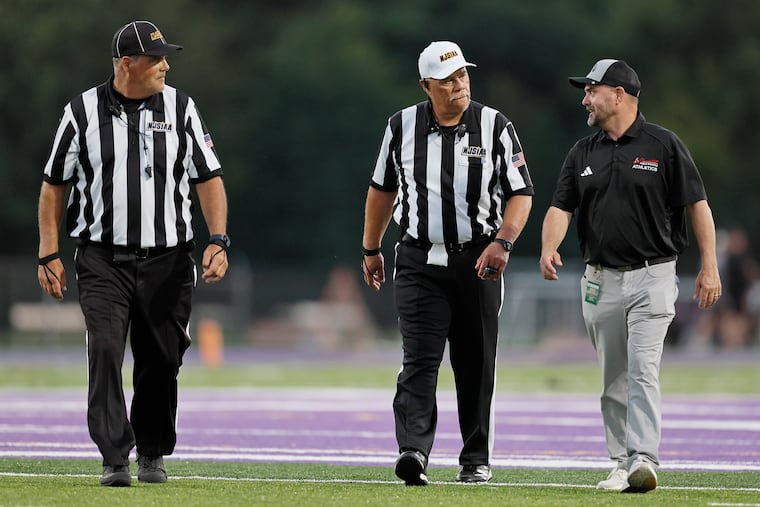
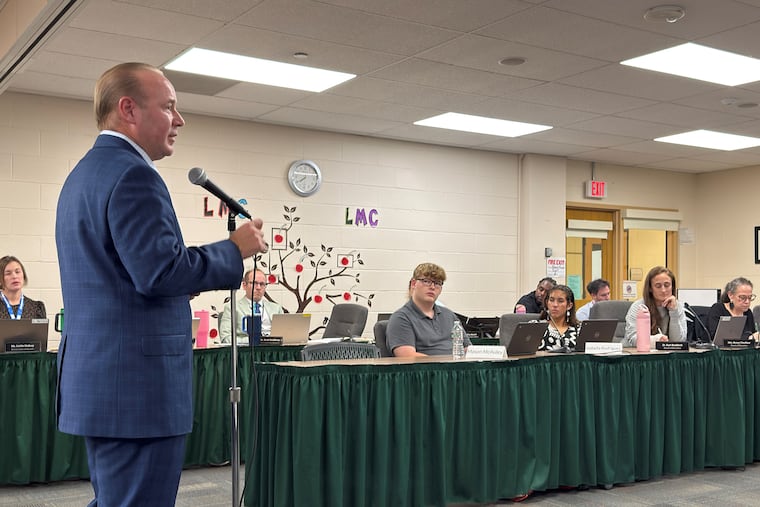
Michael Beirao, the athletic director for Cherry Hill Public Schools, manages about 1,800 athletic events each academic year — with about $130,000 to pay referees for all of them.
The cost of hiring a ref has increased, while the number of officials participating has declined.
In Cherry Hill, Beirao oversees two large high schools, East and West, which have 63 varsity teams, plus another 60 or so junior varsity and freshman groups. The middle schools — Beck, Rosa, and Carusi — each offer 17 sports programs.
His $130,000 — with $100,000 for the high school level and $30,000 for middle school — for officials is considered “a large budget,” Beirao noted.
The change of officiating classification could be slow and gradual. However, it could mean eventual higher property taxes and cutting athletic programs from public schools if they can’t afford the cost, say South Jersey athletic directors.
“It would be devastating, because I’ll use Cherry Hill Public Schools as an example; this year we had to cut our budget by $14 million,” Beirao said. “How do you make a decision between keeping a teacher during the day and having an official after school?”
Meanwhile, Beirao noted, school sports programs face competition from clubs and private-equity-owned programs. Requiring schools to hire referees as employees would be an added “burden,” he said.
“It wouldn’t be feasible, and it wouldn’t be a tenable situation,” Beirao said.
Ken Schoudt, athletic director for the Delsea Regional School District, asked an umpire association how much it would charge for an official classified as an employee instead of an independent contractor. The cost tripled.
“For one umpire at the varsity level, is $110. For them to break even and make the same amount of money, they would have to charge us close to $350,” Schoudt said.
But a proposed bill could help. If passed, it would classify all officials as independent contractors under state law.
» READ MORE: About 1,500 Cherry Hill students are chronically absent from school. School leaders are trying to fix that.
What is New Jersey’s ABC test?
The New Jersey’s Department of Labor and Workforce Development presumes all workers who make compensation in the state are employees, unless they satisfy all three prongs of the ABC test to be classified as an independent contractor. Some changes to the rule are set to take effect Oct. 1.
New Jersey Sen. Kristin M. Corrado (R-District 40) said the system’s new regulations make it even more difficult to be classified as an independent contractor.
Umpires, referees, and other officials are generally paid on a per-game basis and employed primarily in other occupations and supplement their income by officiating part time, according to the U.S. Bureau of Labor Statistics data.
Most officials work through agencies for each sport. The high school and youth programs go to those agencies for assigning games.
New Jersey Gov. Mikie Sherrill’s administration is instructing some agencies to classify their workers as employees. But for “100 years we’ve always been independent contractors,” said John Gallante, president of the New Jersey Umpire Alliance.
The state’s labor department said it’s not targeting sports officials, but “whether a worker is an employee or an independent contractor depends on the specific facts of each individual’s working relationship, under New Jersey’s ABC test.”
New Jersey adopted the ABC test in 1936 under the state’s Unemployment Compensation Law.
Thirty-three states use some version of the ABC test to determine worker classification. In New Jersey, paid workers are presumed to be employees unless they meet all three of the following:
Prong A: individual has been and will continue to be free from control or direction over the performance of services, both under the contract and in fact.
Prong B: the services are either outside the usual course of the employer’s business or are performed outside of all the employer’s places of business.
Prong C: the individual is engaged in an independently established trade, occupation, profession or business.
The test is used to enforce wages, benefits, and labor protections. Misclassification can result in significant financial penalties for employers, according to the NJDOL.
» READ MORE: N.J. Supreme Court refuses to hear appeal in Cherry Hill Democratic Committee battle over control
What are the new regulations?
In May, the state labor department clarified the test’s rules with new regulations in response to court cases in recent years involving worker classifications.
It is set to go in effect Oct. 1.
The clarifications, according to New Jersey law firm Cole Schotz, include:
The business must prove it does not exercise control over the worker and has not “reserved the right to control the individual’s performance.”
Work is not outside the usual course of business if it is “integrated into the hiring entity’s business,” even if the work is done off premises.
The worker must have proof of their independent business, that would keep running even if they lost this specific contracted job.
Corrado said the new regulations put further and narrower definitions on each of the prongs, making it more difficult to be an independent contractor in New Jersey.
“The ABC test itself is not new and neither are the problems that come with it,” Corrado wrote in an email. “These regulations would exacerbate those problems.”
How are amateur officials being impacted?
Gallante, of the New Jersey Umpire Alliance, recalled that two years ago an amateur official incorrectly filed for unemployment.
“The officiating association responded and said they don’t have any employees,” said Gallante, whose organization represents 13 certified baseball and softball officiating associations. “So that claim was denied. But then it prompted an unemployment audit of that association.”
The department determined from its audit that all officials in the association should be classified as employees, Gallante said, and that the association should backpay unemployment dating back to 2020. That “would in essence put them out of business. They would no longer be able to function,” he said.
Gallante added, “the Department of Labor has told us that in ‘fairness,’ they would examine all the other officiating associations in the state as well.”
The state labor department said it “does not comment on ongoing legal or administrative proceedings.” And labor commissioner Kevin Jarvis said he could not give examples of what differentiates an employer from an independent contractor.
Corrado said the Sherrill administration levied a fine that could put that association out of business, which would impact thousands of youth baseball and softball games.
“Thankfully, the organization is standing strong against the Department of Labor and fighting this determination,” Corrado added.
An organization with employees must account for payroll, unemployment, disability, workers’ compensation, wage and hour requirements, and other employment laws — all of which comes with a cost.
» READ MORE: Popular food truck from a Camden County nonprofit provides job training for people with disabilities
Corrado emphasized the uncertainty is problematic: “A Little League, travel tournament, high school, or other organization should not need lawyers and accountants to determine whether classifying someone who officiates a few games qualifies as an independent contractor.”
Who is trying to change this?
Corrado introduced bill S4045 in March, along with Sen. Paul A. Sarlo (D-District 36) and Sen. Latham Tiver (R-District 8).
If passed into law, it would specify that amateur sports officials are not employees under state employment laws.
“It would ensure that youth sports officials are able to work when they want, where they want, and how much they want,” Corrado said. “It would also allow youth sports organizations and high schools to continue to pay the officials at the rates they are accustomed to, not needing to worry about the burden of payroll taxes or workers’ compensation insurance.”
The bill is pending in the Senate and Assembly labor committees.
The New Jersey State Interscholastic Athletic Association (NJSIAA), which oversees and registers high school sports officials in the state, said in an email to The Inquirer that it is monitoring the issue and has been in conversations with lawmakers and regulators.
“We recognize the potentially significant impact this could have on interscholastic athletics and continue to make sure policymakers understand the critical role officials play,” a spokesperson wrote. “Our position is clear: high school sports officials are independent contractors and should continue to be treated as such.”