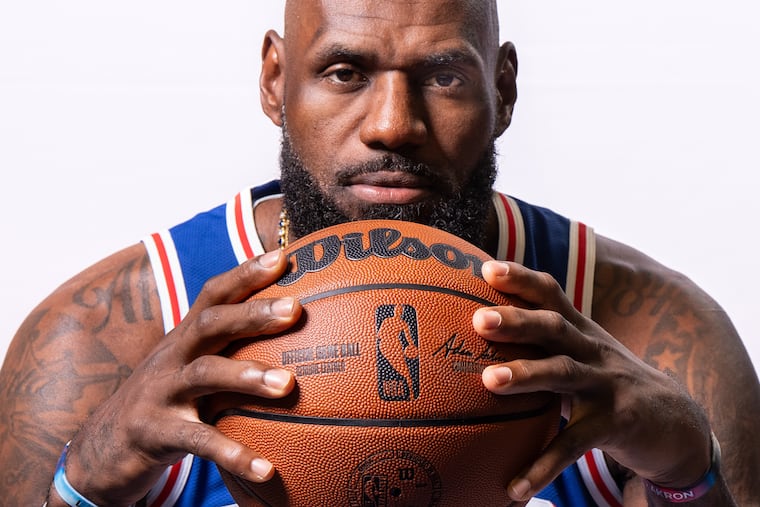
LeBron James is here because of Tyrese Maxey. That says something about both of them.
In hindsight, maybe those of us who’d witnessed Maxey’s rise shouldn’t have been so floored when LeBron announced that he would be joining the Sixers.
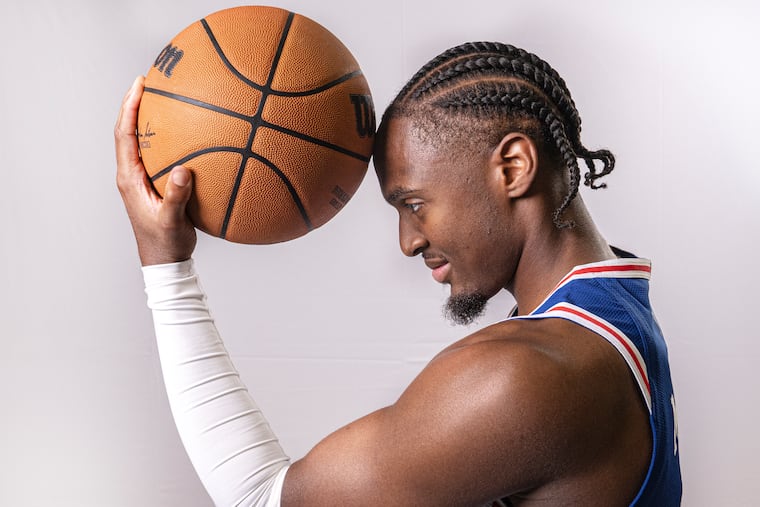
The three words that have long defined Tyrese Maxey were also the ones that landed LeBron James with the 76ers. They were spoken a little more than six years ago by Rajon Rondo, the longtime NBA point guard who’d starred at the University of Kentucky before embarking on a pro career that saw him win a championship and make four All-Star teams with the Celtics.
This was the summer of 2020, and the world was on hiatus, and Rondo found himself sharing the court with a 19-year-old kid who was about to become the latest in a long line of first-round draft picks from his alma mater. Maxey liked waking up early, and he liked working late, and the kid could ball a little bit. Rondo was impressed enough that he mentioned Maxey to James, his then-teammate on a Lakers team that would go on to win the NBA title once play resumed that summer.
“He works hard,” Rondo told James.
» READ MORE: LeBron James’ goal in Philly is clear: ‘I didn’t leave my family to lose in the second round’
In hindsight, maybe we shouldn’t have been so floored three months ago when James announced that he would be continuing his Hall of Fame career with the Sixers. Those of us who’d witnessed Maxey’s rise over the last seven years were well aware of his irrepressible good nature and earnest commitment to his craft. There may not be a more likable player in all of professional sports, let alone the NBA. It isn’t just his magnetism and work ethic, but also the genuineness with which these traits express themselves. What we didn’t know was the extent to which James, too, valued such things. Turns out, he values them a great deal.
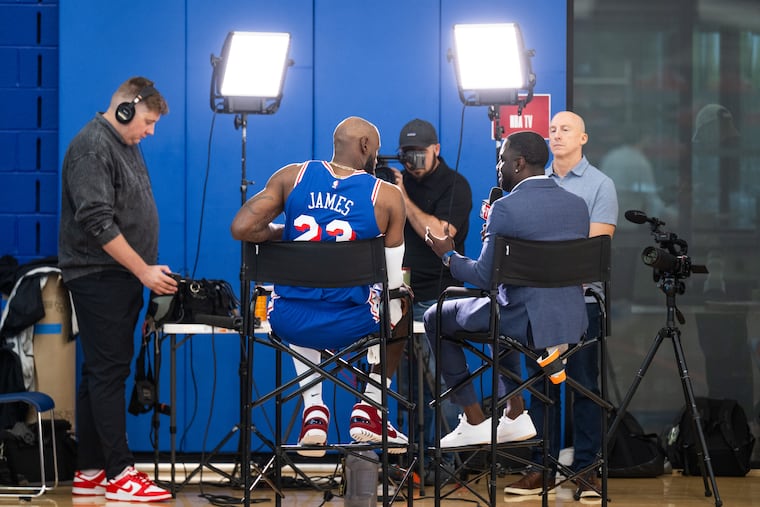
“Our relationship, when I broke a lot of the teams and franchises down I could possibly play for, he was one of the main deciding factors,” James said Monday in his first official public appearance as a Sixer.
It’d be easy to interpret that solely as an endorsement of Maxey. But, in a funny way, James’ relationship with Maxey speaks as much to his own character as vice versa. Most of us here in Philadelphia know James only from afar, which means our impressions of him are inevitably shaped more by secondhand narratives than by firsthand witness.
In the weeks leading up to his decision to sign with the Sixers, local airwaves and social-media feeds crackled with skepticism from a contingent of fans who not only doubted James’ intentions but also recoiled at the idea of seeing him in a Sixers uniform. However genuine some of those skeptics were, others were undoubtedly reacting to a heroes-and-villains caricature that develops with all superstars who reach a certain stature. James’ relationship with Maxey doesn’t necessarily square with that caricature.

David Murphy alerts
“He’s worked for everything he’s gotten,” Maxey said. “He was put on a pedestal where a lot of guys don’t succeed. And he probably surpassed expectations. For myself, I kind of had the opposite start of my career. I was put on a different pedestal, and I felt like I had to work my way up to where I am.
“But still, at the end of the day, both of us had to work to get to where we were. I believe in the work, he believes in the work. Like I’ve been saying for years, we’ve got to get one percent better [every day], and not just on the court, but as a group, the camaraderie. It’s gonna be new. It’s gonna be different ... But it’s gonna be good.”
» READ MORE: Jaylen Brown adjusting in ‘phases’ to his new home with the Sixers
The most striking thing about James’ first news conference as a Sixer was both his maturity and the way in which it echoed Maxey’s.
“You got to try to stay even-keeled, understand that the noise is gonna be noise, what happens outside of this building is gonna consistently happen, and it’s going to be doubled and tripled and quadrupled now that I’m here,” James said. “And it just comes with the territory, I understand it. So the work that we put in in this building, the work that we put in when we’re on the road, watching film, the work that we put in, will take care of itself. …
“Guys will hold each other accountable. We put the work in, we have honest conversations, things of that nature. So, you know, just staying even-keeled and everything that’s going on out there does not matter. It does not matter at all, it’s about the results and the things that happen in this building for us. And if we do that, we’re a really talented team, but the talent will only get you so far.
“But if you put the work in, and you continue to be better and better every day, and you have this championship approach every day to get one percent better, and then it definitely will work in our favor.”
Whatever your preconceived notions about LeBron, he is clearly an athlete who treats his craft with the utmost sincerity. As Maxey said, plenty of athletes have begun their careers on pedestals similar to the one James occupied as a generational schoolboy star at Akron’s St. Vincent-St. Mary and the eventual No. 1 overall pick in the 2003 NBA draft. The dividing line between the greats and the coulda-been-greats is more often than not an internal will that manifests itself in both work ethic and competitive drive. Both are evident in the words James speaks and the manner in which he speaks them. One suspects his new teammates will have no choice but to listen.
Maxey wasn’t blessed with the same raw physical gifts as James. He had the misfortune of entering college the year the world shut down, which limited his exposure and precipitated his fall to the Sixers at No. 21. But there is clearly something kindred between the two players. Listening to them talk, seeing them side-by-side wearing the same uniform, it suddenly seemed obvious why James ended up with the Sixers. That says something about Maxey. It says more about James.