AND1’s trash-talking factory was based in the Philly suburbs. It began with a stolen roll of Wawa toilet paper and a dream
Inspired by the dialogue heard in pickup games on Penn's campus, AND1's T-shirts and sports apparel ignited something of a revolution.
When Tom Austin lived in Philadelphia, he liked to go on long walks. Sometimes for three or four hours. The Wharton grad would roam to Center City, to Boathouse Row. It helped him clear his head, and sometimes generate new ideas.
One morning in the summer of 1993, while strolling down Spruce Street, he had a good one. Or rather, five good ones. He, a fellow Penn alum, Seth Berger, and a friend, Jay Coen Gilbert, were in the process of creating a start-up.
Their first concept, a coupon book for basketball gear and equipment, had failed. The $50,000 they’d raised was rapidly dwindling. So, the group decided to pivot.
Instead of selling coupons, they’d sell T-shirts. The company would be named “AND1,” a nod to streetball slang. Now, they needed something to put on said T-shirts, an edgy slogan that would resonate with hoopers of all ages.
As Austin continued to walk, and think, and walk, and think, it came to him. They’d use trash-talk; the kind you’d hear in a local pickup game. He started coming up with boastful taglines, carefully crafting each quip in his head.
Call 911 — I’m on fire.
Call the police — there’s a beating in progress.
It’s just you and me. OK, it’s just me.
Go to church — pray you don’t guard me.
It is hot in here, or is it just me?
More insults started to spill out, and in a moment of panic, Austin realized he needed to write them down. He was living frugally, and didn’t have a notepad at home. He didn’t have a car to drive to an office supply store, either.
So the 21-year-old walked into Wawa and stole a roll of toilet paper.
“I’m not proud of that, but that’s how it happened,” Austin said. “I didn’t have anything to write on.”
He added: “I hope the statute of limitations on that is over.”
Six months later, Austin’s phrases were printed on T-shirts sold at Foot Locker, coupled with a logo of a faceless basketball player. What started as a small order turned into a financial boon.
AND1 sold $1.6 million worth of T-shirts in its first year. More retailers came calling, and before long, the company was expanding to shorts, sneakers, and more.
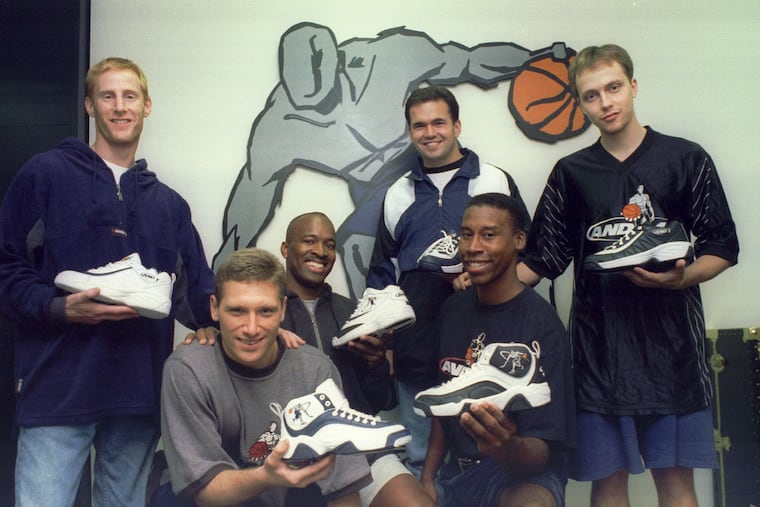
It became a cultural phenomenon. NBA players would get AND1’s faceless man tattooed onto their arm. Latrell Sprewell, Vince Carter, and Kevin Garnett wore their shoes.
AND1’s mixtapes — video compilations of street ball moves — and the subsequent AND1 mixtape tour, made celebrities out of everyday people. Most were known only by their nicknames: “The Professor,” “Hot Sauce,” “The Bone Collector.” One of them, “Skip To My Lou,” had a long NBA career.
Because the first mixtape was shot at Rucker Park in Harlem, the company became synonymous with New York basketball. But at its core, AND1 was a Philadelphia brand.
And while it is not the powerhouse it once was, that brand’s legacy still has plenty of cachet.
“There was something about the Philly identity,” Austin said. “It was always the underdog. We were always that underdog story, taking on Nike and Adidas. They’re the Rocky villains, man.”
Philadelphia roots
Austin transferred from Holy Cross to Penn in 1990, a lanky sophomore from rural Massachusetts. He was far from home and had trouble meeting people at first.
The teenager decided to branch out in the only way he knew how: by finding a pickup basketball game.
He discovered a nearby spot on campus, Gimbel Gym, which was open to the public. Inside were courts full of players who likely wouldn’t have otherwise met. There were law school students, business school students, janitors, locals from the neighborhood.
Gimbel’s mainstay was a man known only as “Moose,” who loomed at 250 pounds. Austin didn’t have that kind of size — an “eighth grade-level body with a 20-inch vertical,” he said — but he was skilled.
Before long, the New England native was hooping in Gimbel seven nights a week. And he quickly established himself as a “Moose”-caliber gym rat.
Austin could shoot. And this was not just the consensus among pickup players. Penn’s men’s basketball team would go to Gimbel every so often to practice.
They noticed “Tommy Gun.”
“He could play,” said former Penn standout player and head coach Jerome Allen, now an assistant with the Detroit Pistons. “Just flat-out, in that setting. Whether it was him snatching the rebound and pushing it in transition, or him catching it on the wing and driving a closeout, or him in an iso.
“If you took him for granted, you would get embarrassed. Easily.”
This was how Austin met his friend and future business partner Seth Berger. After the Massachusetts native graduated in 1993, he began to interview with investment banks, but found it wasn’t a fit. Berger had heard through mutual friends at Gimbel that Austin had a 3.95 GPA.
Berger shared a business plan he’d been formulating. The idea was for a coupon booklet that could be used to get discounts on basketball gear. Austin came on board along with Coen Gilbert, a Stanford graduate.
He moved into a house at 40th and Sansom with six other guys, most of them Penn basketball players, renting a room for $100 a month.
The coupon idea didn’t attract the brands or customers necessary to succeed. But the trash-talking T-shirts became a lifeline; a product that was relatively inexpensive to make, quick to turn around, and easy to sell.
And their Philadelphia community came together to make it happen. The entrepreneurs turned to Joe and Dom, two men who worked out of an old Italian neighborhood, to lay out their T-shirts.
Joe and Dom introduced them to Stephen Sistilli, a local comic book designer who created the faceless man. The bulk of the trash talk ideas came from Austin. But to market-test his work, he’d give Moore and his teammates sheets of paper with 20-30 phrases.
They were told to circle their favorite ones.
“I remember this one that was like… ‘Your game’s on the back of a milk carton, it’s missing,’“ Moore said. ”I remember that one."
Added former Penn forward Scott Kegler: “There was something about your game and your girlfriend. ‘Your game’s uglier than your girlfriend,’ or something like that. Really in-your-face and offensive, but also very funny.”
Weeks later, those phrases would be seen on T-shirts, which were stored at a warehouse in Camden. They were printed in Delaware County at a company called AMPRO, which extended a line of credit to the founders in their early days.
“The only reason we could make those shirts is because AMPRO said, ‘Hey, if you bring us a high-quality order, we’ll make the shirts for you,’” Austin said. “When we made shorts, I was driving out to Lancaster, into Mennonite country, driving by these one-horse buggies, to go pick up our short orders.
“We were getting our embroidered stuff done in this Italian shop in an Italian neighborhood. And all the women called me ‘hon’ and had these long fingernails. All these parts of the city came alive to help us. You know?”
Bringing streetball to the suburbs
In its earliest days, AND1 was operating out of Berger’s apartment in Philadelphia. But as the company grew, it moved to the Main Line.
Their first location was in Ardmore, back when the company only had six employees. Then, in the mid 1990s, AND1 relocated to Rosemont to fit about 20 more people, many of them local college graduates.
Justin Cupps was one of those graduates. He was another product of Wharton who had connected with AND1 through one its athletes, NBA guard Darrell Armstrong.
Cupps didn’t know anything about retail, but he did know business and basketball, and those were important qualifications.
He says today it was the best job he ever had. AND1’s employees worked hard and played hard in the most literal sense. They’d hold afternoon pickup games at Haverford College three or four times a week. Trash talk wasn’t just permitted, but encouraged.
On Monday mornings, employees would filter into Berger’s office and sit on his couches, armed with their most insulting one-liners.
“There weren’t a lot of PowerPoints,” Cupps said. “There were no big board tables. It was sit around and talk hoops and try to come up with what we think were going to be the most entertaining or creative sayings to put on T-shirts.”
Those that didn’t make the cut were discarded into a cabinet, a graveyard for barbs deemed too soft. As the staff swelled to 150-200 employees, the company moved to Paoli, but never lost its street ball culture.
Graffiti lined the building’s walls. It housed a pro-sized basketball court inside, complete with a full-service locker room. Cubicles were separated by wire mesh, to simulate a playground court’s chain-link fence. Employees wore shorts and sneakers, with the exception of AND1’s corporate lawyer, who went shoeless.
After going nearly broke, the company was now competing with multi-billion dollar brands by selling high quality goods for a lower price, all targeted toward a specific demographic (basketball players aged 14-25).
By 1999, AND1 was drawing over $70,000,000 in annual revenue. But the mixtapes elevated them into an entirely different category; from selling clothes to steering the cultural zeitgeist.
AND1’s mixtapes would be sold in over 100 countries. Its stars would tour all over the United States; ESPN turned the phenomenon into a reality TV show, Streetball: The AND1 Mixtape Tour, which debuted in 2002.
Still, the company had even greater aspirations; to own an NBA team, to create entertainment properties, to overthrow their multi-sport competitors. But that dream was never realized.
In January of 2002, Austin left AND1. He estimates that he’d worked 360 days a year for six years, five months of which was spent living in Asia, where he learned the manufacturing and export pieces of the shoe trade. He was getting sick, couldn’t sleep, and was completely burned out.
Once Austin departed, AND1’s footwear department had to be restructured. Larger competitors like Nike threw their ample resources behind street ball designs, and the newer company struggled to compete.
Many of the retailers AND1 worked with — Foot Locker, Foot Action, Champs — consolidated, giving the company fewer sources of income.
Annual revenues began to drop, from $175,000,000 in 2002 to $130,000,000 in 2003. They increased again, to $160,000,000 in 2004, and AND1 was sold to a California-based footwear company, American Sporting Goods, in 2005.
Like Austin, Berger and Coen Gilbert were ready for a new chapter. Berger had young children at home, and wanted to spend more time with them; Coen Gilbert was looking to get into social entrepreneurship. Both left after the company was sold.
AND1 became more corporate under its new leadership, and saw its customer base erode. The former start-up was acquired by another entity in 2011, Brown Shoe Company, which sold it a few months later to Galaxy International.
But AND1’s roots remain very much intact. “The Professor” and “The Bone Collector” from the Mixtape Tour continue to share basketball highlights on social media. Many of the Main Line employees are still in touch through a private Facebook group.
You can still find the T-shirts, the sneakers, the mixtapes. And Austin, who now works for a talent assessment company, still has that stolen sheet of toilet paper, scribbled with hypermasculine insults.
Coen Gilbert had it framed for him a few years back; a reminder that before AND1 became AND1, it was just an ambitious idea, spearheaded by three Philadelphia-based entrepreneurs, hustling their way to the top.