Martha Firestone Ford, owner of Detroit Lions, dies at 101
Martha Firestone Ford, the owner of the Detroit Lions and a stalwart fixture in a league that had long been a staunchly male preserve, has died. She was 101.
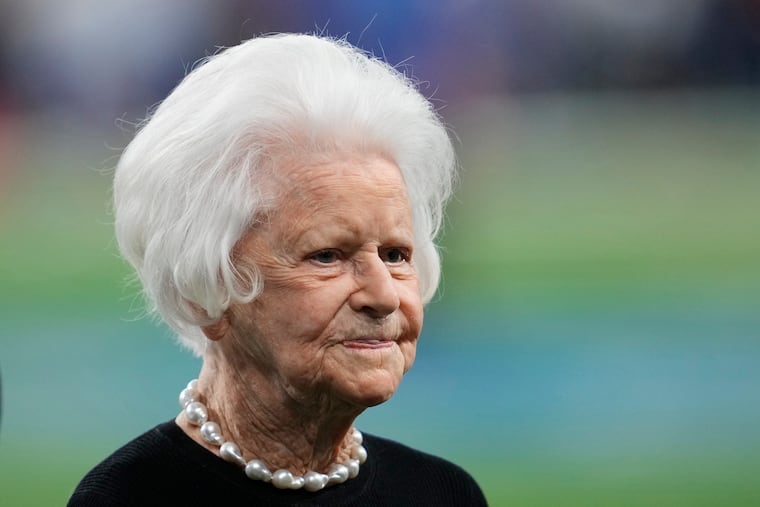
Martha Firestone Ford, the owner of the Detroit Lions and a stalwart fixture in a league that had long been a staunchly male preserve, has died. She was 101.
Her death was announced in a statement by the Detroit Lions on Tuesday that did not give a time or place of death.
Ford, a granddaughter of Harvey Samuel Firestone, the Firestone Tire and Rubber Co. founder, got her first up-close look at NFL team ownership in 1963, when she and her husband, William Clay Ford Sr., a grandson of Henry Ford, bought the Lions. She took over stewardship of the team when he died in 2014; she was 88 at the time.
Martha Ford was one of a handful of female owners that included Virginia Halas McCaskey of the Bears, Kim Pegula of the Buffalo Bills, Amy Adams Strunk of the Tennessee Titans and Gayle Benson of the New Orleans Saints. Ford, a plucky presence in ownership circles, stepped down in 2020, handing over the principal owner’s role to her daughter Sheila Ford Hamp, who had been groomed for the position.
A fixture in the owner’s box and at league meetings, Ford never fulfilled her longtime wish to see the Lions win a Super Bowl. (They remain one of three NFL teams, along with the Cleveland Browns and the Jacksonville Jaguars, never to play in the title game.)
The Lions’ heyday in the 1950s was long gone by the time the Ford family bought the team. During Martha Ford’s time as principal owner, the team was 45-50-1.
The Lions’ best year came in 1991, when they won 12 games and advanced to the NFC Championship game, where they lost to the Washington Redskins. Playing in a division with the Chicago Bears, the Green Bay Packers and the Minnesota Vikings, which all had long stretches of success, the Lions had many other less impressive years, including the 2008 season, when they failed to win a game.
“I just want a winning team for all our fans,” Ford said in “A Lifetime of Sundays,” a 2019 documentary that profiled four female NFL owners as part of celebrations of the league’s centennial. “I’m working on it, day and night.”
Martha Parke Firestone was born Sept. 16, 1925, in Akron, Ohio, to Harvey S. Firestone Jr., who took over his family’s tire business from his father, and Elizabeth Parke Firestone, who worked in clothing design with world-renowned couturiers.
At age 6, Martha went with her father to watch the Portsmouth Spartans, who played in the NFL for a few years before moving to Detroit to become the Lions in 1934.
Growing up, she spent time in enclaves of the country’s industrial elite, including Miami Beach, where her father owned a social club, and on the tennis courts in Newport, Rhode Island. After graduating from Vassar College in 1946 with a degree in sociology, she married William Clay Ford Sr., cementing the links between the two families. (Ford Motor Co. bought millions of tires a year from Firestone.) Their wedding on June 21, 1947, was attended by Edisons and Rockefellers, and was widely covered in the society pages.
William Ford bought the Lions in 1963 for $6 million at the urging of his older brother, Henry Ford II. His tenure got off to a rocky start. That season, the Lions’ star defensive lineman, Alex Karras, and Packers running back Paul Hornung were suspended for gambling. Despite the team’s travails, Martha Ford recognized her husband’s love of football and took an interest in the game.
“She knew my father was passionate about it,” Ford Hamp said in “A Lifetime of Sundays,” “so she figured, if they were going to have things to talk about, she better learn football, and so she did.”
William Ford was criticized by civic leaders in Detroit when, in 1975, he moved the team from the city’s Tiger Stadium to the Silverdome in the suburb of Pontiac. In 2002, his son, William Jr., moved the team back to downtown Detroit, to the newly built Ford Field.
Martha Ford took over the team after her husband’s death and quickly made her presence known. In 2015, she fired the team’s president and general manager, explaining her decisions in a public statement to fans.
She lashed out at President Donald Trump in 2017 after he urged owners to fire players who protested during the playing of the national anthem, calling his comments “negative and disrespectful” and “contrary to the founding principles of our country.”
Ford also played a small but pivotal role in the league’s decision to let the Rams move to Los Angeles from St. Louis. In January 2016, the owners met in Houston to consider a joint bid by the Oakland Raiders and the San Diego Chargers, which was considered the favorite, and a bid by the Rams owner, E. Stanley Kroenke. During the meeting, the Dallas Cowboys owner, Jerry Jones, argued that Kroenke’s plans were more ambitious.
As a tense debate continued into the afternoon, Jones asked NFL Commissioner Roger Goodell for a recess. He rejected the idea, so Jones asked if a bar cart could be wheeled into the conference room, a suggestion seconded by Ford. Cocktails were served, and not long after the meeting resumed, the owners voted to let the Rams move to Los Angeles.
Ford is survived by four children — Martha Parke Morse, Ford Hamp, William Clay Ford Jr. and Elizabeth Ford Kontulis — and by 14 grandchildren and 17 great-grandchildren.
This article originally appeared in The New York Times.