Rachel Apa died at Mile 24 of the NYC marathon. On Sunday, this Philadelphian made sure she got to 26.2
Charlie King was inspired by the tragic story of a stranger. The 28-year-old hopes others will work to help raise awareness for the condition that prematurely took Rachel Apa's life.
Charlie King never knew Rachel Apa. He grew up in Kensington, about 115 miles east of her hometown of Lewisberry, Pa. They went to different colleges, which led to different paths; Apa attended Bucknell, where she played field hockey and studied business, graduating in 2024.
King enrolled in the Community College of Philadelphia, where he majored in cinema and communications, before dropping out to take a full-time job as a home care supervisor in 2018.
But a few weeks ago, the 28-year-old found himself reading up on the life of a complete stranger. He saw Apa’s name by chance, on social media; a 24-year-old woman, in seemingly perfect health, who collapsed at Mile 24 of the New York City Marathon on Nov. 1.
Apa died hours later. Doctors believed the cause was rhabdomyolysis, a rare muscle condition that can be triggered by overexertion. King was training for a marathon of his own at the time, in Philadelphia.
It was a hefty workload, one the Kensington native was quite nervous about, so he opted to learn more about Apa’s story, to better educate himself on symptoms. Common ground between the two runners began to reveal itself.
Apa and King were both embarking on their first marathons. But their biggest tie was in their purpose for running. Apa dedicated the race to her late grandfather, who had Parkinson’s disease and died in 2022.
King could relate to this gesture. Most of his road races were a tribute to his grandmother, Patricia Banks, who had spent the last five years battling bone marrow cancer. Her disease had since gone into remission, so King was in search of a new cause.
» READ MORE: Kenya’s Victor Shitsama and Canada’s Dayna Pidhoresky post record-breaking times at Philadelphia Marathon
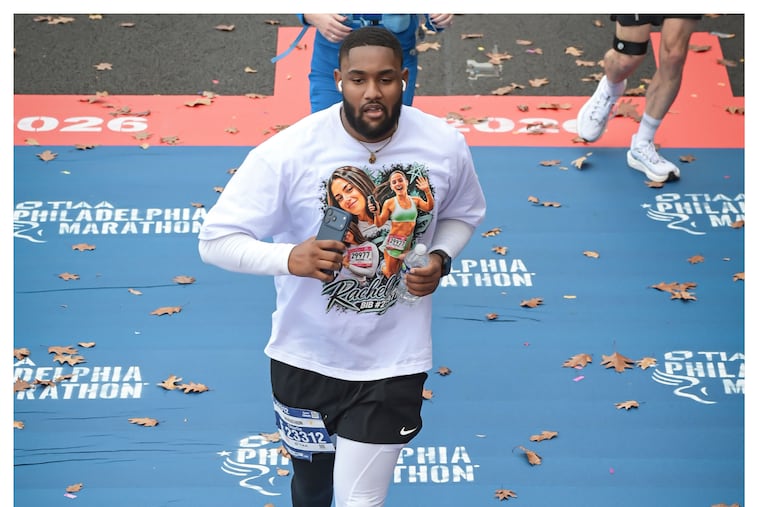
He discovered one in Apa. From that moment, King, who also works as a freelance videographer, decided he would run the Philadelphia Marathon in her honor. When he took to the city streets at 7 a.m. on Sunday morning, he did so in a T-shirt he’d designed himself.
On the front was a photo of the Bucknell alumnus, with her name, and bib number, #29977. On the back, was a message to a woman he knew only in spirit: “Let’s Finish This Together.”
“I didn’t want her name to be forgotten on that course,” King said. “It touched me a little bit. I wanted to do something special for her.”
‘Bring it home for her’
King started running in December of 2023. He came to the practice for its mental health benefits. The Kensington native and his friends had noticed that some of their peers were struggling with depression. A few had committed suicide.
So, the group created the Men’s Night Run Club Foundation, in the hopes of building a supportive space for Philadelphians. Its membership quickly grew, eventually expanding to include women.
They would meet on Thursdays at the Canopy Hotel on Ludlow Street, running anywhere from three to four miles. King was not shy about his desire to someday complete a marathon, but like many members, he’d never committed to it.
» READ MORE: Philly marathon spectators cheered, raised signs, and offered Jell-O shots for their running heroes
The idea of slogging through 26.2 miles was daunting in its own right. Coupled with the training, it seemed nearly impossible. Sensing that King needed a push, his friends at the Run Club decided to sign him up in late October.
The problem was the timing. King would only have a month to prepare. He started doing two-a-days; strength and conditioning in the morning, and long runs at night. This excessive workout regimen eventually led to a knee injury which put him on the sidelines for a few days.
By mid-November, King felt healthy enough to resume training, but now the marathon was only a week away. When he stepped onto the course on Sunday, the most King had run was 10 consecutive miles.
Bridging that 16.2 mile gap would be tough. He wondered if his body would just give out. But King kept reminding himself that he was there for a greater purpose; to spread Rachel’s name, and to spread awareness of rhabdomyolysis.
His friends reminded him of this, too. Before the race, they sent King prerecorded voice memos, set to play at certain mile markers. When his ankles began to hurt, shortly after he jogged past Fairmount Park, the voice of Kyron Haynes filled his ears, evoking the “bigger cause” at stake.
» READ MORE: Happy stragglers: Meet the final three finishers of the Philadelphia Marathon
When his legs began to cramp, as he ran along the Schuylkill River, words of encouragement from Julio Ledesma rang through.
“Just remember who you’re doing it for,” he told King. “For Rachel. Bring it home for her. We’ll be waiting for you, bro. We love you.”
Anthony Phillips took Mile 25. He knew his friend would be completely fatigued. So he kept his message simple and succinct.
“You know who you’re doing this for,” he said. “Rachel. You got this. Push hard. Push for those who can’t actually push for themselves.”
In the moments King didn’t have this auditory support, he leaned on spectators in the crowd, many of whom noticed Apa from his T-shirt. Some gestured excitedly at her photo; in response, he gestured back.
“I [saw] one lady who was totally in shock,” King recalled. “She looked like she was about to tear up. She and her husband, I believe that was, pointed at my shirt. I was glad people were starting to take notice.”
Five hours and 30 minutes later, King crossed the finish line. As his friends began to walk toward him, he broke down in tears.
“Honestly, this was just a mission,” he said. “I just wanted people like Rachel to be seen and not forgotten. Especially when [her race] had a positive goal behind it.”
Remembering Rachel
No one could’ve anticipated what happened to Rachel Apa on the brisk morning of Nov. 1. She had been training for months, and it showed; Apa ran with power but also joy, cheerfully waving to friends and family. Her father, Steve, told CBS Mornings that by Mile 9, his daughter was already texting him about signing up for the Boston Marathon.
When Apa collapsed, in Central Park, bystanders rushed to help. Some gave her CPR. Michaela Nicholas, a hospital social worker who was present, relayed to The New York Times that the medical team took an “unacceptable amount of time” to arrive.
According to the Cleveland Clinic, only 26,000 Americans a year develop rhabdomyolysis. But if untreated, the condition can be deadly. It prompts muscles to break down, shooting toxic fibers into the circulatory system and kidneys.
Apa was taken to a nearby hospital, but doctors were unable to save her. She died in the dawn of her life, before she could see where it would lead. Her family has since created a foundation in her name, dedicated to educating people about rhabdomyolysis, and improving on-course medical care.
It won’t bring their loved one back. But it could save others from more heartbreak. King says he plans to fundraise for the foundation in the future — all while making sure that he and Apa continue to finish every race.
“I wanted to be more invested,” he said. “So we can be aware and keep other runners prepared for things like this.”