What happened to Big 5 basketball?
The Big 5 was a glorious thing that folks knew about beyond Philadelphia. Now it isn’t much of anything anymore. The reasons are many.
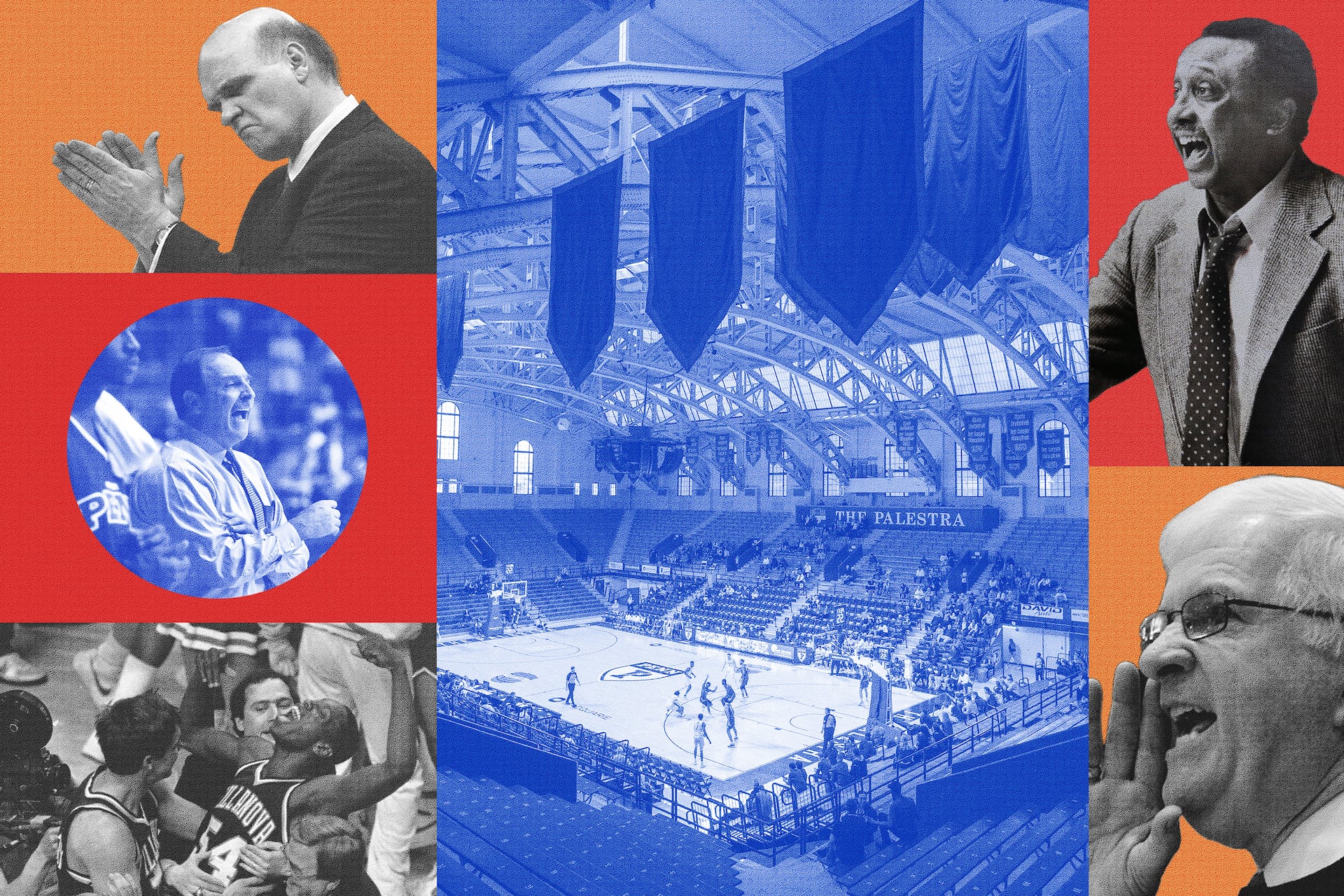
One afternoon in early December, Bill Raftery and Tim Legler, both La Salle alumni, returned to campus for an hourlong panel discussion about their careers in sports media, only to have the conversation shift to a topic with broader implications.
It was a point of pride for the university to welcome back Raftery, who has been college basketball’s preeminent analyst for more than a quarter-century, and Legler, who has reached a comparable status at ESPN with his insights into the NBA. But 33 minutes into the event, the first question from an audience member wasn’t about the origins of Raftery’s trademark catchphrases (The kiss! … Onions! … Laundry on the deck!) or Legler’s game-film breakdowns.
“Can we bring the Big 5 back to its glory?” a man in the auditorium asked. “Because it was a national thing, right? It wasn’t just a Philly thing.”
These days, most people who follow college basketball, if they’re being honest, have to acknowledge that the Big 5 isn’t much of anything anymore. The round-robin rivalries among La Salle, Penn, St. Joe’s, Temple, Villanova, and more recently Drexel have lost most of their juice.
That white-hot competition, fueled by the benign hatred that only proximity and familiarity can ignite, used to define Philadelphia hoops. It has cooled. Now, just one school, Villanova, enters each season with the baseline expectation that it will qualify for the NCAA Tournament, and the pipeline of local recruits that once sustained these programs has all but dried up.
Four of the six schools — Drexel, La Salle, Penn, and Villanova — don’t have a Philadelphia native on their rosters. Interest in the city series has plummeted. A 2022 doubleheader at the Palestra drew an official attendance of just 3,300 people. And the Big 5 Classic, conjured in the aftermath of that alarming display of indifference, hasn’t revitalized the rivalries or restored any prestige to them.
While this season has seen an uptick in the programs’ quality of play — Villanova is virtually assured of an at-large bid, and Penn, St. Joe’s, and perhaps Drexel could be strong enough to win their conference tournaments — that improvement hasn’t been enough to stem the dismal tide.
For their part, the panelists at La Salle mustered some nostalgia but weren’t optimistic. Legler, who grew up in Richmond, Va., remembered attending a Palestra doubleheader on a recruiting trip and marveling at the atmosphere: the streamers, the cheering, the chanting.
“I turned to my parents and said, ‘This is the environment I want to play college basketball in,’” he said. “It was literally that transformative.”
» READ MORE: Does this Big 5 format make sense for all?
Still, he had no solution for salvaging the Big 5, and neither did Raftery, who suggested that smaller programs throughout the NCAA would soon be casualties of this new era of college basketball.
“They’re trying to freeze [out] a lot of programs and leagues,” he said, “and I can envision maybe two or three conferences. They’ll run the whole thing, and the networks will pay for it. That’s the way it is.”
It’s convenient to point to the sport’s lurch into modernity — into the era of Name, Image, and Likeness; of pay-for-play; of the permeable membrane of the transfer portal — as the cause of the decline. And it’s true: With the exception of Villanova, which is ensconced in the Big East and supported by engaged donors with deep pockets, college hoops’ evolution has made everything more difficult for the other, more vulnerable programs in the city. But this train has been rumbling down the tracks for a while, and its arrival should compel a reevaluation of the Big 5’s history, of the decisions and unstoppable forces that led it here, to the brink.
To those Baby Boomers and GenXers weaned on the Big 5’s traditions, it’s surely incomprehensible and saddening to hear Raftery contemplate a world without it. But if the institution as Philadelphia knew it is fading away — and it appears to be, if it hasn’t already — the proper question isn’t Can it be saved? That one has been asked and is on its way to being answered.
No, the better questions to chew on are these: How did the Big 5 survive, and at times thrive, as long as it did? And did any of the attempts over the years to preserve it and its identity actually contribute to its downfall?
The seeds of rebirth and decline
It’s tempting to picture the Big 5’s history as an unbroken string of unforgettable nights at the Palestra, great teams playing great games inside a gym packed to its uppermost corners with 9,000 people, give or take a few rascals who managed to sneak in for free. There were hundreds of such nights, to be sure. But it’s striking to put that past into a wider context and see how much certain changes and trends fostered and then jeopardized everything that made the Big 5 wonderful and unique.
Those fond memories often gloss over a relatively fallow period for the Big 5 during the 1970s. Villanova had three consecutive losing seasons from 1972 to 1975. Temple went 16-37 over the ’74-75 and ’75-76 seasons and qualified for the NCAA Tournament once in an 11-year span from 1972 to 1983. St. Joe’s went 8-17 in ’74-75, the first of six straight seasons in which the Hawks missed the NCAAs. Penn was the exception, and La Salle held its own, but a Daily News back-page photo captured the overall listlessness perfectly: Harry “Yo-Yo” Shiffern, the lovable vagrant who was the city series’ unofficial mascot, fast asleep during a Palestra doubleheader.
The Big 5 was in a collective funk, and it took a few pivotal developments to snap it back to prominence and position it to flourish further.
College basketball’s landscape was flatter then. The NCAA Tournament went to 32 participants in 1975 and to 40 in 1979, and many of the qualifying programs were mid-majors. During the ’70s, each of these teams reached the Final Four: Jacksonville, St. Bonaventure, New Mexico State, Western Kentucky, Marquette, UNC Charlotte — and, in ’79, Penn. The Quakers upset North Carolina, Syracuse, and St. John’s before Magic Johnson and Michigan State pulverized them in the national semis. But their run was the most improbable of the decade, and their timing was impeccable.
The following season, after a star turn at the Pan-American Games in Puerto Rico, La Salle’s Michael Brooks was named the Kodak National Player of the Year. As terrific as Brooks’ senior campaign was — he averaged more than 24 points and 11 rebounds, scoring 51 points in a triple-overtime loss at BYU — his candidacy for the honor was buoyed by Indiana’s Bob Knight, who had coached him at the Pan-Am Games and touted him to reporters.
“If I were allowed to start my own team tomorrow,” Knight said in January 1980, “the first person I would pick would be Michael Brooks.”
Such praise from the best, the most famous, and the most temperamental coach in the country carried weight, and Knight’s words elevated the reputations of both Brooks and Philadelphia basketball. That ascendance continued in March 1981, when St. Joe’s, under Jim Lynam, won the East Coast Conference tournament, knocked off top-ranked DePaul in the second round of the NCAAs, and advanced to the regional final before losing to the eventual national champs: Knight, Isiah Thomas, and the Hoosiers.
So the Big 5 was on its way back, regaining relevance among casual college hoops fans and among the sport’s cognoscenti. The two most significant factors in its renaissance, though, happened off the court. In March 1980, Villanova left the Eastern Eight and jumped to the Big East. And in August 1982, Temple hired John Chaney as its head coach.
Those moves and the rewards they wrought thrust those two programs, and in turn the entire Big 5, into a higher realm. Villanova won the national championship in 1985 — an underdog triumphant, a marvelous story enhanced by the Wildcats’ status as a program in a major conference in a sport whose vast national reach was still expanding: Magic vs. Larry Bird in ’79, North Carolina State surviving and advancing in ’83, Dick Vitale, CBS, ESPN, Big Monday, Selection Sunday, March Madness consuming a month’s worth of America’s attention.
Chaney was this wild-eyed, lesson-teaching, justice-preaching wizard, confounding opponents with his matchup-zone defense, crafting the hardest schedule in the nation every year to battle-test his teams, leading the Owls to a No. 1 ranking in 1988 and three Elite Eight appearances in a six-year span.
Nestled in the Metro Atlantic Athletic Conference (MAAC) with schools of similar profiles, La Salle went to the NCAA Tournament four times and the NIT twice in Speedy Morris’s first six years as head coach and had another national player of the year: Lionel Simmons. From 1992 to 1995, Penn dominated the Ivy League under Fran Dunphy: a 69-14 record, three NCAA Tournament appearances and a first-round victory over Nebraska, Jerome Allen and Matt Maloney forming one of the best backcourts in the country. St. Joe’s went 26-7 and advanced to the Sweet 16 in 1996-97, the season that introduced that notorious wallflower Phil Martelli to the rest of the country.
Those were high times. They wouldn’t last. In fact, by the time St. Joe’s enjoyed its remarkable 2003-04 season and Jay Wright was restoring Villanova to national-title contention, the seeds of the Big 5’s diminishment had already been planted.
Hard circumstances and poor decisions
The factors that damaged the Big 5 were legion. Some applied to just one or two programs. Some applied to all of them. Some were mistakes, bad choices. Some were unavoidable and beyond the programs’ control.
Start with La Salle. Given an opportunity in 1990 to build an 8,000-seat on-campus basketball arena — Tom Gola offered to raise the funding for it — the university said no. Then its leadership made what is commonly considered the disastrous decision to relocate from the MAAC to the Midwestern Collegiate Conference. The program has never recovered.
Look at Temple. Chaney, a singular presence and attraction, retired in 2006. Though Dunphy, his successor, guided the Owls to six consecutive NCAA Tournament appearances, the university’s quest for football dollars led it to leave the Atlantic 10 for the American Athletic Conference — and abandon its basketball-first identity.
Again: individual schools, individual issues. But those problems were byproducts of college basketball’s overall reshaping during the 1980s and ’90s. In retrospect, the most infamous moment in Big 5 history — the dissolution of the round-robin, at the insistence of Villanova and coach Rollie Massimino, after the 1990-91 season — was an acknowledgment of those changes, and the attempts to preserve the Big 5 as it had always been would inevitably fail.
When Villanova pushed to cut back on city series games and Temple pushed for more of those matchups to be played at campus sites other than the Palestra, they weren’t merely trying to make things easier for themselves. They were responding and reacting to college basketball’s new conditions for success.
Sneaker companies had begun financing all-star camps, AAU programs, and college programs. Now coaches didn’t have to rely on local high school teams to find players, and great Philly players were no longer making their names solely in the Public League, the Philadelphia Catholic League, or the Sonny Hill League. They were traveling to play AAU. They were seeing other cities, meeting other coaches. They weren’t as likely to stay home to play college ball.
The most important recruiting device is recognition, and recognition comes from national TV. … They don’t know what the Big 5 is outside of this area
“The most important recruiting device is recognition,” Chaney told author Bob Lyons in Palestra Pandemonium: A History of the Big Five, “and recognition comes from national TV. … They don’t know what the Big 5 is outside of this area. They knew who Villanova was when they won the national championship, so you could always attach yourself to them. But it wasn’t going to get you very far because no one knew the history and tradition of the Big 5.”
In that way and others, the inherent parochialism of the Big 5 worked against it. For instance, Dave Gavitt, the founding commissioner of the Big East, struck a deal in 1980 with ESPN, then a fledgling sports network hungry for programming, for the exclusive rights to televise the conference’s games. That arrangement made it difficult, if not impossible, for Villanova and any other Big East school to be involved in a 7 p.m./9 p.m. Palestra doubleheader and for a national television audience to watch that doubleheader.
“We needed the game between Villanova and Georgetown at 8 p.m. to go on our network,” Gavitt told Lyons. “We couldn’t clear games at 7 p.m. because of the game shows that all the local stations carried.”
As it was, the Big 5 had a TV deal of its own, with the Philly-based premium cable channel PRISM, starting in 1978. Yet the PRISM commitment actually limited the exposure of some of the Big 5’s schools.
During the 1989-90 season, as one example, the Atlantic 10 wanted to place a Temple-La Salle game on ESPN so that it would be telecast nationally. “ESPN,” Lyons wrote, “subsequently refused to carry it, however, because it did not want to black it out in PRISM’s trading area.”
So hoops fans in the Delaware Valley could watch the game at home, but no one else could. At a time when college basketball was becoming more accessible, the Big 5 was cutting itself off from everyone who wasn’t already familiar with it.
That history might seem ancient. It’s not. Wright’s tenure and the economics of the sport have placed Villanova on a separate tier from the other programs. And now that he, Chaney, Dunphy, Martelli, and Morris — the local legends who were the backbone of the Big 5 — aren’t coaching anymore, the remaining infrastructure hasn’t been strong enough to restore the teams to excellence and maintain the intensity of the rivalries.
It’s a shame, but it was only a matter of time. Yes, the Big 5 was a Philly thing. Yes, it was a national thing. Yes, it was a glorious thing. And now it’s gone, and all the wistfulness and wishful thinking in the world won’t change the hard and inescapable truth: That glory isn’t coming back.