Bringing Lincoln University to Philadelphia for HBCU football was ‘personal’ for Mayor Parker
Parker, a 1994 graduate of Lincoln, said the university played a significant role in shaping her success. Friday night was about celebrating the long history of HBCUs: “It’s only going to get bigger.”
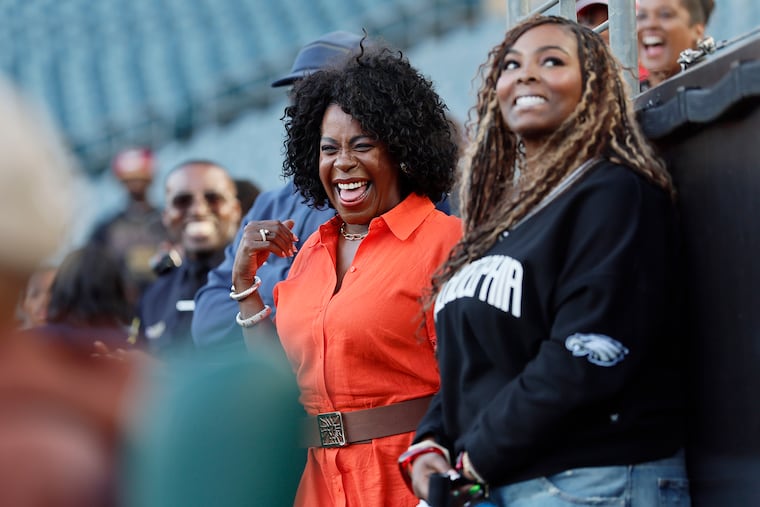
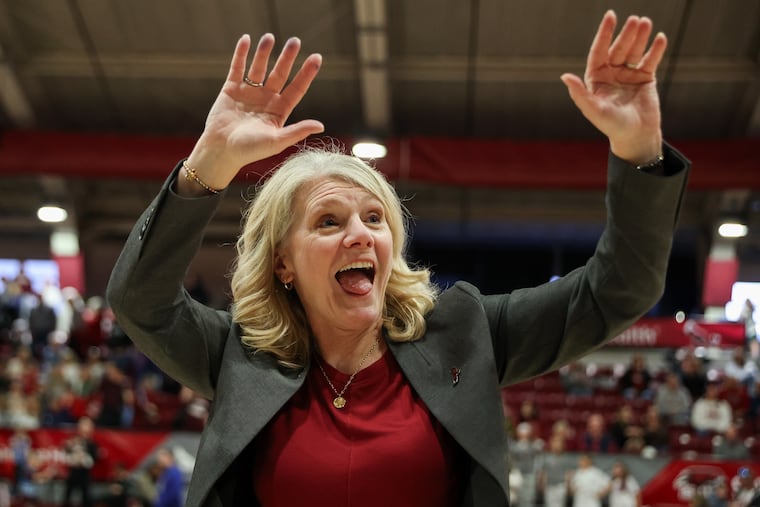
Mayor Cherelle L. Parker began fanning the tears that were starting to form in her eyes inside the northeast tunnel of Lincoln Financial Field, two hours before her alma mater played in the Eagles’ home stadium on Friday night.
A 1994 graduate of Lincoln University, the first degree-granting historically Black college or university, Parker was attempting to put into words what it meant to see the school’s colors, orange and blue, written in the north end zone and wrap the walls of the stadium.
“I’m filled with a lot of excitement right now, but it’s also very personal for me,” Mayor Parker, wearing an orange jumpsuit with orange boots that was an unmistakable homage to Lincoln, told The Inquirer. “I wouldn’t be the mayor without a public education, K through 12, here in Philly, and that foundation I got at an HBCU, which was Lincoln University. They told me I could be anybody.
» READ MORE: HBCU football returns to the Linc. Meet the four teams competing this weekend.
“It didn’t matter that I started behind the starting line. It wasn’t the same for me as it was for other people. But [Lincoln] said, ‘No excuses.’ I’m never satisfied, and it’s never good enough because [Lincoln] planted those seeds in my head, and so, I’m just grateful.”
A few hours later, Mayor Parker, watched near the southwest tunnel in the Linc, when Lincoln’s football team took the field with Meek Mill’s “Dreams and Nightmares” blaring with an orange and blue light show illuminating the stadium. And she was there, too, at midfield, conducting the pregame coin toss between Lincoln and Virginia Union, donning her half orange, half blue Lincoln jacket, with the Lion emblem on the left side.
“[Mayor Parker] gave me a hug [before the game],” Lincoln’s football coach Frank Turner said postgame. “She told me that she was proud of me, proud of of the program, and things like that, and [to] keep pushing.”
The “Orange Crush,” Lincoln’s band, played the national anthem pregame. “Lift Every Voice and Sing” was performed afterward. The various colors of the Divine Nine — historically Black fraternities and sororities — performed at the step show on the east side of the stadium from 3 p.m. to 5 p.m. Mayor Parker was especially excited to watch chapters from Delta Sigma Theta sorority, for whom she became a member of in the Spring of 1994 at Lincoln, perform.
This was all what Mayor Parker had envisioned when she first thought of bringing HBCU football back to the city. A staff member from the mayor’s office says this dream of Mayor Parker’s has been formulating in her mind for at least 18 years, if not longer, and long before she became Philly’s mayor in 2024. She recalls telling the Philadelphia City Council, for whom she was member of, several years ago, “Man, I want to do a classic HBCU Classic here in Philly.”
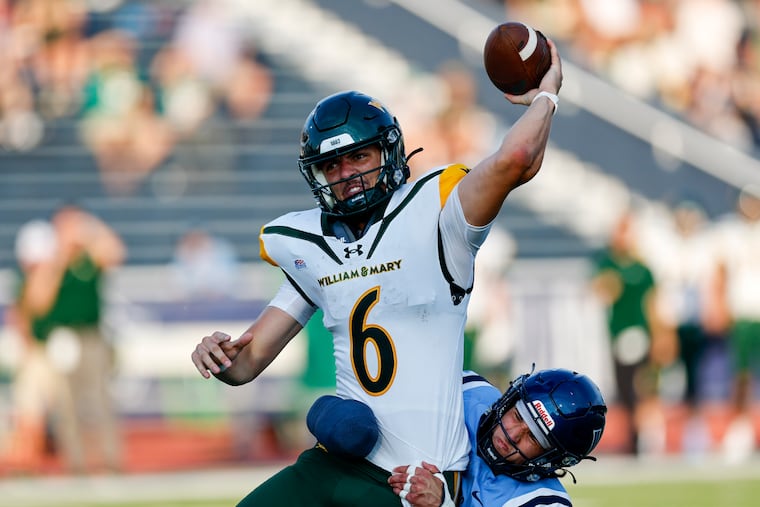
And though her school, Lincoln, were shutout by Virginia Union, 62-0, on Friday night, dropping them to 1-8 on the season, the game marked the first time the school played in Philly in 16 years. Back then, Lincoln played Cheyney University, the oldest HBCU in the country, annually in the city.
Lincoln has a deep history playing football games in Philadelphia. Mayor Parker admitted she hadn’t previously known that in 1919, Lincoln and Howard (based in Washington, D.C.) played in Philadelphia, which became the earliest known use of the term “Classic” to describe an HBCU football game. That game 107 years ago was played at the Baker Bowl, which was then the home of the Phillies, and a series was held for the next decade, alternating at the home of each city’s professional baseball stadium.
Friday night’s game between Lincoln and Virginia Union, which will be followed by DeSean Jackson’s Delaware State facing Michael Vick’s Norfolk State, two former Eagles, playing on Saturday (3 p.m., ESPN+), is a microcosm of the week. There was a Battle of the Bands earlier this week and another to be held on Saturday featuring several HBCUs, along with a job fair and choir show as highlights of One Philly HBCU Week, turning what was a solo HBCU game last year into a full week of celebrating HBCUs and Black culture.
“It showed the range of One Philly [HBCU Week],” Mayor Parker said about the week. “It’s the One Philly and the HBCU Divine Nine fraternal organization culture. So I’m just proud that this excellence, this Black excellence, is on full display. Wow! Wow!”
» READ MORE: ‘Oh heck, no!’: Michael Vick and DeSean Jackson didn’t plan on coaching. Doug Pederson sees why they did.
Mayor Parker reached back into her memory bank, 36 years ago to be exact, to recount when she began her college journey on Lincoln’s campus. In her own words, she practiced with the track team, was a cheerleader, and became the “first female president of the Lincoln University Student Government Association” during the 1993-94 school year.
She spoke of David Haines, a fellow Lincoln graduate who was Will Smith’s photo double in the movie Ali and several other Smith films, Christoper Curry, a minister in Wilmington, among several others for helping her become SGA president.
Mayor Parker became the first person in her family to graduate from college and earned her Lincoln degree in English Education.
“When you go to an HBCU, it’s the football, the bands,” Mayor Parker said, “but it’s [also] the culture in the [Divine Nine]. I’m a Delta. It’s just part of that sense of hope and pride and dignity.”
She added: “If you don’t tell the story about who you are and continue the legacy, you don’t know when somebody will come around and intentionally try to erase you and your community and your contribution and your story and your legacy.”
The night’s festivities continued with three-time Grammy Award winner Ludacris performing hit songs like, “How Low” and “Stand Up” along with his verses in “Yeah!” and “All I Do Is Win” with a gaggle of Lincoln and Virginia Union students watching him up close on midfield, while others danced from the stands.
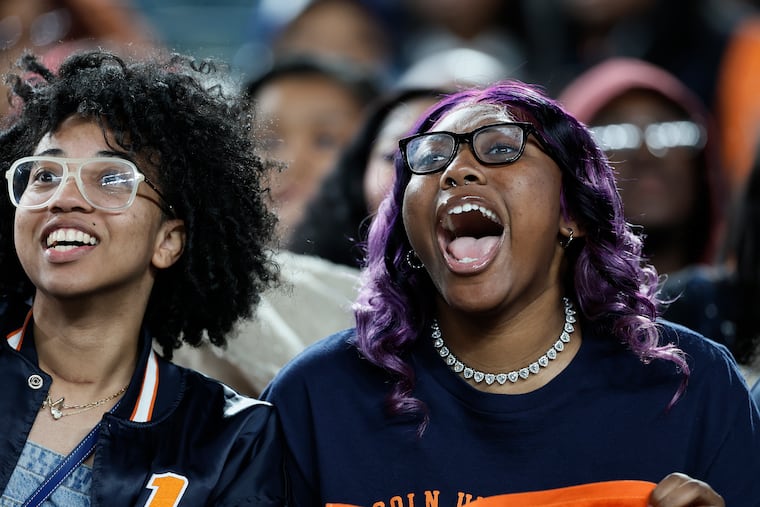
The announced crowd of 21,854, many of which were pro-Lincoln, didn’t have many moments on the field to cheer about. But this was bigger than football. It was a night to celebrate the long history of HBCUs.
“It’s only going to get bigger,” Mayor Parker said. “And listen — the hope is that if we do it right, I’ll be dead. But Philly will still have a HBCU Classic.”