As squash’s U.S. Open approaches, Philly’s own pros make themselves at home at the Specter Center
Philly actually has two professional squash teams in the Freedom and the Lightning. And the squash world will descend on the Specter Center and Drexel's campus starting Sunday.
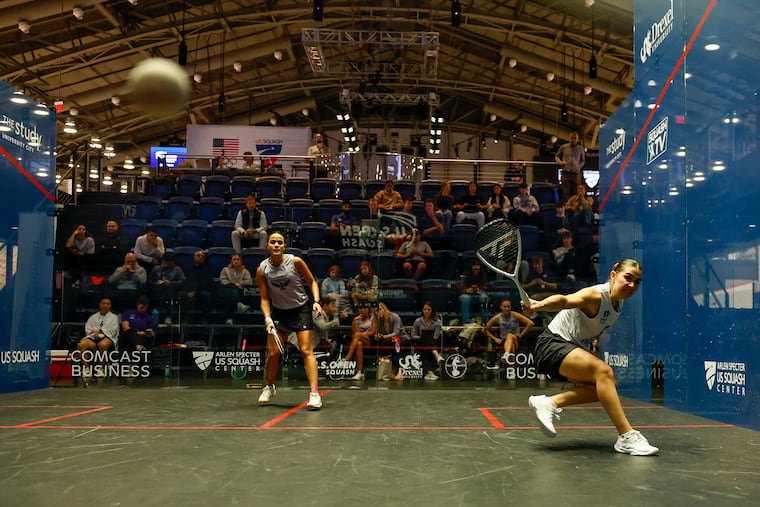
Squash usually is a one-on-one game. But for the Philadelphia Freedom, it’s all about teamwork, strategy, and racing against the clock.
Now in their third season, the Freedom compete in the National Squash League, which puts a twist on the traditional game for men and women (Philadelphia also has a men’s team, the Lightning).
“Personally, one of the reasons I decided to get involved was because I thought it was a good opportunity,” Sunil Desai, the Freedom’s owner, said Thursday as his team lost, 45-34, Seattle Freeze. “I think there’s something to this, and I, as well as all the players out there, would really like to see squash grow.”
In the NSL, the clock is just as important as the scoreboard. Matches are divided into three timed periods, forcing players to rethink how they approach every rally.
Each team gets three starters and three substitutes. The first two periods are 20 minutes long and have one PowerPlay (where only the attacking team serves and scores), while the third period has two PowerPlays and four subs for 30 minutes of action. The team with the most match points after three periods wins.
“If it’s your PowerPlay, you want to try and win points as fast as possible,” Desai said. “If it’s not your PowerPlay, you want to make points last as long as you can to just waste time.”
It’s a learning curve, even for experienced players.
“You can tell them all you want beforehand, and until they get out there, it doesn’t always register,” Desai said. “So the more they play the format, that’s the progression. They learn to adjust.”
» READ MORE: NSL finishes second season with ‘a completely different take’ on the game | from 2025
Though the Freedom’s star, current world No. 5 Olivia Weaver, is from Chestnut Hill, others hail from Egypt, France, and Norway. The sport itself originated in England.
“We travel so much for this sport, it has become normal,” said world No. 35 Mariam Metwally as she stretched after the match. “We have families that take us in in America, which is unlike many other places. They are so nice here.”
Added Norway native Madeleine Hylland: “It’s a very small community, which can be helpful in feeling comfortable with the travel.”
Unlike tennis, which can be played on a variety of surfaces, squash requires specialized indoor courts, presenting a challenge when introducing the sport to youth and school programs.
Desai coaches girls’ squash at Conestoga High School, where the goal is to get as many girls on the court as possible and continue to grow interest in the game. Several members of the high school girls squash team attended Thursday night’s Freedom match.
“It’s really cool to get to watch the pros play,” said Lizzie Brooks, a senior squash player at Conestoga. “I feel like we all learn a lot when we get to come and watch. It’s just really fun.”
» READ MORE: For Olivia Weaver, the center of American squash is home sweet home | from 2024
Brooks said she was especially excited to watch the upcoming U.S. Open, which starts Sunday at the Arlen Specter US Squash Center on Drexel’s campus. Several Freedom players plan to compete.
“The Open is crazy,” Brooks said. “We’re going on one of the days, but it will be way more packed than it is today. But still, it feels like everyone kind of knows everyone here, even during the Open.”
Said Desai: “As you can see, it’s a very friendly community. You can have competition that brings out the best in everyone. And you can have rivalries and at the end of the day still actually be friends.”