Kent State and the silence of American campuses | Will Bunch Newsletter
Plus, a grim World Press Freedom Day for America.
Yogi Berra famously said it ain’t over until it’s over. I turned on the NBA playoffs last Tuesday, expecting to watch funeral services for the 76ers, and somehow they jumped out of the coffin. The Flyers weren’t supposed to sniff the postseason, either. My friend and former Daily News colleague Julie K. Brown was robbed of her Pulitzer Prize for exposing Jeffrey Epstein, until they gave her one. Keep the faith. Things can only get better.
If someone forwarded you this email, sign up for free here.
56 years after the Kent State massacre, the campus silence is deafening
It was exactly one year and one day ago that John Cleary made a very special return trip to the college campus where he earned a diploma in architecture in 1974 — and where a bullet tore through his chest and nearly killed him on May 4, 1970.
For years, Cleary stayed away from Kent State University and the site where National Guard members killed four of his classmates and wounded eight others during a Vietnam War protest. Although he fully recovered to become a successful Pittsburgh architect and a married dad, Cleary’s memories of a bullet “that felt like a sledgehammer,” getting knocked unconscious, and landing on the cover of Life magazine, remained painful for many years.
But time heals all wounds, and over the next 55 years, Cleary reconnected with his “blood brothers” from the era when college campuses were wracked by protests. Last year at 12:24 p.m. on May 4, Cleary rang the Victory Bell in the center of Kent State to mark the solemn anniversary. Like other survivors of that day in 1970, he believed they had a message from the past about free expression.
“It’s important to not let people forget what happened and to understand the significance,” he said. “It could happen again … We need to practice kindness and respect, respect freedom of speech, and learn to get along with people we don’t agree with.”
The 2025 bell ringing was the last for Cleary, who died last October at age 74, and was memorialized at Monday’s commemoration of the 56th anniversary of the student massacre. Other “blood brothers” are gone, too, including shooting survivor Alan Canfora, who spoke with me for a 2020 column and recalled “a sense of disappointment that the government of our country would cover up such an obvious injustice.”
The disappearance of this greatest generation of campus expression comes right at a time when the free speech they so fervently believed in has never felt more endangered, as the repression that was unleashed with those 67 shots now feels suffocating.
Not since that spring — with college students in an uproar after Richard Nixon sent U.S. troops into Cambodia — have there been so many things for young people to protest. The list includes another war — this time in the Middle East — and the Donald Trump regime’s war on higher education. And yet, today’s campuses are so quiet you can hear a bell ring.
A recent article in Mother Jones reported that college protests have fallen off by a whopping 56% since Trump won his second term in the fall of 2024, even as the No Kings demonstrations against the president’s abuses attract record crowds off campus. Indeed, the sounds of silence have been so deafening that it’s inspired a new genre of “Where are all the protests?” op-eds, many with a mocking tone from right-wingers who loathed the spring 2024 encampments against Israel’s war crimes in Gaza.
Those columns are utterly ridiculous. Kids today aren’t protesting because they know their chance for a diploma — the one thing grown-ups have told them they need to avoid utter failure in life — is in jeopardy if they step out of line in the current environment. It’s a perfect storm of red state laws like Florida’s limits on what it calls “woke” classroom discussions, Trump regime probes of alleged antisemitism on elite campuses, and craven college presidents in an arms race to see who can impose the toughest restrictions on protesting.
There’s a strong case to be made that the current censorious environment is the culmination of what began with the Kent State massacre. That shooting happened at a moment when rising conservatives thought the 1960s surge of young people getting a liberal education was becoming a threat to capitalism, that, in the words of one adviser to Ronald Reagan, “an educated proletariat” was “dynamite.”
That was especially true when young people were protesting Vietnam at a place like Kent State, chock full of first-gen students from the Rust Belt working class. The solution from right-wing thought leaders was to cut public aid to higher education to raise tuition, thus making college not a public good but a costly personal obligation. The new zeitgeist gave debt-burdened students little time or incentive to protest.
Yet, in the Trump era, the notion that higher education is the breeding ground for future “woke” voters who want and celebrate a more diverse America — an idea that boiled over with pro-Palestinian encampment protests at a handful of elite schools in 2024 — convinced the far-right to wage their war on college more blatantly out in the open.
The reason we’re not likely to see another Kent State-type shooting in 2026 is not that we’ve learned it’s wrong to crush free expression on college campuses with a militarized response. No, the reason campuses are mostly quiet in a time of societal collapse is that the guys with the guns have won.
Just weeks before Cleary rang the bell in 2025, Ohio lawmakers and GOP Gov. Mike DeWine enacted a sweeping legislative assault on academic freedom, Senate Bill 1. The measure bans all university diversity programs, curbs tenure and union activities on campus, and even includes mandates on what can be discussed in classrooms.
Since the law took effect, college administrators across Ohio have been forced to eliminate 90 smaller academic programs, with the deepest cuts at Kent State. Gone now are degree programs ranging from life sciences to the classics to Africana studies. The move spotlights a wider war on teaching the humanities, and on the quaint 1960s notion that college can be more than just narrow career training.
Monday’s bell ringing at Kent State — part of a weekend of commemorative activities including a candlelight vigil and even a Neil Young tribute band that blasted his post-massacre protest hit, “Ohio” — was a remembrance, a requiem, and a challenge. Today’s young people want to be heard by the grown-ups who’ve made such a mess of the world, if we can give them some space to breathe.
Yo, do this!
I was struggling to pick a new audiobook this month, until the U.S. Supreme Court reminded me of all the political ups and downs of the Deep South. Thus, I am finally listening to White Flight: Atlanta and the Making of Modern Conservatism, a 2005 book by the great Princeton historian Kevin M. Kruse. It tells the story of how 1950s and ’60s integration and the rise in response of predominantly white suburbia also inspired the philosophies of modern American conservatism. It’s the story of our time, hiding in plain sight.
May has brought a bounty of riches to the City of Brotherly Love. Friday night, I was expecting to be cheering Bruce Springsteen from the nosebleed seats at whatever they call that South Philly arena these days. Little did I know that, in rooting for the Sixers to oust the hated Boston Celtics, I was also rooting for the postponement of Bruce. Now I’ll be in front of a TV set watching Joel Embiid, Tyrese Maxey, and the boys against the also-hated New York Knicks on Friday in Game 3 at 7 p.m., streaming on Amazon Prime. Springsteen has been moved to May 30 … assuming the Sixers and Flyers don’t keep winning and bump him again.
Ask me anything
Question: “I see that Trump keeps bringing up taking a cognitive impairment screening three separate times, seeming to think it’s an IQ test or something. Has a reporter ever asked him point blank why he keeps being screened, and told him what it is? And if not, why don’t they? He talks to the press a lot.” — Dr. Pretorius (@doctorpretorius.bsky.social) via Bluesky
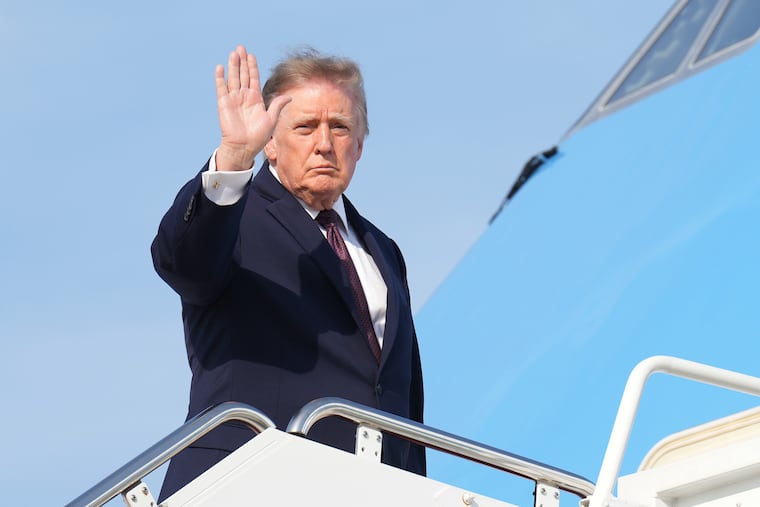
Answer: I could not agree more about the president’s cognitive health, which is deteriorating before our very eyes. (On Tuesday morning, a viral video revealed Trump’s growing difficulty in walking a straight line when he gets off Air Force One. And what was up with that emergency dental visit?) So why don’t reporters ask more pointed questions about this? Some of it is probably because they expect a gobbledygook answer about giraffes or squirrels or whatnot. But mainly, they fear losing access. A pointed question to Trump might also be their last. This is why I can’t stand access journalism.
What you’re saying about …
Not a lot of responses to last week’s question about rescheduling the cursed White House correspondents’ dinner, which was postponed late last month when a gunman rushed the event, attended by Donald Trump. Those of you who did respond all agreed that journalists shouldn’t be partying with the president in the first place. “Hell No!!” wrote Janet Wamsley about the notion of trying to hold the event again. “The press should be acting like the press, not mouthpieces for the administration.”
📮 This week’s question: Politico is reporting that Pennsylvania Democratic Sen. John Fetterman, who has taken an increasingly conservative stance on a few key issues, is being wooed as a potential party switch by some top Republicans, including the president. He probably won’t join the GOP, but … seriously, should he? Please email me your answer and put the exact phrase “Fetterman switch” in the subject line.
Backstory on a glum World Press Freedom Day
This past Sunday marked World Press Freedom Day, a moment that inspired the moral leader of the free world to warn about the growing risks to journalists, even in his native United States. “Today we celebrate World Press Freedom Day … unfortunately, this right is often violated, sometimes in blatant ways, sometimes in more hidden forms,” he said, adding a remembrance of “the many journalists and reporters who have been victims of war and violence.”
The American leader who criticized today’s repressive environment was Pope Leo XIV, speaking at Vatican Sunday services. President Donald Trump, who was out on a Florida golf course, made no mention of World Press Freedom Day. That may have been appropriate, considering a White House war on the media is a main reason Reporters Without Borders has dropped the United States down to just 64th out of 180 nations for press freedom, America’s worst showing since the survey was launched in 2002.
The group, which is known by its French acronym RSF, stresses that the U.S. is not unique and that it finds censorship and repression on the rise all over the globe, with the overall press freedom scores for all 180 countries also at the lowest point ever. More than half are now listed as “difficult” or having serious problems by RSF, which notes that national security clampdowns have been rising ever since the terror attacks on U.S. soil in 2001.
Still, the fact that the United States, which has always cited First Amendment freedoms as a selling point for our brand of democracy, is dropping down the ladder behind countries such as Liberia and war-torn Ukraine ought to be a wake-up call. RSF cited not only Trump’s frequent attacks on the media as “the enemy of the people,” but also the arrest and subsequent deportation of Salvadoran journalist Mario Guevara, and the government’s deep cuts to news services such as Radio Free Europe.
And yet, journalism lumbers forward. Only one day after the press freedom commemoration came this year’s Pulitzer Prizes, in which many of the awards went to investigative reporting on the very things that most threaten the media, including corruption from the Trump regime and among Big Tech billionaires (along with a feel-good story, a belated Pulitzer citation to my former Daily News colleague Julie K. Brown for her exposure of Jeffrey Epstein).
Still, it was a bittersweet celebration. The Washington Post won the Pulitzer for feature photography, but the winner had left the paper months ago, right before the entire photo staff was laid off as part of a massive cutback at the news organization owned by Jeff Bezos, one of the richest people on Earth. Beyond the Pulitzers, the new owners of the Pittsburgh Post-Gazette — the nonprofit behind the successful Baltimore Banner project — who’d been initially hailed as saviors, announced their own crushing layoffs that included dozens of union journalists who’d been on strike against the prior owners for more than three years.
American journalists need to acknowledge that we are in a fight for our very survival, and we’re never going to win if we keep shooting ourselves in the foot.
What I wrote on this date in 2020
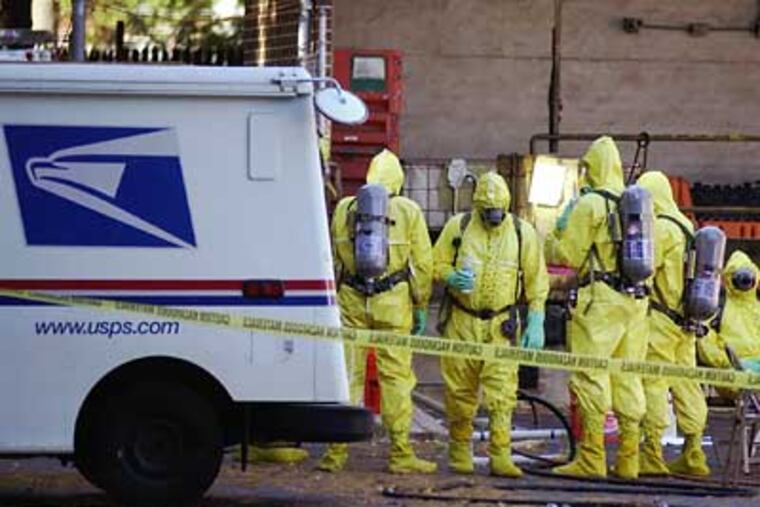
I think we’ve purposefully tried to forget how horrible the spring of 2020 truly was, when COVID-19 was ravaging an undefended nation. One lost chapter was the wave of deaths six years ago this week in America’s meatpacking plants, which also shone a light on how awful conditions had become even before the coronavirus outbreak. I wrote: “In September 2019 — that would be six months before the first coronavirus death in the United States — [Human Rights Watch] revisited the issue and found that the lives of many workers in America’s meatpacking plants are still consumed with managing injuries, illness and chronic pain.”
Read the rest: “Meat crisis undoes lesson of classic 1906 novel.”
Recommended Inquirer reading
I haven’t taken much vacation in 2026 because things keep happening. Much of last week’s writing centered on the major, and horrific, 6-3 ruling by the U.S. Supreme Court that finished the gutting of the 1965 Voting Rights Act, which had done so much to boost Black political power in the South. Last week, I recalled the heady era in the 1980s after the enactment of the VRA, and the psychic blow the high court has delivered to the lost sense that America was a place where things were finally getting better. Over the weekend, I wrote about how the ruling tied into a new “Southern strategy” for the Trump regime that is now looking to the former Confederacy to punish the president’s enemies and redraw the political map.
It’s only two weeks until Pennsylvania’s primary election, and the highly contested race for a Philadelphia open congressional seat — the 3rd District, where veteran U.S. Rep. Dwight Evans is retiring — is finally getting the attention it deserves. The top three contenders are a machine-backed political insider in State Sen. Sharif Street, a political outsider in physician Ala Stanford, and a progressive in State Rep. Chris Rabb. In recent days, The Inquirer has shone a light on the growing role that differing opinions about Israel have played in shaping the race, on the finances of Stanford’s health nonprofit, and on a controversial social media post from the Rabb campaign. The Inquirer Editorial Board has endorsed Rabb, who could potentially join “The Squad” in pushing congressional Democrats further left. The battle for Congress is one more reminder that local journalism still matters, a lot. Join the conversation. Subscribe to The Inquirer.
By submitting your written, visual, and/or audio contributions, you agree to The Inquirer’s Terms of Use, including the grant of rights in Section 10.

Sign up for the Will Bunch Newsletter