Congressional hopeful Ala Stanford’s Black Doctors Consortium was fueled by $13 million in public funding
An Inquirer review of public records related to the Black Doctors Consortium also found deficient recordkeeping and incomplete tax returns.
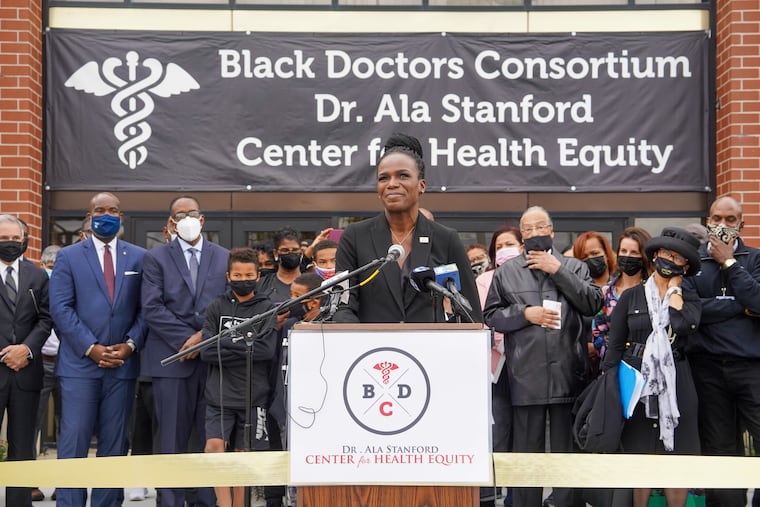
In the early days of the COVID-19 pandemic, physician Ala Stanford rented a van to conduct coronavirus testing in parking lots, traveling to Philadelphia’s most underserved neighborhoods, where the virus was raging. For months, she and a group of healthcare workers called the Black Doctors Consortium were funded largely by Stanford’s credit cards and a crowdfunding campaign.
But in the ensuing years, as Stanford and her efforts gained national acclaim, public money began to flow to the nonprofit. As of this month, the consortium has received nearly $13 million in government contracts and grants for a range of work over about six years.
Today, Stanford, a pediatric surgeon, is running in a highly competitive election for Philadelphia’s open seat in Congress, with the backing of three local sitting members. During forums and in campaign ads, she has in large part leaned on her reputation as a North Philly native who ensured the city’s most neglected communities had access to COVID testing and vaccinations in the throes of the pandemic.
With about three weeks until the Democratic primary on May 19, Stanford’s messaging is largely focused on that work. “My neighbors helped raise me,” Stanford, a first-time candidate, says in one of the television commercials paid for by her campaign. “So when they were hurting, I started the Black Doctors Consortium to heal our city.”
» READ MORE: Ala Stanford is banking on a healthcare message to break through crowded Philly primary for Congress
Her rivals in the 3rd Congressional District race have at times made an issue out of how the organization was funded and been critical of Stanford’s portrayal of herself.
State Sen. Sharif Street said he, as an elected official representing Philadelphia during the pandemic, played a key role in securing funding and reimbursement for the Black Doctors Consortium — a characterization Stanford disputes. And State Rep. Morgan Cephas, who dropped out of the race last month, earlier in the campaign emphasized that Stanford was not merely an altruistic volunteer, but was paid to test and vaccinate Philadelphians.
The Inquirer reviewed hundreds of pages of tax filings, financial disclosure statements, and other public documents to account for Stanford’s stewardship of taxpayer dollars that flowed from federal, local, and state sources. Among the findings was deficient recordkeeping, including that the Black Doctors Consortium at times filed incomplete tax returns to the IRS and failed to properly report nearly $1 million in compensation to Stanford over four years.
Across five years of tax returns, the nonprofit reported Stanford’s compensation in only one year — 2020, when it indicated she was paid $350,000.
In response to questions from The Inquirer that raised inconsistencies in Stanford’s tax filings and other disclosures, her attorney, Dwayne M. Grannum, said the nonprofit identified an “inadvertent omission.” Grannum said that, over four years of returns, the organization did not list Stanford’s pay, totaling more than $962,000.
On Friday, he said, the Black Doctors Consortium filed amended returns.
Lloyd Mayer, a law professor at the University of Notre Dame and a nationally recognized expert in nonprofit law, characterized it as “a very significant omission.”
He said it would be “concerning” if Stanford, as the executive of the organization, personally signed off on tax returns that omitted her own pay.
“She should have caught that it doesn’t list her compensation,” Mayer said. “She has personal knowledge, and she’s responsible for the return.”
Of the four returns on which Stanford’s pay was not listed, two were signed by her. The other two were signed by Byron Drayton, Stanford’s husband, an accountant who has worked with the Black Doctors Consortium.
Grannum said that the filings were submitted electronically by an accounting firm, and that Stanford and the nonprofit’s finance department “were not aware” of the omissions until they were identified by The Inquirer.
A 2025 tax return for the Black Doctors Consortium has not yet been made public.
Stanford drew a salary of at least $400,000 from the nonprofit last year, according to city invoices obtained through an open records request under Pennsylvania’s Right-to-Know Law. That was her salary, paid for by the city, for working as the medical director at the Riverview Wellness Village, a recovery house in Northeast Philadelphia that is a critical initiative for Mayor Cherelle L. Parker.
The compensation was part of a $5.38 million contract between the city and the Black Doctors Consortium, by far its largest government deal.
Prior to that contract, public dollars accounted for nearly half of the organization’s revenue between 2020 and 2024, according to tax filings and government records.
» READ MORE: Meet the 4 Democrats vying to replace Dwight Evans in Congress
Taxpayer support continues today. The group recently opened an imaging center at Stanford’s North Philadelphia primary care clinic, and it was funded by a $3 million federal grant, Grannum said.
Stanford’s financial disclosures show additional income from a variety of sources, including Stanford’s pediatric surgery practice, a book deal, teaching at the University of Pennsylvania, and income from her small concierge medical practice, where she serves as actor Will Smith’s doctor.
On the campaign trail, Stanford, 55, has said that she is proud of her success as someone who became an accomplished surgeon after coming from humble beginnings. The daughter of teenage parents, she grew up in North Philadelphia and relied on public assistance.
“I knew what it was to be poor and Black in America, and to see adults look me over and drop their eyes and expectations for what I could become,” she wrote in her memoir, Take Care of Them Like My Own. “It never leaves you, this knowledge. Not ever.”
The growth of the Black Doctors Consortium
When Stanford established the Black Doctors Consortium in 2020, she already had a nonprofit infrastructure in place.
Seven years earlier, she had founded It Takes Philly, an organization that connects children with mentorship and educational opportunities. In the chaos of the pandemic, she established the Black Doctors Consortium as an offshoot of It Takes Philly.
As COVID-19 rates soared — and were disproportionately high among Black Americans — Stanford’s group provided testing services to Philadelphians in underserved neighborhoods. The consortium’s goal was to connect Black healthcare workers with Black patients, who research has shown can be distrustful of the medical industry after generations of health, social, and economic disparities.
Stanford said she spent much of that time calling and writing to elected officials in search of funding. In June 2020, the city announced a series of grants to community groups, including $1.3 million in funding to the Black Doctors Consortium.
In her book, Stanford wrote that the funding was “less than one-fifth what we had asked for” and that money and resources were a continuing problem for the Black Doctors Consortium.
She continued: “It was only after one of the volunteers from my church, a retiree who had worked in the claims department for Independence Blue Cross and Blue Shield, asked if I needed help sorting through all the paperwork (Yes, please!) that I started seeing some reimbursement from all I’d laid out.”
When the vaccine became available in early 2021, the city partnered with a group called Philly Fighting COVID to hold mass vaccination clinics. Stanford said city officials were dismissive of the Black Doctors Consortium and told her she wasn’t ready to administer vaccines.
Less than a month into 2021, Philly Fighting COVID failed spectacularly. The Inquirer reported that the group was unprepared and underqualified, and had established a for-profit arm that could sell residents’ data. Its 22-year-old founder, a white graduate student, was accused of giving vaccines to his friends.
Stanford said the city came to her hat in hand and asked the Black Doctors Consortium to conduct vaccine drives.
“We only got the contract because the people they chose first failed, and then the city needed someone who was mobilized and ready to do it,” Stanford said. “So that’s when we stepped in.”
The Black Doctors Consortium hosted 24-7 mass vaccination events and continued pop-up testing clinics. It received an additional $1 million in city funding for testing and vaccine work, totaling $2.3 million in city grants in 2020 and 2021, according to Stanford’s campaign.
As rates of COVID-19 began to subside, the Black Doctors Consortium shifted its programming. It offered mobile and in-home vaccination services. And in late 2021, the group began accepting patients at a new primary care facility: the Dr. Ala Stanford Health Equity Center in North Philadelphia.
That work was funded by about $4 million in government grants and contracts.
Today, the Black Doctors Consortium operates inside a wing of Deliverance Evangelistic Church at 21st Street and Lehigh Avenue. The health center inside the church is a joint venture of the nonprofit consortium and a private for-profit entity that Stanford controls. The nonprofit consortium provides a range of care, including primary care, psychiatry, gynecology, pediatrics, imaging, and nutrition.
Government contracts and grants support the nonprofit consortium, which pays expenses such as employee salaries and rent payments to the church.
Several experts in nonprofit law said it is common for tax-exempt organizations to have relationships with for-profit entities, but arrangements in which there is overlapping personnel require safeguards.
“A relationship between a charity and a for-profit enterprise is not inherently bad,” said Eric K. Gorovitz, a principal attorney at the San Francisco-based Adler & Colvin group who works with nonprofits. “The question is why and what are the terms?”
In Stanford’s case, she is an officer and board member of a nonprofit, the Black Doctors Consortium, that is working with her own medical practice to provide services for patients. Experts said that means the nonprofit must take extra steps to avoid conflicts of interest in setting revenue-sharing ratios or other arrangements that could benefit Stanford’s for-profit company.
Grannum, Stanford’s lawyer, said revenue is apportioned to the nonprofit and the for-profit in accordance with an agreement that was approved by the organization’s board. Stanford recused herself, he said.
He cast the structure as typical for healthcare entities and “industry standard.”
Stanford said a majority of revenue from insurance claims for care provided at the medical center goes to the nonprofit, although she declined to say what the exact ratio was.
Asked this month if the health center is profitable, Stanford said “not really.”
“We do so much charity care,” she said. ”We can only submit claims for people who are insured or insurable. But there are folks that don’t have anything, and we see everybody.”
Tax forms that were ‘not fully completed’
At times, the Black Doctors Consortium filed paperwork with the IRS that was incomplete, and did not include the names and compensation details of those who were top executives or served on its board.
In annual filings, nonprofits are required to list all officers, board members, and key employees, even if they are unpaid, Mayer said.
From 2020 to 2024, Stanford’s nonprofit only ever named one executive on its tax forms: her. But Stanford said the nonprofit, It Takes Philly, has had a board for more than a decade — today, it consists of seven members, including her.
The same filing is required to list compensation for those top employees and board members. Stanford’s compensation was listed only in 2020 — from 2021 to 2024, the tax filing said she was not paid.
Those same tax filings later indicate that the organization spent at least $200,000 per year on aggregate officer compensation, without specifying who was paid. And Stanford’s April 2022 federal financial disclosure indicated her salary from the nonprofit was $562,500 over the preceding 16 months.
Grannum said the section of the tax filing where officer compensation and board members are supposed to be listed was “not fully completed for the years in question.”
He said Stanford’s compensation was $449,999 in 2021, $147,115 in 2022, $110,000 in 2023, and $255,846 in 2024. Stanford said she did not draw a salary during parts of 2022 and 2023 while she worked in the Biden administration.
Laura Otten, a Philadelphia-based nonprofit consultant, said it is critical for tax-exempt organizations to file accurate paperwork with the IRS because the returns are public documents used by foundations, corporations, and individual donors to evaluate a nonprofit’s trustworthiness.
“Our reputation is our currency,” Otten said. “This isn’t just a document you check off to make the federal government happy.”
‘I stepped up’
Stanford’s accomplishments as a physician and her work with the Black Doctors Consortium are a key part of her campaign’s message. She attended a recent campaign event in scrubs, and she attempted — unsuccessfully — to list her name on the ballot with “Dr.” in front of it.
Indirectly, her career is also a major reason she has been able to gain visibility and compete as a first-time candidate.
314 Action Fund, a Washington-based political action committee that boosts doctors and scientists who run for office, has spent more than $2 million on TV ads in support of Stanford’s bid, making her the first candidate in the race to be featured on television.
In an interview at her North Philadelphia health center office in March, Stanford said that she will not let her political rivals “diminish what happened.”
“And what happened is I filled in a gap that saved lives, that required courage, innovation, and intentionality for a group of people who are often left behind, or always left behind,” she said. “And I stepped up.”

- Meet the Democrats vying to replace Dwight Evans in Congress
-
Ala Stanford is banking on a healthcare message to break through crowded Philly primary for Congress
-
Big money is flooding into the Philly congressional race as all three front-runners hit the airwaves
-
How two Philly congressional candidates are quietly guiding super PACs in plain sight