Philadelphia needs more housing. So why does Center City still have so many parking lots?
More than two dozen sites continue to be used for public parking in Center City, one of Philadelphia’s most desirable residential areas. Those lots are a valuable, untapped resource.
Certain things in Philadelphia defy logical explanation. I call them the Mysteries of Philadelphia.
Why do plans for taming the Benjamin Franklin Parkway never seem to go anywhere? Why do so many cafes close at 4 p.m., just when you need a jolt of caffeine? Why can’t the Sixers win a championship, despite their owners’ oft-repeated pleas for us to trust the process?
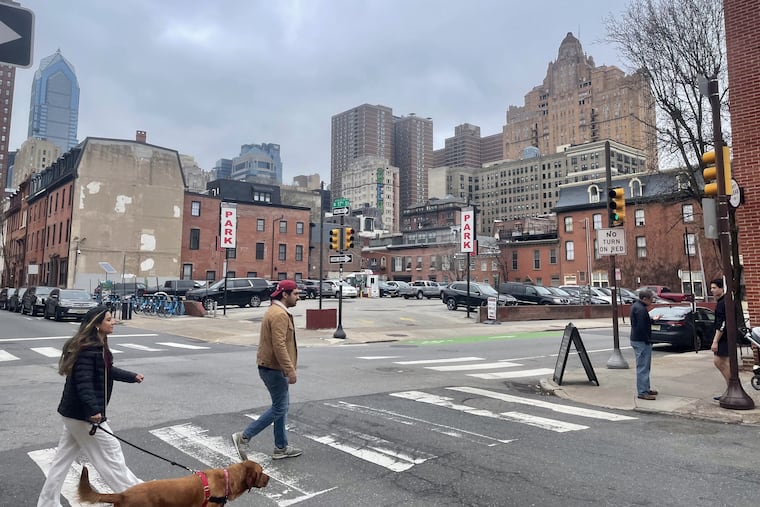
But, for me, the most enduring and existential mystery is this: Why does Center City still have so many surface parking lots?
Even while other neighborhoods have exploded with development in recent years, and scores of vacant parcels have been filled in with apartment buildings and rowhouses, more than two dozen sites continue to be used for public parking in Center City, one of Philadelphia’s most desirable residential areas.
Many are full-block lots that were paved over during the urban renewal excesses of the 1960s, which means they have been a blight on the city for almost 70 years. Besides discouraging normal urban activities, like shopping and drinking coffee after 4 p.m., these asphalt voids contribute far less in property taxes than buildings.
Philadelphia, of course, is hardly the only recovering Rust Belt city where parking has remained an “interim use” for half a century. Even Manhattan still has a few parking lots, despite the city’s insatiable demand for housing and stratospheric rents.
Part of what distinguishes Philadelphia is the longevity of its downtown surface lots, said Andrew R. Waxman, a University of Texas professor who studies land use issues. Some have become such fixtures in our daily lives that we’ve given them names, i.e. the Disney Hole at Eighth and Market, born 1981.
We also keep adding to the supply by allowing owners to demolish buildings and use the land for parking, like the lot that E-Z Park created in 2020 on Chestnut Street in Old City.
Maybe it was possible to rationalize the presence of these eyesores in the 1990s before Philadelphia began to recover from decades of population loss. Since the city wasn’t growing, and almost nothing new was being built, there was little demand for land. Those were the days when you could buy a nice rowhouse for the equivalent of your annual salary.
That’s all changed. Instead of too much housing, we now worry about having too little, especially for low-income Philadelphians. The median sale price has shot up almost 40% since 2019, and even middle-class people struggle to afford a home.
Recognizing where these trends could lead, Mayor Cherelle L. Parker has rightly made affordable housing her top priority, launching an $800 million initiative to build and rehab 30,000 units over the next few years. As part of that effort, her administration wants to encourage more high-density, parking-light development around SEPTA stops, an approach known as transit-oriented communities.
Besides reducing construction costs, Parker’s legislation would make it easier for residents to live without a car, a major savings at a time when the cost of owning one is skyrocketing. The administration also sees the measures as a way to help SEPTA grow its ridership.
So it’s a shame that Center City’s two dozen parking lots haven’t figured much in the discussion, even though they sit at the crossroads of the regional transit system and are already zoned for high-density development. These two dozen large tracts — between Vine and Pine Streets, Front to 25th — are a valuable, untapped resource that can accommodate thousands of apartments and rowhouses.
The parking business is dying
Before we can put these surface lots back into productive use, we need to understand why they have stubbornly resisted development for so long. For perspective, I reached out to Robert Zuritsky, president and CEO of Philadelphia’s Parkway Corp. His family, which has been in the parking business for a century, owns and operates dozens of garages and surface lots, both here and in other American cities, and they’re spending $100 million to acquire more.
That sounds like he’s bullish on the parking business. Actually, no. Zuritsky told me that business is dying, partly because remote work and other factors have greatly reduced the demand for parking. He’s trying to transition Parkway into a development company that also happens to own parking garages.
Parkway is wrapping up an 18-story headquarters for the insurance giant Chubb on the former Avis parking lot at 20th and Arch. Although the office building is the latest of several large projects Parkway has completed in the last decade, the company still has plenty of surface lots in its portfolio. Parkway has owned some for so long that the company no longer carries a mortgage, which means it has little overhead beyond taxes and insurance.
The problem is that “development is really hard,” Zuritsky explained with a sigh. For every success, like the Parkway’s Pearl Condominiums in Chinatown, there has been disappointment.
Zuritsky said he has tried four times to partner with a developer to build an apartment tower on the 700 block of Chestnut, where a high-rise would have fantastic views of Washington Square. Each time, the deal fell apart at the last minute.
E-Z Park has also struggled to build on its parking lots.
It took the company decades to find a partner to help develop a sprawling lot on Bainbridge Street in the popular Queen Village neighborhood, just outside Center City.
Two blocks from Rittenhouse Square, a large lot at 17th and Pine owned by PS Associates has been used for parking since the Ulysses S. Grant school was demolished in the ’40s, despite being surrounded by some of the most expensive homes in the city.
Beyond the difficulties of raising capital, material costs have risen sharply during the Trump administration, making new construction more difficult than ever. It’s easier and cheaper to convert an old office building to housing than to build something new, Zuritsky said.
While he’s right that new development is hard, it’s still far too easy for Philadelphia’s parking companies to do nothing with their land, even if those lots are now half-full. Many lot owners scooped up their sites in the ’60s and ’70s, when Philadelphia real estate was selling at rock bottom prices. Since parking fees provided a steady revenue stream, they didn’t need to hone their development skills.
Now, as the original owners approach the end of their careers, they’re less likely to undertake a complex development project, according to experts who study Philadelphia land use. Most Center City lots are owned “by a handful of people,” added John Mondlak, a top official in the city’s Department of Planning and Development.
Parking lots weren’t meant to be permanent
The irony is, Philadelphia zoning code doesn’t actually permit surface parking as a permanent use. In most cases, property owners need to obtain a variance, as well as a special license, which must be renewed every three years.
Although those renewals have become a formality, some companies don’t even bother. Centra Associates, which owns a large lot at Juniper and Vine, behind the Pennsylvania Convention Center, was cited in October for operating without a license, and the city is now trying to determine the legal boundaries of its parking operation. The fine for the transgression is $300.
Because there is a sizable demand for parking in Center City, the ease of obtaining renewal licenses has effectively become a crutch. Many parking lot owners are simply happy to wait for a “big payday,” said Daniel Baldwin Hess, a professor of urban planning at the University of Buffalo.
When it comes to housing affordability, Philadelphia is a strange market. Unlike America’s most expensive cities — New York, Boston, San Francisco — Philadelphia has plenty of vacant land where new housing could be built. Hess and other experts say the existence of so many downtown parking lots suggest that the city’s property tax system is out of whack and that it under-assesses vacant land.
Fixing that imbalance might nudge some parking lot owners to develop their properties. The city also could impose a limit on the number of licensing renewals a parking lot owner can receive. That would make parking truly an interim use. Ten renewals — 30 years — would give property owners plenty of time to put together a development plan and wait for the right market conditions.
The Parker administration has made some good moves recently to encourage new development. It introduced legislation last year to eliminate parking requirements for projects in the high-density CMX-4 and CMX-5 zoning districts. The mayor also convened a commission to look for ways to revitalize Market East, which has more than its share of surface parking, despite having the best transit access in the region.
But Mondlak doesn’t expect change will happen fast. “There is only so much we can do,” he said, and predicted “some of these lots may still be there in a few decades.”
Sadly, that view is also one of the mysteries of Philadelphia.