How law enforcement built a sprawling case against a longstanding Kensington drug gang
Philly police and federal authorities used wiretaps, cameras, and confidential informants to target dealers on Weymouth Street.
Ramon Roman-Montanez knew the police were watching.
One day last April, as Roman-Montanez prepared to hand out free drug samples to users on Weymouth Street — a common tactic that dealers use to attract customers — he stood in the middle of the Kensington block and spotted a problem.
The cops had put up a pole camera.
Using binoculars, Roman-Montanez scouted out the new device at the end of the block, prosecutors said in court documents. But he had a business to run — and so, after talking with a few associates in the street, he decided that giveaway day would move forward as planned.
Shortly after dawn, prosecutors said, customers were recorded on the new surveillance camera crowding onto the 3100 block of Weymouth to receive their samples.
And in the weeks to come, business continued to boom.
The camera, however, was just one hint of what authorities now say was a sprawling, multiyear investigation into the gang Roman-Montanez helped lead — a group that sold thousands of doses of heroin, fentanyl, crack, and cocaine over the course of more than a decade, and effectively took over a residential block in a neighborhood that has long suffered from crime, open-air drug dealing, and neglect.
The results of the probe came to light last month, when FBI Director Kash Patel came to Philadelphia to announce that 33 people, including Roman-Montanez, had been indicted on drug charges. Patel called the case a model for law enforcement across the country, and an example of how to take out a drug gang terrorizing a community.
To understand the scope of the case — which U.S. Attorney David Metcalf described as the region’s largest single prosecution in a quarter-century — The Inquirer reviewed hundreds of pages of court records, examined social media accounts and videos connected to the group, and interviewed law enforcement officials and Weymouth Street residents.
The review revealed previously unreported details about the investigation, including that authorities ran monthslong wiretaps on about a half-dozen phones tied to gang members, placed a recording device in a vacant lot the gang used as a meeting place, employed at least seven confidential informants, and believe that over the course of nine years, the group trafficked tens of thousands of doses of drugs into the city — worth millions of dollars.
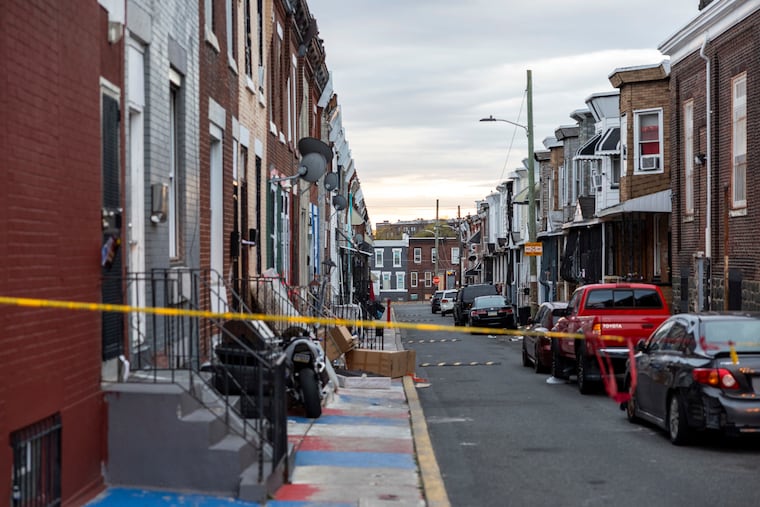
Philadelphia police this month continued to restrict access to Weymouth Street long after gang members had been arrested, a highly unconventional approach that officials said was aimed at sustaining the block’s newfound sense of quiet. Several residents said they didn’t mind the unusual tactic, in part because it helped prevent their block from quickly returning to its status as a marketplace for round-the-clock drug deals.
Those tactics underscored the depth of the investigation, which unfolded in the heart of Kensington — where law enforcement has employed a variety of approaches over the years to try to address crime, drug dealing and violence, sometimes with mixed results.
But the review also showed that even as the investigation was underway, the gang continued to operate in the open — and some of law enforcement’s attempts to hold people accountable as the probe was unfolding were unsuccessful.
In August, for example, Roman-Montanez was charged in state court with drug possession and related crimes after police found fentanyl, crack, and $20,000 in cash in his house — the result of a raid on Weymouth Street that was part of the investigation into his gang.
But a few weeks later, his attorneys persuaded a Philadelphia judge to reduce his bail and he walked out of jail. The 40-year-old — who federal prosecutors now say was the de facto chief operating officer of one of the city’s biggest drug conspiracies — was taken back into custody only this month, when federal authorities unsealed his indictment.
Even as investigators were continuing to collect evidence against the gang, members routinely appeared in videos and songs on social media in which they boasted about their gang affiliation, brandished guns, and threatened acts of violence against rivals.
Some of the videos made modest Weymouth Street look more like a nightclub. Men wearing shimmering gold chains can be seen carrying designer bags and waving guns with extended clips at the camera. Others smoke blunts, or mix soda and a purple liquid together to make what appears to be the codeine-infused drink “lean.”
A video for the song “Philly Boy,” uploaded to YouTube last spring, made clear where the debauchery was taking place: It opens with a shot of the Weymouth street sign.
Beyond the fact that people who remained on the street could continue to sell drugs, prosecutors said the gang used threats to maintain control over their territory. And at least two suspected coconspirators were killed as the investigation wore on — sparking the potential for more retaliatory violence. Prosecutors have not yet charged any gang members with any shootings or homicides, but have said their investigation is continuing.
Metcalf, through a spokesperson, declined an interview request to discuss the case in more detail. But while announcing the takedown last month, he said there is always a tension in long-running investigations between making quick arrests and taking time to gather evidence for broader or stronger cases. And in this instance, he said, the goal was clear: Prosecutors were seeking to “eliminate the organization.”
“We could obviously just prosecute individual seizures of guns and drugs. But the organizational prosecution … that’s what’s going to make a difference in the community,” he said. “This neighborhood will be a lot safer than it [would’ve been] if we didn’t take our time to do that.”
A sophisticated operation
Weymouth Street is one of a series of narrow, rowhouse-lined blocks in Kensington just a few steps from McPherson Square and near the intersection of Kensington and Allegheny Avenues — long the epicenters of a bustling narcotics bazaar.
Some corners in the area can pull in tens of thousands of dollars a day in drug sales, authorities say. And the competition among dealers has often led to violence, with shootings and homicides in Kensington historically outpacing the rest of Philadelphia.
The crew on Weymouth Street thrived in that environment, prosecutors said, and developed a sophisticated system for seeking to build and protect a business that sold fentanyl, crack, and cocaine 24 hours a day, seven days a week.
Their drugs were branded with unique stamps or names like Ric Flair, Horse Power, Gucci, or Donald Trump. Bags were sold for $5 each, prosecutors said, while “bundles” of about a dozen packets went for between $55 and $75.
The group maintained an internal hierarchy, prosecutors said, with key figures at the top overseeing layers of workers who engaged in hand-to-hand sales, watched out for police, managed the drug supply, or used violence to protect the operation. Many members were related to one another, prosecutors said, and some families had people from multiple generations working for the group.
The leader was Jose Antonio Morales Nieves, prosecutors said, who “owned” the block and allowed people to deal there in exchange for payments he called “rent.”
His top deputies ran the day-to-day operations, prosecutors said, and included Roman-Montanez, nicknamed Viejo, and Roman-Montanez’s paramour, Nancy Rios-Valentin.
The two set and distributed schedules for lower-level employees, kept track of how and when drug stashes needed to be refilled, and maintained handwritten ledgers tracking sales per shift.
The first episode in the indictment dates to January 2016, when, prosecutors said, Angel Rios-Valentin — the brother of Nancy Rios-Valentin — stood watch as someone sold drugs to a confidential informant.
A few months later, the indictment said, police conducted a traffic stop on the block, and gang leader Morales-Nieves — also known as Flaco — responded by approaching the officers in a threatening manner carrying a shovel.
As the gang continued to build its business on Weymouth, prosecutors said, several members took up residence on the block, including Roman-Montanez, and members used a variety of houses or abandoned lots to store or sell drugs.
Among them, prosecutors said, was a vacant lot with a tent they labeled the “bunker.” It was next door to the house Roman-Montanez shared with Rios-Valentin, they said, and served as a meeting place, stash location, and place to cook crack.
Last May, prosecutors said, it also served as a site for violence, when Roman-Montanez dragged a man into the bunker, and another gang member — who is not named in court documents — beat him with a rod.
Crimes involving violence
Much of the 170-page indictment revolves around individual episodes in which members of the gang conducted operations that would be considered routine if they weren’t illegal, such as selling drugs to users, managing the block’s supply, or handling illicit proceeds.
The document includes detailed quotes from those accused of taking part in the operation and describes their actions with unusual precision, the result of what prosecutors said were a series of wiretapped phones, cameras — including one inside the bunker — interactions with informants, and seizures of drugs by police.
Some incidents, however, went well beyond the everyday rhythm of drug sales, prosecutors said.
In November 2024, several gang members ran after a car that had sped down Weymouth, then fired shots at the vehicle after they caught up to it around the corner, the indictment said. The document does not say if anyone in the car was struck.
Six months later, prosecutors said, the pole camera captured footage of two members of the gang — John David Lopez-Boria and Luis Williams — laughing at someone sitting on a front step across the street, then beating the person and dragging the victim into an abandoned lot to continue the assault.
The gang’s violent nature was also captured on YouTube, where gang members appeared in videos taunting rivals and flaunting guns.
In one video, the rapper Sombra PR — whom prosecutors described in court documents as an unindicted coconspirator — made clear that he and a Weymouth Street gang member known as Panza would use a Draco gun to come after anyone who threatened them.
“I’ll get you with Panza with Draco and you’re stiff,” he rapped.
Panza, whose given name was Heriberto Torres Gual, was described by prosecutors in court documents as one of the group’s enforcers, and he appeared in some of Sombra PR’s videos.
But last month, Gual, 31, was gunned down while riding an electric bike on the 3000 block of Kensington Avenue, just a few blocks from Weymouth, according to police. Surveillance footage showed a torrent of shots being fired out of an SUV that had pulled up beside him.
In all, police recovered 35 spent shell casings from the scene and said it was a targeted attack.
Gual was the second high-ranking gang member to be killed in the last year, authorities said. Last November, Felix Rios-Valentin — the brother of Nancy and Angel Rios-Valentin — was fatally shot in Mayfair.
Police have made no arrests in either case.
After Gual’s death, an Instagram account for a record label dubbed “Weymouth Family” made a post referencing the title of a new song that memorialized Gual. The post tagged Pressure 9X19, the artist behind “Philly Boy.”
And on another account associated with Weymouth-tied rappers was an illustration of an unmistakable street sign: the marker for the intersection of Allegheny Avenue and Weymouth Street.
Evading accountability
During their long investigation, law enforcement did sometimes disrupt the gang’s drug operations and make arrests.
In 2020, Angel Rios-Valentin was convicted in federal court of illegal gun possession after officers found him carrying a loaded handgun that he had taken from Roman-Montanez’s house. He was sentenced to five years in prison and was on supervised release when he was arrested again last month.
Police found four guns in Rios-Valentin’s house, a discovery that prosecutors said showed his ongoing commitment to the gang.
Roman-Montanez, meanwhile, was arrested twice in the last three years, court documents show — but in both cases managed to avoid significant consequences.
In October 2022, police searched his house and found 96 grams of fentanyl, four loaded guns, and nearly $125,000 in cash, prosecutors said. Roman-Montanez was charged in state court, but the case was withdrawn.
Federal prosecutors did not explain the withdrawal in court documents, and because the case did not result in a conviction, the records are now sealed under Pennsylvania law. The district attorney’s office did not respond to a request for comment.
A source familiar with the case said it collapsed because scheduling issues with lawyers and witnesses delayed the preliminary hearing for more than a year and prosecutors ultimately withdrew the charges.
The second arrest was in August, when police, acting on a search warrant, again searched Roman-Montanez’s house and found more fentanyl, crack, and cash inside, court records show. He was charged with crimes including conspiracy and possession with intent to deliver, and his bail was set at $750,000.
But a month later, his lawyers persuaded a judge to lower his bail.
The prosecutor argued against that, according to a transcript of the bail hearing, saying the sheer amount of drugs and cash involved made clear that Roman-Montanez was “not a minor player.”
But Common Pleas Court Judge Elvin Ross III said details about Roman-Montanez’s role in the conspiracy were lacking. He reduced bail to $300,000, and a few weeks later, Roman-Montanez was back on the street.
Will the quieter aftermath last?
On the morning of Oct. 24, dozens of federal agents and city police officers swarmed Weymouth Street to arrest suspected gang members and gather additional evidence to use in their court case. Some targets were taken into custody elsewhere — the group’s leader, Morales Nieves, was arrested in Luquillo, Puerto Rico.
Patel, the FBI director, said at a news conference afterward that the case “is not just one instance of removing a couple of people — it is an example of how you remove an entire organization that has corrupted not just the city of Philadelphia but the state of Pennsylvania as well."
Roman-Montanez has pleaded not guilty, as has Nancy Rios-Valentin. Her attorney wrote in court documents that she maintains her innocence, that the case against her was “not strong,” and that she “cannot be convicted on a theory of ‘guilt by association.’” A federal judge on Monday ordered that Rios-Valentin — who has four children — be released from jail and placed in home confinement at her sister’s house while awaiting trial.
On Weymouth Street, residents said in interviews that life has been quieter in the weeks since the raids. Some of that is the result of the ongoing police presence, which began to relax this week as officers resumed allowing passersby to walk or drive through the street.
One resident, who asked not to be identified for fear of retaliation, said he appreciated law enforcement’s attempt to help clean up a struggling area.
But he was skeptical that one prosecution — even one as ambitious as this — would reverse a persistent and neighborhood-wide problem.
“I don’t see it making a big difference any time soon, and it’s nobody’s fault,” he said. “This is not an overnight fix.”