Eagles’ key offensive players were better (or worse) than you might have thought, the advanced stats say
The offense will be remembered as a drain on the Eagles' 2025 Super Bowl repeat efforts. But what do the deeper statistics reveal?

For most of the season, the 2025 Eagles offense did not pass the eye test.
Execution errors plagued them. The Eagles suffered from negative plays and penalties on early downs, setting themselves up for third-and-longs and ultimately forcing them to punt early and often. Options were seemingly limited in the passing game. Rushing lanes failed to open for a previously dynamic running game.
But what do the underlying numbers reveal about the offense’s performance that could have implications going forward? Here’s one compelling advanced stat about each notable offensive starter, the first installment in a two-part series that will also analyze the defense:
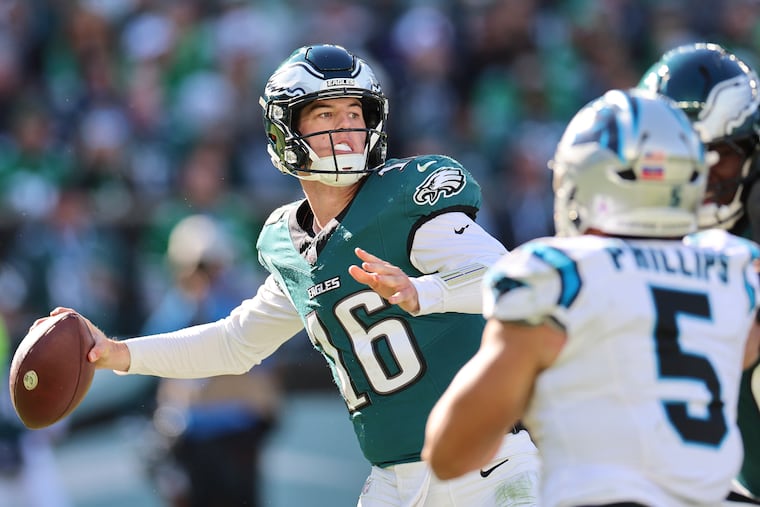
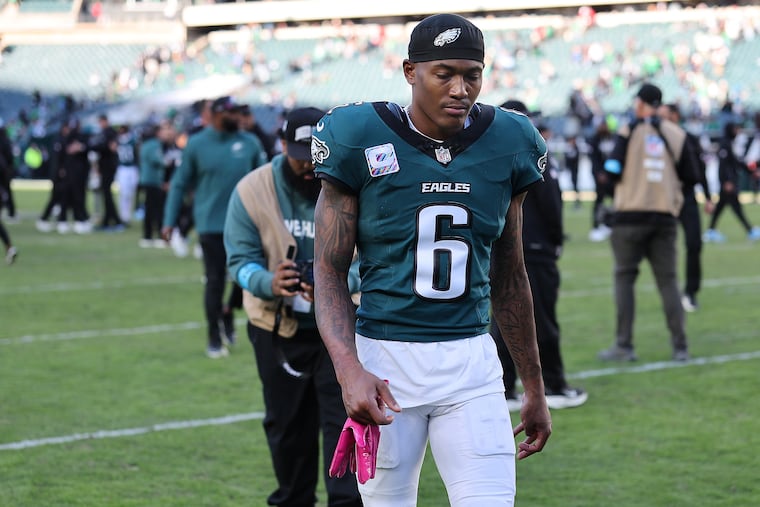
Jalen Hurts
One stat alone can’t sum up the season for Hurts, who plays the most important position on the team. So, let’s dissect two.
First, the rushing component of his previously self-described “triple-threat” ability seemingly went by the wayside this season. Hurts, 27, averaged a career-low 1.7 designed rushing attempts per game this year, according to Next Gen Stats. That’s a notable decrease from his 2024 averages — 3.2 during the regular season and 3.8 during the Eagles’ four-game Super Bowl run.
Even though he had fewer designed carries this year, he wasn’t any less effective. On 27 designed runs, he collected 143 yards and nine first downs, including a touchdown, good for 5.3 yards per carry (his career average is 5.2).
Here’s the $255 million question: Why the decrease? Was it a matter of preserving the franchise quarterback, as Nick Sirianni suggested, or was it just a symptom of Kevin Patullo’s offense, as Hurts said? Will this trend persist in 2026, or will Hurts be called upon to use his legs to help invigorate the offense once more?
Second, the downfield passing game wasn’t nearly as effective for the Eagles in 2025, which hindered an already limited air attack. Hurts completed 47.9% of his downfield passes (10-plus air yards), according to Next Gen Stats, the lowest percentage of his five seasons as the starter.
Wins and losses were often reflected in his downfield completion rates. In the Eagles’ five losses this season (not including Week 18), Hurts went 10-of-17 for 233 yards, a touchdown, and an interception (58.8% completion rate) when targeting open receivers (at least three yards of separation) downfield.
His 65.6% completion rate when targeting open receivers downfield this year was roughly 25 percentage points lower than last season’s (89.3%). Again, can the next Eagles offensive coordinator reverse this trend and improve Hurts’ downfield accuracy in 2026?
A.J. Brown
At his end-of-season news conference, Sirianni noted that the next offensive coordinator will help “evolve” the offense. Perhaps that person will refresh the Eagles’ route concepts.
Brown, 28, ran a hitch route on a career-high 24.9% of his total routes run, according to Next Gen Stats. A hitch is a short route that starts vertical, then requires the receiver to plant his foot and turn toward the quarterback for a pass. Brown’s hitch rate this season was the eighth-highest among receivers who ran at least 200 routes.
Despite the lack of variety in his routes, Brown was still effective when targeted on those hitches. He collected 263 receiving yards and a touchdown on hitch routes, which ranked second in the league behind Dallas’ George Pickens (275).
Brown wasn’t the only Eagles receiver who ran a lot of hitches. The entire group ran hitch routes on 22.1% of its combined routes, which was the second-highest single-season rate by a receiving corps since 2016 (23.4% for the 2019 Chicago Bears).
DeVonta Smith
Smith may primarily line up as a slot receiver, but he was most effective when split out wide this season.
The 27-year-old receiver aligned in the slot on a career-high 57.1% of his routes, according to Next Gen Stats. Still, he posted career bests when he lined up outside in yards per route run (3.1) and yards per target (11.9). Smith trailed only Seattle’s Jaxon Smith-Njigba (3.8) and the Los Angeles Rams’ Puka Nacua (3.6) in yards per route run from the outside among 89 receivers (minimum 150 routes).
His yards per target increased when split out wide to the right. He averaged 13.9 yards per target from that alignment, which led receivers (with at least 20 targets). Smith was particularly efficient downfield, as he caught 12 of 17 targets for 300 yards and a touchdown (17.6 yards per target).
Will his efficiency on the outside change how frequently he lines up in the slot going forward?
Saquon Barkley
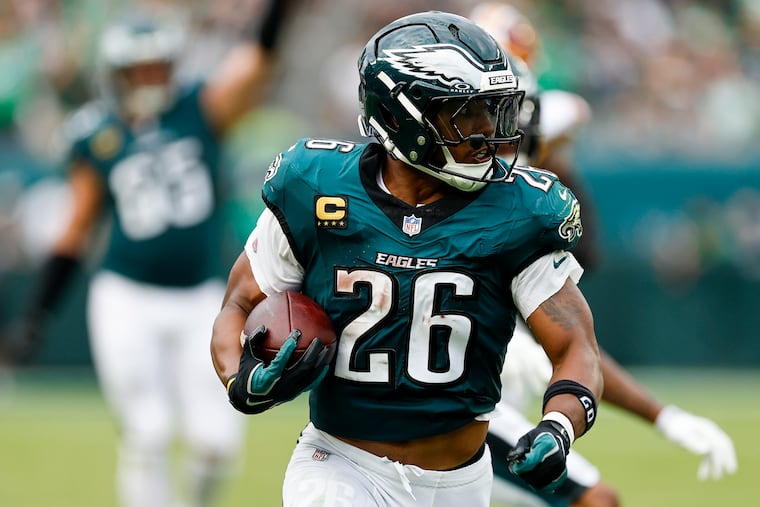
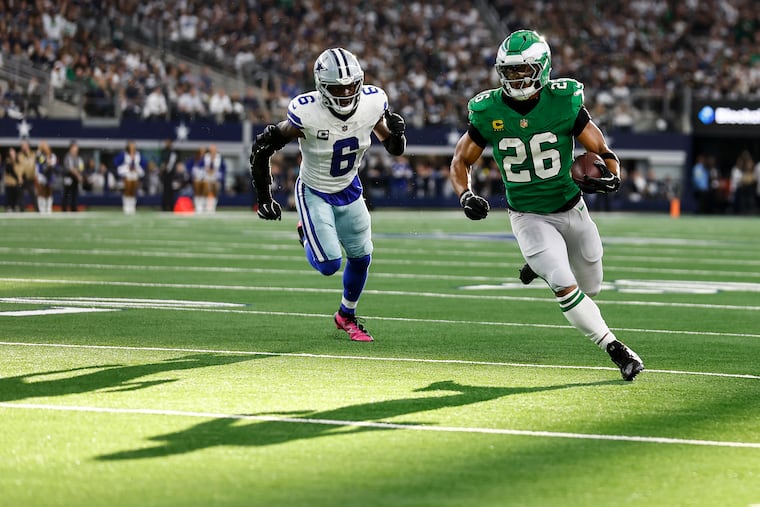
Barkley eclipsed 1,000 rushing yards for a second consecutive season (1,140), but he didn’t come anywhere close to his total of 2,005 from 2024.
He didn’t get much help up front. According to Next Gen Stats, Barkley took hits behind the line of scrimmage on 47.1% of his carries, which was the ninth-highest rate among 49 running backs (minimum 100 attempts) this season.
By comparison, the 28-year-old running back was hit behind the line of scrimmage on 37.7% of his carries in 2024.
This season, Barkley averaged 1.1 yards before contact per carry, trailing his 2.4 clip from last year. When he was hit behind the line on 132 carries, Barkley combined for 93 yards (0.7 yards per carry) and produced a single explosive run. On the runs without contact before the line, he averaged 7.1 yards per carry and had a 18.2% explosive run rate (both are above the league averages of 6.5 and 15.8%).
What can the Eagles do to improve their run blocking in 2026? Is it a matter of changing the personnel, banking on the improved health/performance of the existing players, or changing up the blocking schemes?
Dallas Goedert
No player was more sought-after in the red zone this season than Goedert.
With his 10 red-zone touchdowns this season, the 31-year-old tight end accounted for 58.8% of the Eagles’ red-zone receiving touchdowns, according to Next Gen Stats. That was the highest share of any player in 2025.
Goedert’s 11 total receiving touchdowns were tied for the most among tight ends (with Arizona’s Trey McBride) and tied for the second-most among all players (trailing the Rams’ Davante Adams).
Hurts may look to someone else in the red zone next season. Goedert is set to become an unrestricted free agent at the start of the new league year.
Lane Johnson
The Eagles felt the absence of Johnson, the 35-year-old right tackle, in the seven games he missed at the end of the regular season because of a Lisfranc foot injury.
There was a difference in the running game’s efficiency with and without Johnson on the field, especially on carries to the right side. When Johnson was playing, the Eagles averaged 4.6 yards per carry (84 carries) on designed runs to that side, according to Next Gen Stats. Without him, going into Week 17, the Eagles averaged 3.2 yards per carry (97 runs) on those same runs.
In that same span, the Eagles amassed 26 yards before contact on designed runs to the right without Johnson (and 288 yards after contact).
Will Johnson be back for his 14th season with the Eagles, giving an instant boost to the running game? Or will he be unable to overcome his injury and call it a career?
Tyler Steen
Steen, 25, was the only new starter in the 2025 Eagles offense, replacing Mekhi Becton at right guard.
He had his struggles in pass protection. According to Pro Football Focus, he conceded 37 pressures, which were tied for the third-most among guards with at least 500 pass blocking snaps. Those pressures broke down to two sacks, one quarterback hit, and 34 hurries on a total of 626 pass blocking snaps.
Is Steen the long-term starter at right guard? Or will he face competition in training camp again as Howie Roseman retools the roster for 2026?
Cam Jurgens
It was an injury-riddled year for Jurgens, who underwent back surgery after the Super Bowl in February. He also played through a knee injury and suffered a concussion in 2025.
Despite earning a second-straight Pro Bowl nod, Jurgens was seldom dominant in the running game. According to Sports Info Solutions, Jurgens posted a 5.9% blown run block rate on more than 300 run blocking snaps, which reflects the percentage of blocking snaps on which a player had a blown run block. That rate led starting centers.
Can Jurgens’ struggles be attributed to his injuries? Or did the 26-year-old center simply regress, providing cause for concern for next season?
Landon Dickerson
Like Jurgens, Dickerson also pushed through myriad injuries in 2025. After playing through a knee injury in the Super Bowl, he dealt with meniscus, back, and ankle ailments this season.
Dickerson wasn’t his sharpest in pass protection, allowing 33 pressures, according to Pro Football Focus. That total is tied for the second-highest in his five-year career despite posting a career low in pass-blocking snaps (506). Those pressures broke down to five sacks, seven quarterback hits, and 21 hurries, finishing No. 13 in pressures among guards with at least 500 pass-blocking snaps.
Is the 27-year-old left guard capable of healing up and returning to his three-time Pro Bowl form in 2026?
Jordan Mailata
While the offensive line struggled as a whole, Mailata fared better than his counterparts in pass protection.
The 28-year-old left tackle conceded 28 pressures, according to Pro Football Focus, which ranked No. 6 out of 28 tackles with at least 600 pass-blocking snaps. The 28 pressures allowed were the third-fewest of Mailata’s six-year career as a starter. Meanwhile, Mailata’s 602 pass-blocking snaps were the third-highest total of his career.