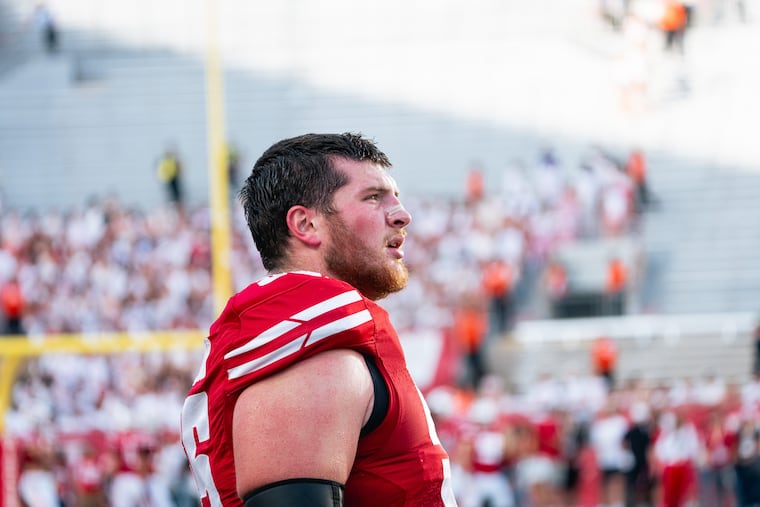
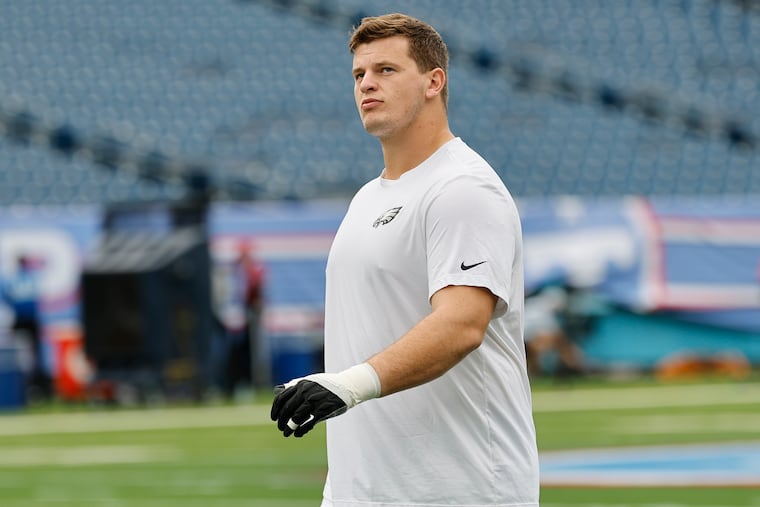
Center Drew Kendall is the Eagles’ newest O-line starter. Witnesses to his rise always saw a pro in the making.
Once the top recruit in Massachusetts, Kendall developed into a decorated lineman at Boston College and is now proving himself in the NFL.
Jordan Mailata wasn’t exactly bashful when he shared his instant analysis of Drew Kendall’s first meaningful start at center, even as the second-year player stood within earshot of him in the Tennessee Titans visitors’ locker room.
Kendall, the Eagles’ 2025 fifth-round pick out of Boston College, took over Cam Jurgens’ typical starting spot at center, while Jurgens slid over to left guard in place of the injured Landon Dickerson last Sunday.
The Titans turned up the temperature of the game — and not only in a literal sense, with the turf reaching 157 degrees Fahrenheit, according to the Fox broadcast. The Eagles offensive line was also tasked with containing a Titans defensive front headlined by All-Pro defensive tackle Jeffery Simmons.
Kendall didn’t show any nerves, according to Mailata.
“He’s got f—ing ice in his veins,” Mailata said after the game.
Mailata then turned in Kendall’s direction and doubled down.
“Yes, you do, son,” Mailata continued. “Yes, you do. He’s cool as a cucumber out there, making sure that we’re all on the same page. That’s what you need. I think we won this game because of just his operation, the way he was very cool, calm, and collected.”
Confidence begets confidence. Earlier in the week, Kendall noted that his confidence in his own play — one of the biggest self-identified differences in his mindset between his rookie and second seasons with the Eagles — stems from his teammates’ demonstration of belief in him.
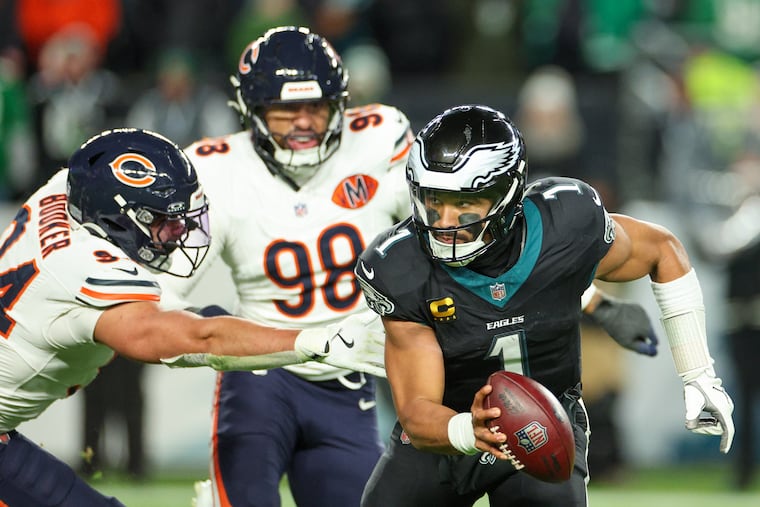
Kendall could have more opportunities to affirm those votes of confidence, as Dickerson must miss at least the next three games while on injured reserve with a knee injury. Offensive coordinator Sean Mannion would not confirm that the Eagles will go with the same offensive line configuration against the Chicago Bears on Monday night, but Mailata emphasized the importance postgame of continuity among the group.
Regardless, Kendall met the moment on Sunday, with room to grow going forward. His solid start was no surprise to his former coaches at Boston College, who long believed he had the ability and the makeup to carve out a role on an NFL offensive line.
“He had the traits,” said Matt Applebaum, Kendall’s offensive line coach of three seasons at Boston College. “Just the competitiveness, the desire to do things the right way and be a great player. He just has all those traits. I thought very early in the process, in recruiting, my vision for him was that he could be a pro center.”
A ‘pro center’ in college
Bill O’Brien assumed the head coaching role at Boston College in 2024, his 32nd season coaching at either the collegiate or pro levels.
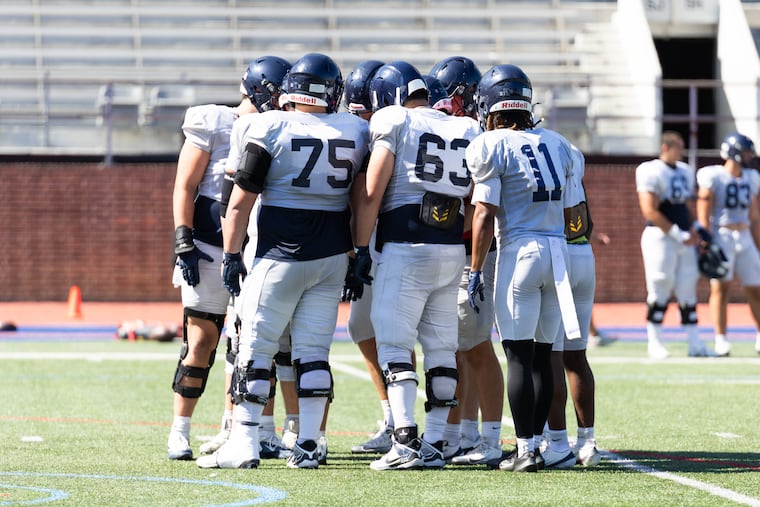
When O’Brien arrived in Chestnut Hill, Mass., Kendall was entering his third season as the starting center in his redshirt junior season. According to O’Brien, who served as the Houston Texans head coach from 2014-20, Kendall reminded him of the centers he had encountered in the NFL.
“He was kind of like having a pro center in the college program,” O’Brien said. “That’s basically what Drew was. He knew exactly what we wanted to do, how we wanted to do it, and he was great at it.”
The signs of his potential were there early on, long before he started a game at BC. Applebaum, now the Miami Dolphins assistant offensive line coach, recruited Kendall out of high school in 2020. At the time, Kendall was a four-star recruit out of the Noble and Greenough School in Dedham, Mass., and the No. 1 recruit in the state.
Applebaum understood why. The young offensive lineman possessed a maturity atypical of most 18-year-olds, which lent itself to his makeup as a center. He had a strong foundation, too, given that his father, Pete, was a first-round pick in the 1996 draft out of Boston College by the Seattle Seahawks and played at guard and center in the NFL for 13 seasons.
Then, there were the physical traits. Applebaum called the then-6-foot-4, 285-pound Kendall a “natural athlete,” as he played on both sides of the line in high school and even lettered in lacrosse.
“He was just one of those guys that was good at things and athletic and smart,” Applebaum said. “So the only thing he was going to have to do when he got to school was just get bigger and stronger throughout his career, which he did in college.”
Alec Lindstrom, who was the starting center for BC when Kendall arrived, was struck by his athleticism at his first summer workout. As Kendall went through positional drills, Lindstrom could tell that he wasn’t like most 18-year-old newcomers.
“You could kind of tell he was a step ahead, and you knew he was going to be a good player based on his quickness, his body control, and things like that,” Lindstrom said.
But Kendall would have to wait to display that athleticism on the gridiron on game days. He took a redshirt year in 2021 as Lindstrom, an eventual Rimington Trophy finalist and undrafted free agent in the NFL, commanded the starting center role in his redshirt senior season.
Kendall had the right attitude about taking the season to learn and grow behind Lindstrom, Applebaum said.
“Drew, right from the jump knew, OK, this is set up for me to learn from somebody that’s been there, done that, knows what it’s supposed to look like, and he really took that very seriously and really pushed the envelope in terms of being ready to play if he needed to,” Applebaum said. “So he developed very quickly that way.”
Kendall spurred that development, especially as he continued to grow comfortable with the pre-snap responsibilities on the center, by asking questions of his fellow offensive linemen and coaches. Lindstrom recalled Kendall asking him questions about what he was seeing from the defense in practice, after games, and in the meeting room while watching film.
That attitude toward learning was just as important as his intelligence and ability to process information quickly, according to Lindstrom.
“To play center you have to be smart, but you also have to be quick-thinking,” Lindstrom said. “You break the huddle, you get up to the line, you have two seconds to identify everything, so you have to be kind of quick on your feet and smart. And I think Drew, he has that to begin with, but also when you put his attitude and his wanting to learn together, I think it’s a good combination.”
Kendall would go on to put those traits together as a three-year starter in the ACC for the Eagles. He had to learn three different offenses throughout his college career, and Applebaum said he picked them up “excellently” thanks to his processing ability.
He could make all of the pre-snap identifications and adjustments with ease. While quarterbacks and centers typically share the burden of those pre-snap responsibilities on most teams, Applebaum said the team predominantly leaned on Kendall in that area.
“I would say we put probably more on his plate than a lot of other college centers would have to handle, because he was capable of handling it,” Applebaum said.
His athleticism also fit well in Boston College’s offense, which incorporated a variety of run schemes, including outside zone, pin-and-pull runs. Kendall was often one of the pullers, O’Brien said, as he harnessed his initial quickness and lateral agility by kicking out defenders on the edge.
Kendall could handle the rigors of executing each play, all while ensuring everyone on the line was on the same page. But what ultimately made him a pro at the college level was his consistency, according to O’Brien.
“He was there every single day,” O’Brien said. “Did his job in every game. I wanted him to come back, and obviously he made the right decision [declaring for the draft], because he’s doing great.
“But we really missed him last year. We did not have a great year, and I think not having him was a big part of that.”
Emerging from another redshirt season
When the Eagles drafted Kendall last season, he didn’t have a clear path to a starting job with Jurgens — and even Brett Toth — ahead of him on the depth chart at center. In a way, history was repeating itself for Kendall, who didn’t start his first season at BC.
Kendall already understood how to take advantage of a redshirt season. But the challenges that awaited him at the NFL level were different.
“The type of guys you’re blocking week-in and week-out at practice, and then obviously on Sundays, much bigger, much stronger,” O’Brien said. “Maybe there were some guys that he blocked in college that were that size and that strength and had that power and explosion. But it’s every guy in the NFL.”
Kendall said during training camp that he made it a priority to “reshape” his body, with a focus on adding muscle. He estimated during the summer that he was hovering between 300 and 305 pounds, and he’s now listed on the Eagles roster at 308.
He noted that prioritizing sleep, and not eating too close to bedtime, helped him with muscle growth. Kendall said he wasn’t “killing myself in the weight room” as he has in years past. He combined his focus on sleep, nutrition, and hydration with a consistent offseason workout plan, which included training sessions with Lindstrom, Bears left tackle Ozzy Trapilo, and other former Boston College offensive linemen.
Lindstrom said the group, led by former New England Patriots offensive line coach Dante Scarnecchia, would work out five days a week for two hours a day. They would also incorporate boxing into their regimen once or twice a week.
“You can learn how to throw your hands, even if you’re in different positions, weird positions,” Kendall said. “And hand speed was probably the biggest, but it’s also really good cardio.”
Jordan Davis could feel the strength behind Kendall’s hands this offseason. Kendall took what he learned playing behind the veterans of the Eagles offensive line last season and combined that with improved power, Davis said.
“He’s surprisingly savvy for a young player, very savvy,” Davis said. “He has strong hands, great grip. All those combined, all the best O-linemen have those traits. So when he started learning that, he started learning the savviness from the players that he’s playing with, like Lane [Johnson], Landon, Cam. All those guys have experience, it kind of adds into that.”
Even though he wasn’t playing last season, Kendall said he still prepared as if he was the starter, a directive that former offensive line coach Jeff Stoutland emphasized. He cross-trained at both guard and center. Kendall attributed his growth behind the scenes to the Eagles’ development staff for curating a specific plan to keep him on track.
Kendall’s experience learning a variety of prostyle offenses at Boston College helped him make the leap with the Eagles, he said. His understanding of a variety of schemes has allowed him to pick up Mannion’s offense quickly, as he can draw connections between plays in the Eagles’ new scheme to plays in past Boston College offenses. Similarly, Mannion’s offense also requires its linemen to possess great athleticism in order to execute the wide-zone blocking schemes at the foundation of the run- and play-action pass game.
He is also leaning on the leadership experience he cultivated in college. Jurgens lauded Kendall’s communication skills, especially when passing off [defensive line] games and stunts, as evidence of his improved confidence this season.
Willie Lampkin, Kendall’s contemporary among the Eagles interior offensive linemen, said the players listen to Kendall because they respect him.
“We respect Drew because he comes to work every single day,” Lampkin said “He’s always doing the right thing, and I feel like that just comes with respect. He does the right thing, and people look at him as a leader.”
Kendall appreciates his teammates’ confidence in him as the team leans on him in the absence of Dickerson. The second-year center called their support “awesome” — but their belief alone isn’t enough for him to feel comfortable in his newfound role.
“Everyone in this locker room, they’re all great guys, and they all support one another,” Kendall said. “The biggest thing that we all care about is winning. And then after that, it’s about, OK, how do we get rid of the bad stuff that might keep us from winning the next game?
“So you’re always happy after a win, but you always got to be your hardest critic.”

The Eagles survived -- again. This time, instead of holding on for dear life as they did in their opener against Washington, the Eagles came from behind in the final minutes to pull out a gutsy win at Tennessee, with their quarterback leading the way. With the Eagles 2-0, The Philadelphia Inquirer’s Jeff McLane and Mike Sielski examine Jalen Hurts’ promising performance through two games, and dig into the uneven play of the defense. Listen here.
Listen to all episodes here or wherever you get your podcasts.