What it's like to dive the SS United States
One of the first people to explore the vessel underwater shares his first impressions and photos.
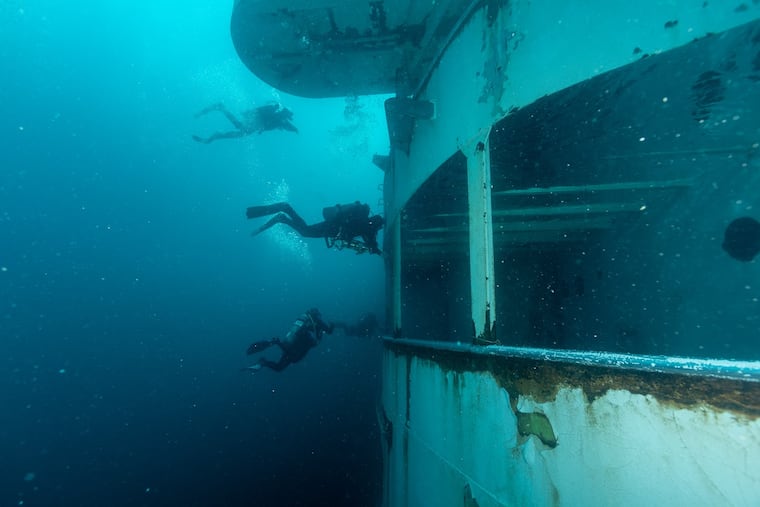
The SS United States is — finally — open for business.
The 990-foot ocean liner that spent close to 30 years rusting away in Philadelphia finally sank to the bottom of the Florida panhandle in melodramatic fashion earlier this month.
The process took much longer than expected due to unforeseen logistical issues and in the end most people had to resign themselves to seeing the sinking on a livestream, complete with a sweeping musical score reminiscent of the Titanic.
But the vessel landed upright and is already drawing adrenaline junkies looking to dive the world’s largest artificial reef.
The Inquirer spoke with Alex Fogg, Natural Resources Chief for Destin-Fort Walton Beach, who is widely credited with bringing the SS United States to the panhandle and was among the first to explore the vessel underwater.
Fogg shared some of the first images of the ocean liner in its new home and first impressions of divers.
The natural lighting is great
First thing to know: You can see the top of the SS United States from a boat if water visibility is good.
Fogg, along with partners from Divers Alert Network and the National Association of Underwater Instructors, went down to explore the vessel on a day when visibility was about average, so they could see up to 80 feet ahead of them. Under the best water conditions, Fogg said divers could experience up to 100 feet of visibility.
High visibility and design choices make natural light permeate throughout the vessel.
Part of the sink prep included removing doors, portholes, and cutting 10 foot by 10 foot holes into the ship. Much of the aesthetic changes were for diver safety and to allow future marine life to freely move around, but Fogg said it also means divers can see natural light even in the lower decks of the vessel.
“It creates some really, really cool looks and really cool feelings, if you will, when you go into these different spaces,” he said, describing the dreamlike effect.
The promenade deck, a long hallway that ran the length of the ship, is already being touted by divers as one of the vessel’s standout sections. In the lower decks, the promenade used to be enclosed by tall glass windows.
“The way the light comes through and shines on the floor on the promenade deck is hard to describe,” Fogg said.
Marine life
Thirty-six hours after the sinking, Fogg said bottom-dwellers, called blennies, were plentiful.
“A couple days after that, I got a report that there’s some large red snapper that have already taken up residence,” he said, adding it’ll be a few more years until the ship is a fully functioning reef that’s producing new marine life, as opposed to merely attracting fish from nearby reefs.
Divers will see yellow tags tied throughout the ocean liner. Those are for research partners at the Woods Hole Oceanographic Institution, who plan to study the artificial reef’s development over the next 10 years.
Researchers are slated to return each year to track the progress of marine life surrounding the tagged sites, and collect samples.
Though it’ll be a few years until the vessel is brimming with marine life, Fogg said exploring the ocean liner underwater is a worthwhile adventure and nothing like roaming the ship on land.
“You can pretty much go anywhere on the ship and not run the risk of falling down an elevator shaft or a big hole or something like that,” he said, noting that traveling vertically through the vessel is part of the fun.
Set aside a few days to explore
Even with two 45-minute dives, Fogg said he and his team were only able to explore so much of the ship, with many of their photos restricted to the perimeter of the vessel.
It’ll take multiple visits to truly experience the SS United States in its entirety.
“If you want to just check the box and say you dove it, that’s fine,” said Fogg. “But if you actually want to experience the wreck and see a significant portion of the wreck, you’re going to have to stick around for a few days.”