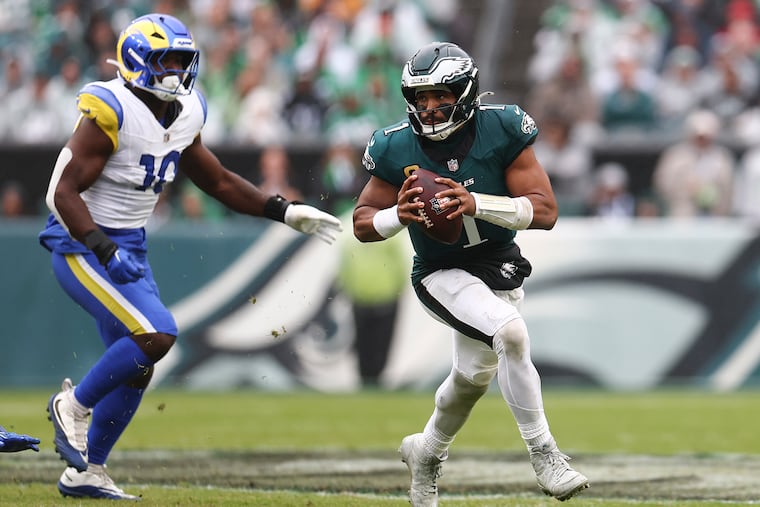
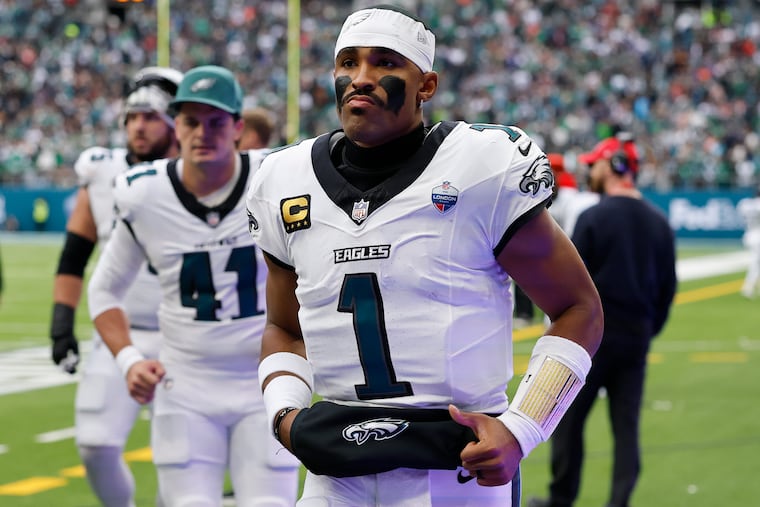
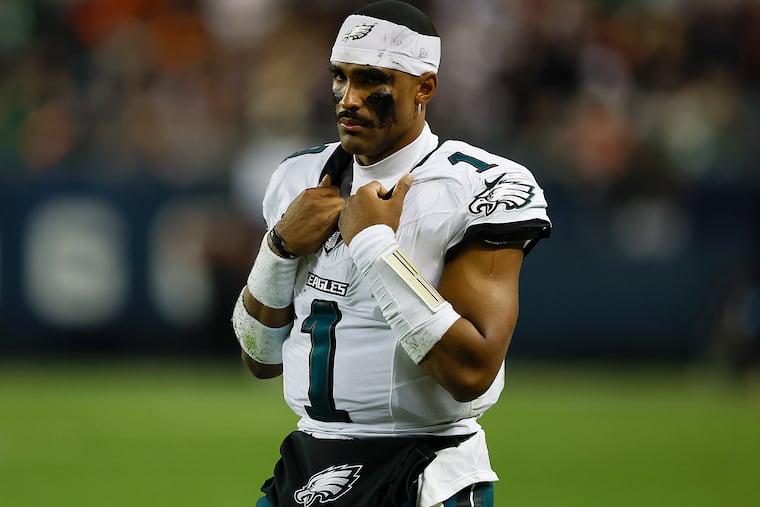
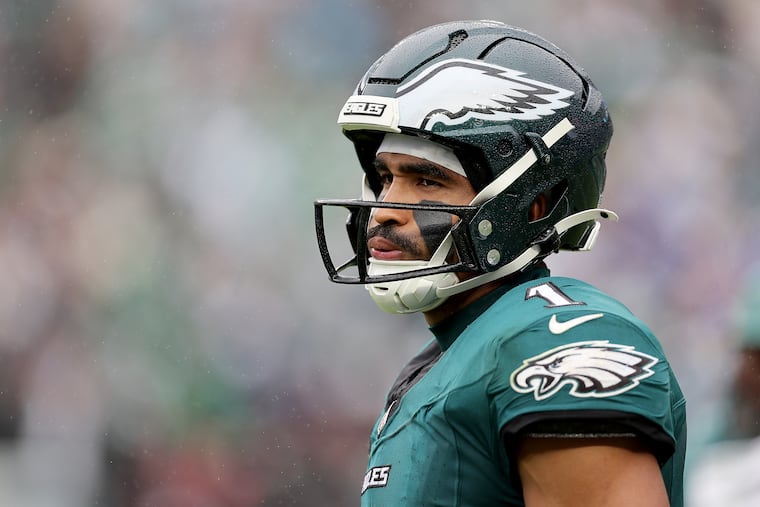
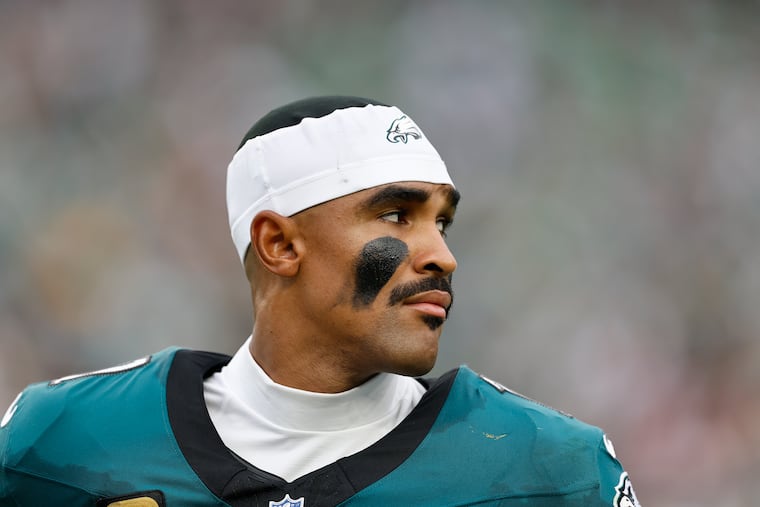
Did Eagles protect Jalen Hurts enough with his life-threatening blood clot? Experts say yes — generally.
Hurts’ situation has been a cascading series of unfortunate, unlikely events, none of which can reasonably be blamed on the Eagles’ well-advised, if counterintuitive, course of action.
The team of medical lawsuit winner Chris Maragos now has a Chris Bosh problem.
Before we address how the progression of the blood clot through Jalen Hurts’ body will affect the Eagles’ profile as an organization, we will first address the larger issue.
Jalen Hurts is a 28-year-old and recently married. He now faces a medical issue that threatens his life, and could linger as a threat if and when it is resolved in the short term. It’s happened before to athletes in his situation. Nothing matters more than preserving his health.
Which begs the question:
Did the Eagles and Hurts’ handlers have this in mind the past few days? Yes, according to two medical sources contacted by The Inquirer who have no ties to Hurts or the Eagles.
Hurts’ situation has been a cascading series of unfortunate, unlikely events, none of which can reasonably be blamed on the Eagles’ well-advised, if counterintuitive, course of action.
Eagles coach Nick Sirianni did not offer any clarity on any of the questions surrounding the Eagles’ decisions and pointed only to a pair of vague statements issued by the franchise and Hurts’ representative.
Did they have Hurts’ best interests in mind on Thursday, Oct. 8, when he first reported symptoms in his calf? Yes, said Dr. Michael Seidman, a hematology professor at Fox Chase Cancer Center; there was no reported indication that further examination was necessary, and football players get minor injuries, like calf bruises, all the time.
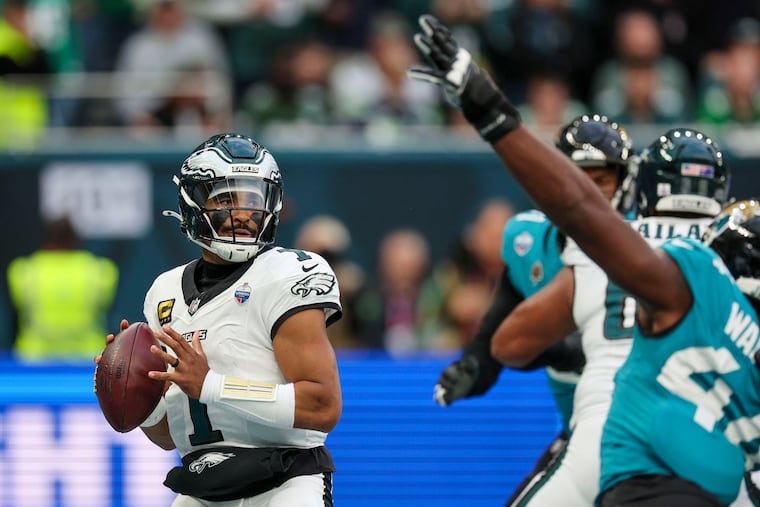
Did they have this in mind when Hurts was diagnosed with a superficial blood clot in his calf in a London hospital on Saturday, Oct. 10, just hours before a game against the Jaguars? Did they have this in mind when, with the blood clot present, he flew home after the game?
Sure, Seidman said, considering the clot, at the time, was a stationary, superficial clot and specific safety measures were followed.
“A superficial clot — I don’t think he put himself at any risk by playing,” Seidman said. “Even flying, with a superficial clot, as long as you can get up and move around, wear compression gear — that’s not unreasonable.”
Hurts reportedly was not allowed to sleep during the testing and stayed awake all night. Did the Eagles have his best interests in mind when they allowed Hurts to play despite having so little sleep?
”The staying awake part — not knowing what they found and how that led into keeping him awake — it’s hard to make a comment on that,“ Seidman said.
Asked specifically about allowing Hurts to play while sleep deprived, Sirianni only insisted that the team’s top priority is the players’ health.
Notably, the Eagles and the NFL do not have pristine track records in this regard.
Did the Eagles have Hurts’ best interests in mind when they let Hurts work out twice and practice once in the three days following the game? The Eagles say that doctors recommended a three-day lapse between the game and Hurts’ follow-up exam.
“That is completely reasonable. It’s not as if, within 12 hours, you’re going to get a clear change,” Seidman said. “We typically [wait three days] to see if that superficial clot extends to the deep veins.”
That exam revealed that the blood clot had, indeed, moved, and the team announced that Hurts would miss at least one game, Sunday against the visiting Panthers.
On Saturday, the team had announced that Hurts would be placed on Injured Reserve, which would sideline him for at least four weeks, an indication that the clot was not dissolving on its own. The implication was that Hurts would start a regimen of blood thinners, which would preclude him from playing since athletes cannot play contact sports while on blood thinners.
On Monday, they announced, in conjunction with Hurts’ agent, that Hurts’ clot had become deep-vein thrombosis and that he had multiple clots in both lungs.
The medical experts The Inquirer spoke with agreed that, had he simply gone on IR, Hurts would have needed four to six weeks to let the medicine work and allow it to evacuate from his system.
Now, they say, Hurts will not be allowed to engage in contact for three to six months. That’s how long Saints receiver Chris Olave needed to get clearance after he was diagnosed with a pulmonary embolism in December.
That’s where Hurts stands today.
So, were the Eagles responsible in their handling of Hurts?
Despite the deterioration of Hurts’ condition, the two experts contacted by The Inquirer say, generally, yes. The way the Eagles acted in relation to Hurts — letting him play, letting him fly, letting him practice — followed sensible recommendations and plans of treatment.
Allowing him to play without much sleep? Neither would touch that one.
I will.
It was dumb.
It is a nightmare scenario on every level.
Primarily, of course, for the health of the player.
Secondarily, for the prospects of a team — already rocked by injuries, a surprise retirement, and an early-season trade — that has lost four games in a row.
And, finally, fairly or not, it is a nightmare scenario in regards to optics.
Remember: Hurts reported the initial injury just 12 days ago. It got steadily worse, and quickly.
He then practiced at least three times after reporting the injury and also flew across the Atlantic Ocean. After it was diagnosed as a blood clot, Hurts stayed up all night, then he played an entire NFL football game. Then he flew back across the ocean. Then he (presumably) worked out for two days, then practiced again, before finally being shut down.
None of these practices raised concerns for either of the hematologists The Inquirer contacted, but public perception and experts’ opinions often diverge.
The Eagles and Hurts’ agent, Nicole Lynn, on Monday offered a few details in a statement about how this situation was handled.
They did not offer complete details. The mechanics of Hurts’ hospital stay in London came from independent reporting. The progression of the diagnosis was only vaguely referenced: The statement references “Over the last few days.” The doctors involved were not detailed, only “Physician experts,” which, in itself, is an unfortunate malaprop.
The statement asserts that Hurts is expected to make a full recovery and one day return to playing football.
Maybe. Maybe not.
NBA Hall of Fame center Chris Bosh was diagnosed with a blood clot in his lower leg that traveled to his lung in February of 2015 that cost him the rest of that season. He returned to the league but in February of 2016 he developed another clot, and that ended his career. Bosh also reported that a clot-related pulmonary embolism nearly killed him earlier this year in January.
Bosh was speaking in the context of NBA star Victor Wembanyama, who dealt with deep-vein thrombosis in his shoulder during the 2024-25 season. Recently in Philadelphia, Phillies ace Zack Wheeler dealt with deep-vein thrombosis in his shoulder that cost him the last portion of the 2025 season and the first month in 2026, but that situation was different from Bosh’s and Hurts’.
Hurts’ situation is similar to Bosh’s. Hurts’ clot appears to have stemmed from getting cleated in the previous game, which indicates a lesser likelihood of a recurring issue, according to a medical source who wished to remain anonymous. Seidman concurred.
However, the origin of Bosh’s clot was a calf bruise suffered late in 2014, not unlike Hurts’. However, unlike Hurts, Bosh’s clot went undiagnosed for several weeks, during which time Bosh traveled extensively and without precautions, such as constant movement and leg compression devices.
And, while the successful lawsuit filed by Maragos, a former Eagles safety, has nothing to do with blood clots, it has everything to do with the profile of the Eagles.
Maragos won a $43.5 million award in 2023 from his medical malpractice suit directed at Dr. James Bradley and Rothman Orthopedics Institute for $43.5 million for their treatment of his knee injury in 2017. The suit led to the end of Rothman’s long association with the Eagles as their official team physicians. Bradley was not an employee of Rothman and was sued independently of the institute.
Maragos didn’t have a blood clot, and he didn’t sue the Eagles or the NFL, but his case was a massive news story and featured Super Bowl LII MVP Nick Foles as a key witness, and it wasn’t fully settled until it was upheld on appeal in 2024.
It was the last big medical news story associated with the team, until now.
Neither left the Eagles with a good look.

The news keeps getting worse. Eagles quarterback Jalen Hurts will likely miss the rest of the 2026 season with a deep vein thrombosis blood clot, as well as bilateral pulmonary emboli. Moments after the story broke, The Inquirer’s Jeff McLane and Marcus Hayes reacted to the news, looking at what the diagnosis means for the Super Bowl MVP, how the Eagles handled the situation dating back to their trip to London, and whether backup Tanner McKee is ready to take the helm on a full-time basis. Listen here.
Listen to all episodes here or wherever you get your podcasts.