Before Lane Johnson was an Eagles All-Pro tackle, he was a ‘pretty boy’ quarterback for a junior college in East Texas
Lane Johnson once played quarterback for the only school that would give him a shot. His perseverance paid off on an unlikely journey that would make him one of the best tackles in NFL history.
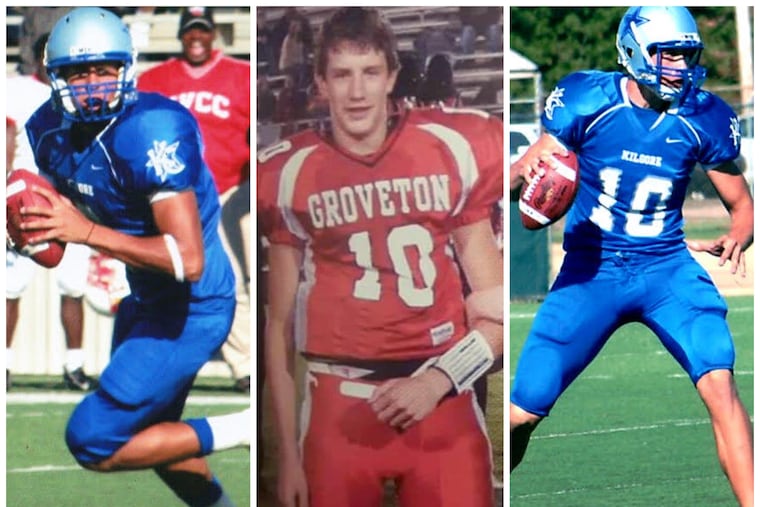
When Keith Thomas first met Lane Johnson, he was on his way to the Groveton High School weight room. It was his freshman year, and Johnson was a lanky quarterback, donning athletic shorts and cowboy boots, with a jug of water by his side.
The teenager was far from the behemoth he’d later become. He was clean-shaven, with “literally no muscle,” according to Thomas, his coach at the time. He estimated that the quarterback weighed “maybe” 180 pounds by the end of his junior year.
But Thomas could see potential. Johnson was a versatile athlete who excelled in seemingly every sport he tried. On the basketball court, he regularly put up 20 to 25 points. On the track, he ran the 400-meter and threw shot put (and made all-state).
» READ MORE: Why Lane Johnson called it a career four games into the 2026 season, and what's next for the Eagles
On the football field, he played both quarterback and safety, and while his arm was average, his legs more than made up for it. So did his height. At 6-foot-6, Johnson towered over defensive linemen, with a toughness that could only be forged in East Texas.
“He was so big, half of ‘em couldn’t tackle him,” said Thomas.
The coach tried calling colleges, big and small, in the hopes of finding his pupil a football home. But none were interested; at least not to the level of offering Johnson a scholarship.
They didn’t see the senior as a fit at quarterback, and were discouraged by his slender frame. So, Thomas contacted Kilgore College, a junior college about 100 miles north of Groveton.
Stevie Moore, Kilgore’s defensive backs coach, made the two-hour drive in January of 2008, and immediately saw what the other schools didn’t. He brought back a DVD of Johnson’s film for head coach J.J. Eckert, and together, the two men decided to make him an offer.
By February, the future Eagles All-Pro right tackle was sitting across from Moore in a Groveton sandwich shop, The Wooden Indian, talking about his future in the sport.
The day ended with Johnson’s verbal commitment to sign with Kilgore. But before he did, Moore made a prediction, one that proved prescient, on the week Johnson retired from the NFL after 14 seasons.
“I said, ‘Son, I just feel like one day, you’re going to be playing on Sundays,’” Moore recalled. “‘I really believe that.’”
From field general to dirty work
It was Johnson’s role on Sundays that no one anticipated. Moore thought he would stay at quarterback, or maybe move to tight end. Eckert and Thomas agreed with the latter.
Few, if anyone, expected Johnson to become an offensive lineman, let alone one of the preeminent offensive linemen in the league. But by 2011, he was in the trenches at Oklahoma, tasked with protecting the “pretty boy quarterback” he’d once personified, in Thomas’s telling.
To get to that point — to get to the Eagles in the first round of the 2013 NFL draft — he’d have to survive JUCO first. And that was no small feat.
Even though Johnson wasn’t at a Division I school, he was often competing against Division I talent; players who had transferred in due to academic or personal struggles, or had somehow fallen off the radar.
On top of that, he’d be working out with 40 to 50 redshirt players, all of whom had the chance to walk-on, and 85 players who had guaranteed spots on the roster.
It was quite different from the tiny Division 2A high school Johnson had come from, which only had 16 to 20 guys on varsity.
“Now, you’ve got five to six people at every position,” said Willie Gooden, who coached the offensive line and now runs Kilgore’s program. “You really have to bring your best, every single day, to even have a chance.”
Johnson told The Athletic in 2019 that the workouts he underwent at Kilgore were some of the toughest of his life. The football program didn’t have dedicated strength coaches. They used the same rusty equipment that Gooden used when he was a player eight years prior.
Kilgore didn’t even have its own weight room. The team would share the recreation center on campus with students and faculty, lifting at times when it was less busy.
But the coaching staff made the most of what they had. And together, they drew up workouts that built not just strength, but endurance, with minimal recovery time mixed in.
Among the most challenging was the “four quarters drill,” a staple of the winter and spring, which was held in a carpeted gym (with concrete beneath).
Players would do three exercises per quarter, with 10 reps each, and repeat those exercises in the fourth quarter, but increase their reps to 12.
Coaches would pace the room, carefully studying the athletes’ form. If one did a crunch without lifting his shoulders, or a pushup without his flattening his back, he’d have to start the drill all over again.
» READ MORE: From Jeff Stoutland to former teammates and NFL stars, tributes roll in upon Lane Johnson’s retirement
“Every time you went in there — pure chaos,” Johnson told The Athletic. “There was gonna be people possibly getting in fights, there was gonna be people puking, there was gonna be people quitting. It was just all-out mania every day. That’s what I remember. But I remember we did work our ass off.”
Kilgore placed a premium on punctuality, and if a player was late to a workout, or practice, or even skipped a class, they would face what Gooden referred to as “Ranger Reminders.”
These reminders had a somewhat medieval flair. One, called “Block Busters,” involved lifting cinder blocks up and down the bleacher steps, while a player wrapped his arms through the holes of the blocks.
Another, called “Screaming Cats,” involved hanging off a chain-link fence, with hands fastened to the pole at the top, and feet fastened between the chains.
(Wooden says Kilgore has since moved on to other disciplinary measures).
Johnson didn’t often find himself in these positions. He was not the kind of player that the coaches needed to stay on top of. He was a strong student, and well-behaved; one of Moore’s most vivid memories was of the teenager helping the assistant coach’s wife carry her groceries up the stairs.
He split his 2008 season with another quarterback, Shane Fry, rotating every few games. Johnson was now closer to 220-230 pounds, but could still move quite fluidly, which was among his biggest assets.
» READ MORE: Lane Johnson is retiring. Let’s look back at some of his most memorable moments with the Eagles.
“People didn’t realize how fast he was,” said Eckert. “I remember one play, when we were playing Trinity Valley … and this kid took a flat angle like he was going to get him.
“And Lane was just more athletic. It wasn’t even close. This guy thought he was gonna just cut him off, like it was real easy. Like it was some slow quarterback. And [Lane], he runs what, a 4.6 at the combine?”
Tackling Johnson was an exercise in futility. Defenders would take on a giant coming out of the backfield, who could stiff-arm players with ease.
Nevertheless, it was not a strong enough performance to take the starting spot. Johnson finished his season with more interceptions (seven) than touchdowns (three), completing 32 of 61 pass attempts.
He went into an exit meeting with Eckert looking to improve. They talked about adding weight, and the quarterback spent the entire offseason getting after it.
Every morning, the team held breakfast checks from 7:00 to 7:50 a.m. Johnson would arrive just before then, lining up for two waffles from Eckert, before heading to class or the gym.
» READ MORE: Lane Johnson announces retirement after 14 seasons with the Eagles: ‘It’s time to say goodbye to football’
When he wasn’t at the gym, he was lifting dumbbells in his dorm room at Stark Hall. The quarterback weighed 240 to 245 pounds by spring practices.
This was when Division I schools began to take note. One day, a Kilgore tight end, Derek McGahee, injured his knee. Eckert wanted to get into a 22-personnel alignment, but didn’t have the players to do so.
He turned to the hulking man in the green jersey, sitting beside him.
Johnson was dubious.
“He was like, ‘What do you want me to do?’” Eckert recalled. “I was like, ‘I don’t know … just get in a stance, run C-gap. If you see somebody, hit them.’”
The future Eagle did more than that.
“Lane goes backside C-gap, and he hits a guy and pancakes him,” the former head coach said. “First play he’s ever [done] there. He goes and pancakes the guy.”
A coach from Rice University was in attendance, and asked about the “tight end in the green jersey.” Before long, word got out about Johnson, and powerhouse programs all over the country started calling.
» READ MORE: Jalen Hurts, Jordan Mailata wish Lane Johnson well as they bid longtime teammate goodbye: ‘A lot to process’
Before he signed with Oklahoma ahead of the 2009 season, Johnson sat down with Eckert and athletic director Jim Rieves. It was not the happiest of conversations.
The former head coach remembers a player who was “sad-eyed” about leaving the school that chose him when no one else would.
“And I remember saying, ‘Don’t be sad-eyed,’” Eckert recalled. “‘I told you before that you should be playing in front of 100,000 people. And guess what? This is your opportunity to go do that.’”
Giving back to Kilgore
It was not an easy path from there. At Oklahoma, Johnson went from tight end to defensive end, before joining the offensive line in 2011.
But he eventually found his calling (and Jeff Stoutland) and embraced his new role wholeheartedly, en route to two Super Bowl titles and six Pro-Bowl appearances.
And he never forgot where he came from. Over the last seven years, the longtime Eagles right tackle has donated over $700,000 to Kilgore. Most of this money went toward “The Lane,” a 3,800 square foot, state-of-the-art athletic performance center on campus.
Since it was built in 2021, he’s continued to give, helping to renovate the locker rooms, the restrooms, even paying for new uniforms and shoulder pads.
Toward the back of the athletic center, just past a line of bench presses, is a wall with three photographs. On the left, is a slimmed-down Johnson, in Kilgore bright blue, football in hand.
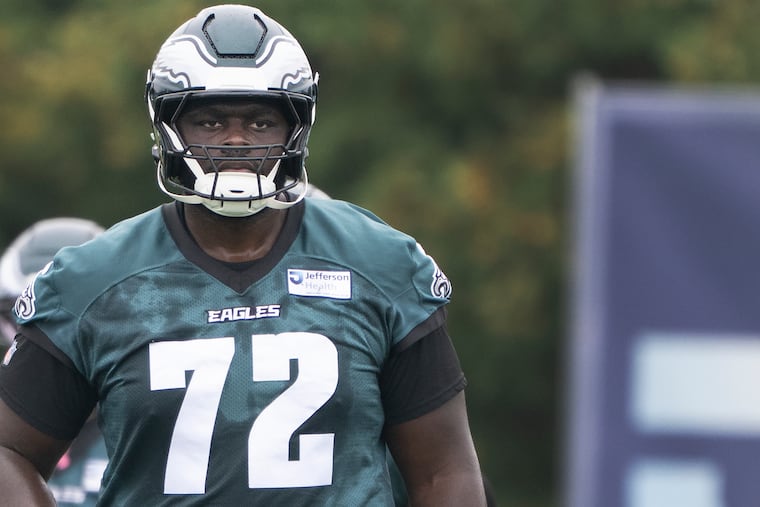
In the middle, is Johnson in his two-point stance at Oklahoma. And on the right, is Johnson as Eagles fans will remember him: in midnight green, his right foot forward, staring menacingly ahead; ready to protect a position he knows all too well.

Different year, different offensive coordinator, yet still, it feels like Déjà vu all over again. The Eagles had little margin for error Sunday vs. the Rams because of injuries. They played hard despite being shorthanded, but in the end, couldn’t put the Rams away, mainly because of poor execution on offense. Why hasn’t Sean Mannion's scheme clicked? How culpable are head coach Nick Sirianni and quarterback Jalen Hurts in the offensive rut the Eagles find themselves in? The Inquirer's Jeff McLane and David Murphy analyze the fallout from the 24-20 loss to L.A. Listen here.
Listen to all episodes here or wherever you get your podcasts.