Lower Merion is advancing a policy to eliminate iPads and laptops for K-2 students
Parents who have accused the district of overusing screens say the proposed changes don't go far enough. Some would still like a chance to opt out of screens for their children.
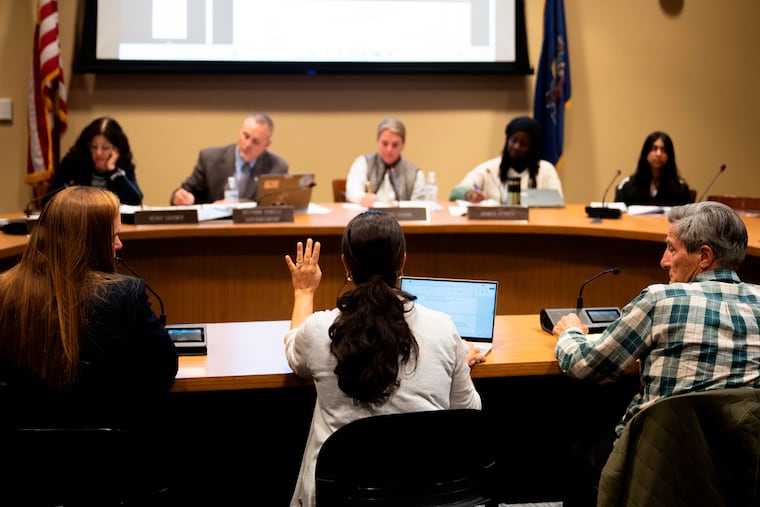
The Lower Merion school board plans to stop assigning personal laptops and iPads to kindergartners, first graders, and second graders after facing intense pushback from parents who say kids are getting too much screen time in school.
Members of the school board’s policy committee announced the plan during a meeting Monday, along with other proposed limits on technology use. Under policy changes going before the full school board for review next week, third and fourth graders would use electronic devices stored on carts in classrooms, while fifth and sixth graders would be permitted, but not required, to bring devices home.
“This is a huge movement forward,” said the board’s president, Kerry Sautner, describing revisions made to the proposed technology policy in response to community feedback.
But parents who have accused the district of overusing educational technology said the proposed changes did not go far enough — leaving too much room for interpretation around when technology should be used, and failing to adequately restrict kids’ access to inappropriate websites.
Some parents also expressed anger that the board is moving forward with repealing the current technology policy, which contains language accommodating families who opt out of district-issued devices.
“You are removing the escape hatch,” said David Smyth, a parent from Merion Station, who said the district had produced no data supporting its use of technology. “You know that ed tech is failing, it’s suboptimal, and you don’t want to be embarrassed.”
Here is what to know about the tech debate in Lower Merion, the board’s latest policy proposal, and what happens next:
Lower Merion at the center of ed tech backlash
As backlash to technology in schools has spread across the region and nationally, Lower Merion has become an epicenter of parental opposition.
At meetings this spring, dozens of parents have voiced concerns about weakened attention spans and classroom distractions, and expressed fear that the quality of their kids’ education is declining as a result.
More than 800 parents have signed a petition asking for the right to opt out of one-to-one devices, according to parent organizers in Pencils Over Pixels. The group, which started a GoFundMe campaign, has distributed lawn signs and enlisted a public relations firm as part of its advocacy efforts.
But district officials have repeatedly said that the technology policy’s language is dated, stemming from when Lower Merion first introduced one-to-one devices, and that it is not possible for families to opt out.
Instead, the board has been reworking the technology policy to address when and how devices should be used in classrooms.
A revised policy after meetings with parents
The latest policy proposal outlines guidelines for technology use at different grade levels, rolling back one-to-one devices for Lower Merion’s youngest students.
“Technology shall not be used for routine classroom instruction in these grades,” the policy says. “Any use shall be minimal, highly structured, and limited to specific educational purposes such as diagnostic testing or for teacher-directed, whole-class demonstration, visual display, or state testing preparation.” (Pennsylvania’s standardized tests, which start in grade 3, are required to be administered on computers.)
In grades 3-4, the policy says, students “shall have supervised, teacher-directed access to technology resources” that stay in classrooms, while in grades 5-6, students will be permitted to bring their devices home, but not allowed to use them between classes or at lunch.
The policy describes students in grades 7-8 and 9-12 as having increased responsibility for independent technology use, but says devices should be used only for school-related work.
The policy changes are “meaningful responses” to community feedback, said Anna Shurak, the chair of the board’s policy committee, who said board members had met with concerned families.
But some parents said the policy — which says teachers should use technology “only when doing so serves a clear educational purpose” — would not adequately limit an overreliance on screens in classrooms.
“The verbiage of this policy is very carefully crafted to say nothing,” said Eleanor Stanford, a parent and a writing professor at Bryn Mawr College, who also questioned why the district was still “dragging its feet” on imposing a bell-to-bell ban on cell phones in its high schools, even as legislation advances in Harrisburg to do so. (Shurak said the district would fully ban cell phones in 2027-28.)
Parent Matthew Posey quoted the policy’s language that technology belongs in the classroom when it “genuinely amplifies human curiosity.”
“Did Albert Einstein need Kahoot or iReady?” Posey said, referring to two educational technology programs. “Is this a public policy document, or a corporate marketing brochure?”
Some parents also questioned proposed administrative regulations that include suggested time ranges for technology use by grade level. In grades K-4, the guidelines are less than 30 minutes a day; by high school, they increase to less than 120 minutes a day.
Calculating the high school upper limit as about 40% of daily instructional time, “to me, that’s way, way too high,” said Sam Handlin, a parent and a professor at Swarthmore College. He said the only way teachers would approach that time limit was either by using technology “as a babysitting device” or letting students take notes on computers, “which is just a recipe for distraction.”
Shurak did not comment on the time frames specifically but told Handlin the administrative regulations still need to be revised.
When will changes take effect?
The committee endorsed sending the revised technology policy to the full board for review next week, along with a recommendation to repeal the current technology policy.
While the board may repeal the current policy at next week’s meeting, the new policy would need to be considered a second time to before it could go into effect.
The goal is to have the new policy in place in August, Shurak said. She said the board would be directing administrators to implement changes in time for the coming school year.
Board member Jason Herman, a member of the policy committee, said some of the new policy’s language should be revised to limit “ambiguity and subjectiveness.” He also questioned why the district could not move to a content filtering model where only certain websites were permitted for students to access, rather than restricting sites after problems are reported.
Officials did not address questions around content filtering Monday, or calls from the Pencils Over Pixels group for the release of district contracts with educational technology companies and a technology advisory board that would include parents.
Sautner said the board had more work to do, including around technology questions related to the district’s curriculum.
But “we cannot micromanage” administrators through policy language, she said.
Some expressed concern that the board could overreact in response to anti-tech opposition.
“Banning technology isn’t going to be the way to ensure that our kids critically think,” said Emma Benn, who urged the board to “take a step back” before passing a new policy. “This world is a technology-driven world, and we need to make sure our children can function within it.”

Inquirer Lower Merion